


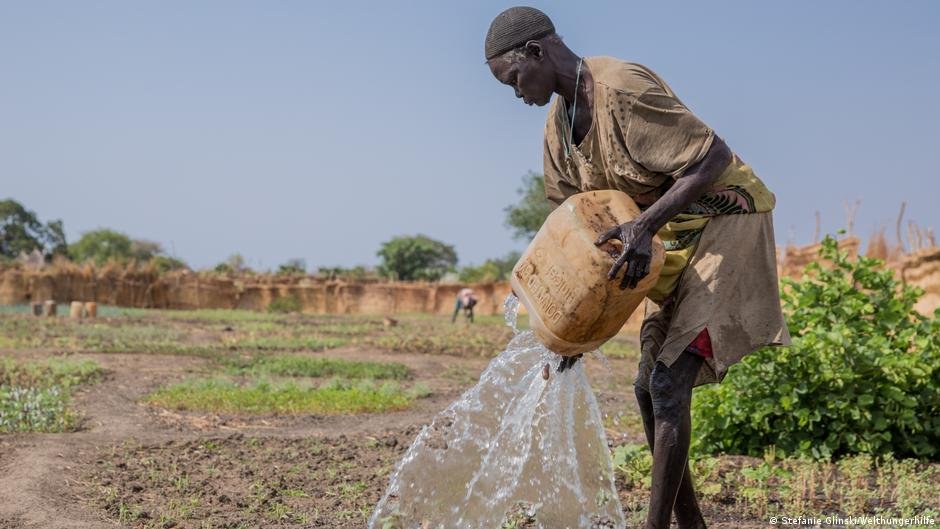
The children’s aid organization Terre des Hommes and the development organization Welthungerhilfe presented their devastating analysis of Germany’s development aid efforts in their annual report, “Kompass 2026,” in Berlin earlier this week.
“A failure of political support, a drastic decline in funding and a growing disregard for international humanitarian law are making it harder to reach people in need and are undermining the effectiveness and reliability of humanitarian aid,” the report reads.
The budgets of Germany’s Ministry for Economic Cooperation and Development and for humanitarian aid have been cut every year since 2022. All in all, funding has been slashed by a third. What remains is about €10 billion ($11 billion) for development aid and €1 billion for humanitarian aid. And funding is set to be cut even further.
The two organizations seem to suggest that development policy — both that of Germany and the international community — has completely lost its way. But Mathias Mogge, head of Welthungerhilfe, said that’s not what should be concluded. “What’s missing is a real strategy,” he said.
Mogge is not impressed with the reform plan presented by Development Minister Reem Alabali Radovan in January. He argues that a political plan is only credible if it involves true partnerships between equals — not just rhetoric.
Joshua Hofert, spokesperson for the board of Terre des Hommes, summed up his criticism in a single sentence: “The reform of development policy must not become a mere administrative project led by Berlin.”
In their report, the aid organizations have called for greater involvement of civil society actors from the so-called Global South.
“Young people, in particular, must be involved throughout the process of formulating, implementing and evaluating development policy strategies,” the report said, emphasizing that these perspectives and expertise are crucial to the legitimacy, effectiveness and sustainability of political decisions.
Military spending on the rise everywhere
Germany’s massive cuts to development aid are part of a global trend coinciding with an increasing number of wars and crises. Almost all countries are responding in the same way: with ever-higher investments in the military and drastic cuts to global development policy and humanitarian aid.
To view this video please enable JavaScript, and consider upgrading to a web browser that supports HTML5 video
However, the organizations believe Germany is compromising its credibility and reliability with the significant aid cuts. They are calling on the federal government to better integrate development cooperation, peacekeeping and humanitarian aid and to secure them through multi-year funding.
The report contains numerous recommendations. “The German government should utilize diplomatic channels to protect humanitarian principles and prevent the political instrumentalization of humanitarian aid. Furthermore, it must advocate more effectively for compliance with international humanitarian law,” the report said.
This includes systematically addressing violations of international law in United Nations forums and demanding humanitarian access to crisis areas.
North-South Commission will ‘expand and strengthen a global network’
For the aid organizations, the new North-South Commission could be a ray of hope.
The commission will consist of about 20 experts from the Global South and the Global North representing politics, academia, the private sector, labor unions, civil society and international organizations.
The kickoff event will take place on June 30 in Hamburg.
To view this video please enable JavaScript, and consider upgrading to a web browser that supports HTML5 video
“The global order is shifting — toward more multipolar centers of power,” said Development Minister Alabali Radovan. “If Germany wants to continue shaping the global agenda in the future, we need stable partnerships with countries in the Global South.”
According to Alabali Radovan, the commission will “further strengthen our partnerships with the countries of the Global South and to expand and strengthen a global network.”
The opposition Left Party in the German Bundestag has taken a more critical view of the North-South Commission.
Its spokesperson for global justice, Charlotte Neuhäuser, sees it as little more than an empty gesture.
“While the federal government, under the guise of promoting fair partnerships, is mostly interested in gaining access to new markets, cheap labor and raw materials, German funding for hunger relief, hospitals, schools and social security systems in the Global South is being slashed on a historic scale,” she said.
This article was originally written in German.
To view this video please enable JavaScript, and consider upgrading to a web browser that supports HTML5 video
About The Author







