He knew what it was like to go hungry. Today, Willing Hearts founder Tony Tay feeds thousands
A childhood marked by hardship, little formal schooling and the kindness of strangers shaped the man behind one of Singapore’s most remarkable community kitchens.
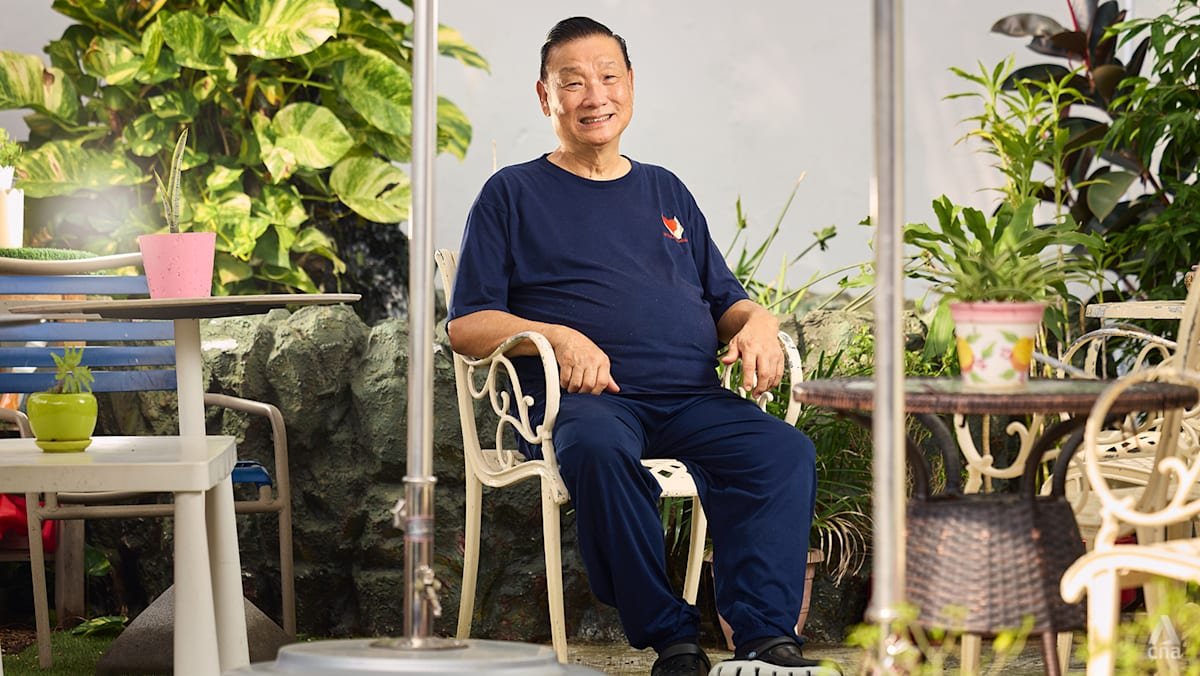
Having experienced the kindness of strangers growing up, Willing Hearts founder Tony Tay has spent much of his later life extending that same generosity to others. (Photo: CNA/Dillon Tan)
New: You can now listen to articles.

This audio is generated by an AI tool.

By
Read a summary of this article on FAST.
Get bite-sized news via a new
cards interface. Give it a try.
Click here to return to FAST
Tap here to return to FAST
FAST
Every morning, somewhere in Singapore, someone opens a door to find a meal waiting, cooked by people led by a man who knows what it is to go without one. Tony Tay, founder of Willing Hearts, has spent more than two decades building a daily routine out of that knowledge. The organisation now delivers about 10,000 food packets across the island, seven days a week. It began with a few pots and pans, some surplus bread, and a decision to cook something proper for a man who needed more than he had been given.
His work was recognised at the Spirit of Enterprise (SOE) Awards 2026 on Nov 5, 2026, where Tay was among 59 honourees and the inaugural recipient of the SOE-EATZ Social Impact & Entrepreneurship Recognition.
Born in 1947, Tay dates the organisation to 2003, when he began using his late mother’s cooking equipment to feed people in need. The scale of what followed might have surprised him. The instinct behind it had been forming for decades.
A LOAF OF BREAD, A PROPER MEAL
The equipment had sat at home since around the time of the SARS outbreak, when his mother bought cooking utensils, donated some to her church and kept the rest. After she died, her friends used the pots to cook for mourners at her wake. Tay gave the leftover food to neighbours and to the workers renovating nearby houses.
Then a nun asked whether he would collect bread for the needy. He declined, then agreed to help once. Each night he gathered 200 to 300 loaves. The nun kept 20 or 30, and Tay delivered the rest the next morning to elderly residents in Bukit Ho Swee.

“We first started by collecting leftover bread and vegetables to distribute to people in need,” Tay recalled. “One day, an elderly man came to collect bread but did not take any vegetables. My wife asked him why he didn’t take the vegetables. He replied that he couldn’t cook.”
Tay’s wife, Mary, asked if he would like some cooked food instead. He happily agreed. Mary brought him two packets of food. Soon after, another elderly man came and asked for food too. “What started with just two meals grew to four, then gradually to 100 packets,” Tay said. “And that was how our kitchen began.”
The difference between being handed food and being properly fed has stayed with him. Tay and Mary began cooking at their home in Jalan Taman. They rose early, prepared meals, gathered donated breakfasts and fruit, and stretched thin supplies as far as they would go. The Church of St Michael joined the effort. As the work grew, Tay’s son suggested formally registering the organisation, mindful of the potential legal issues surrounding food safety and the handling of donations. They called it Willing Hearts, registered it in 2005 and joined the National Council of Social Service the following year.
Tay remembers the early helpers, many of them older women, as people who simply turned up. They came “with one heart”, he said, which is as good a description of those days as any: strangers giving their mornings to the practical business of getting meals to people who needed them.
A BOYHOOD WITH A HUCK FINN QUALITY

Before there was a kitchen to run, there was a childhood to get through.
When Tay was five and a half, his family broke apart and he was placed with his siblings at Canossian Convent. Boys had to leave at 10, he recalled, while girls could stay until 18 or 19. He and his older sister moved to their grandmother’s home in Mackenzie Road, behind Rex Theatre. His other sisters remained with the nuns.
It was an early education in making do. His recollections carry some of the scrapes, improvisations and small defiances of Mark Twain’s Huckleberry Finn, though the deprivation underneath was real. There were rules to dodge, places to explore and pleasures to be found when money was short.
“We used to sneak through the back door of Cathay Theatre to watch movies for free,” he said.
One can see the appeal. A boy with little schooling could still slip into a cinema, where the world arrived in a more generous form than the one outside.
He attended school for about a year before his family could no longer afford the fees, books and food. He later enrolled at a vocational institute to study electrical work but left soon after.
At 12, he was an odd-job boy at a milkshake bar in The Arcade, near Change Alley. At 13, he sold vegetables. At 14, he took a bus to Tapah and a taxi onward to the Cameron Highlands to work at the Eastern Hotel. The job meant heavy cleaning, little rest and meals of kidney beans, eggs and meat that never seemed enough. Then the hotel stopped paying him for two or three months.
Eventually, he ran away. A Malaysian taxi driver took him to Kuala Lumpur and arranged for a friend to help him get back to Singapore.
“So I was given help by a Malaysian,” Tay said.
It is a modest remark, and a revealing one. The people who helped him were strangers who saw a need and acted. Years later, he would offer others the same unfussy generosity.
By 16, Tay had held a string of jobs, most lasting a year or less. In 1973, he started an insurance agency that grew to about 160 agents and kept him occupied until around 1990. After that came printing, while Mary, whom he married in 1969, ran a shipping and forwarding agency that provided the steadier income. They have three children, nine grandchildren and one great-grandchild.
His limited schooling closed some doors, and experience opened others. He might have ended his career among the printing presses. Instead, it turned towards a kitchen in Jalan Taman.
INNOCENCE IN AN ADULT MIND THE IMPULSE TO HELP

Tay’s account of his life reveals a certain simplicity of outlook. He has known hunger, precarious work, unpaid wages and the limits poverty imposes. He understands that charity needs organisation, resources and dependable routines. Yet his reasons for helping remain plain. Someone is hungry, so food is needed. Someone is ill, so a meal may serve better than bread. He answers the need in front of him, trusts that the next step will reveal itself, and deals with whatever follows. There is something close to a trust in Providence in that, and it is expressed entirely through action.
That temperament has produced an undertaking that delivers thousands of meals daily, and an organisation of this size demands buildings, vehicles, staff and donations. Willing Hearts now operates from a campus in Telok Kurau. Its three buildings house facilities for food preparation and cooking, low-cost medical and renal care, and accommodation for rough sleepers. Tay runs it with 22 full-time employees and a fleet of 13 cars, kept moving by four drivers. “We do need more volunteer drivers to help deliver food!” he said.
THE THINGS A BOY REMEMBERS

Tay speaks with some regret about his curtailed education. Leaving early, he believes, narrowed his choices, and he urges anyone with the chance to study to take it seriously. “At that time, I had no regrets. We just needed to work smart and be street smart,” he said. “Today, everything is about AI, so education is important.”
His memories are not all sombre. He recalls playing in rivers, picking fruit, and cooking it on the spot. Everyday life, he feels, once offered freedoms that have shrunk as restrictions have multiplied. The Huck Finn comparison returns, with a qualification: Twain’s boy could turn the river into an escape route, and Tay’s childhood offered fewer guarantees.
Food holds a particular place in these memories. Having known deprivation as a child, Tay says he has no favourite dish. All food is good. Coming from a man who has spent decades making sure others have something to eat, the remark carries weight. He also loves the sea, and once operated a boat, though his last outing was about 22 years ago.
WHEN THE NEXT BIRD ARRIVES
Asked about succession, Tay reaches for an image from nature. Leaders, he suggests, are like birds: when one disappears, another comes. He is confident that someone will emerge to carry on the work and that the organisation will find its next leader and keep serving the community.
His life has held business ventures, hard jobs and the consequences of an education cut short. It has also held strangers who helped him when he had few options, and people who joined him when he began helping others. Willing Hearts is where those threads meet.
The boy who slipped through the back door of a cinema grew into a man who opened his kitchen to people in need. The scale has grown, and the impulse has stayed the same. At Willing Hearts, the work still begins with the ordinary business of finding out what someone needs and doing what one can to provide it.

Source: CNA/bt
Get bite-sized news via a new
cards interface. Give it a try.
Click here to return to FAST
Tap here to return to FAST
FAST