Skip NavigationMarketsBusinessInvestingTechPolitics & PolicyVideoWatchlistInvesting Club PRO
PRO LivestreamMenu
- House China committee Chairman John Moolenaar is urging the Fed to review Hong Kong’s access to the FIMA repo facility, which provides short-term dollar liquidity to foreign monetary authorities, CNBC has learned.
- The request comes as China promotes the renminbi more aggressively in global finance and expands Hong Kong’s role in that effort.
- Hong Kong has barely used the Fed facility since 2020, making the immediate financial impact of any restriction relatively small.
- Economists warn that restricting access could also reduce one of the mechanisms that reinforces demand for dollars and U.S. Treasurys.
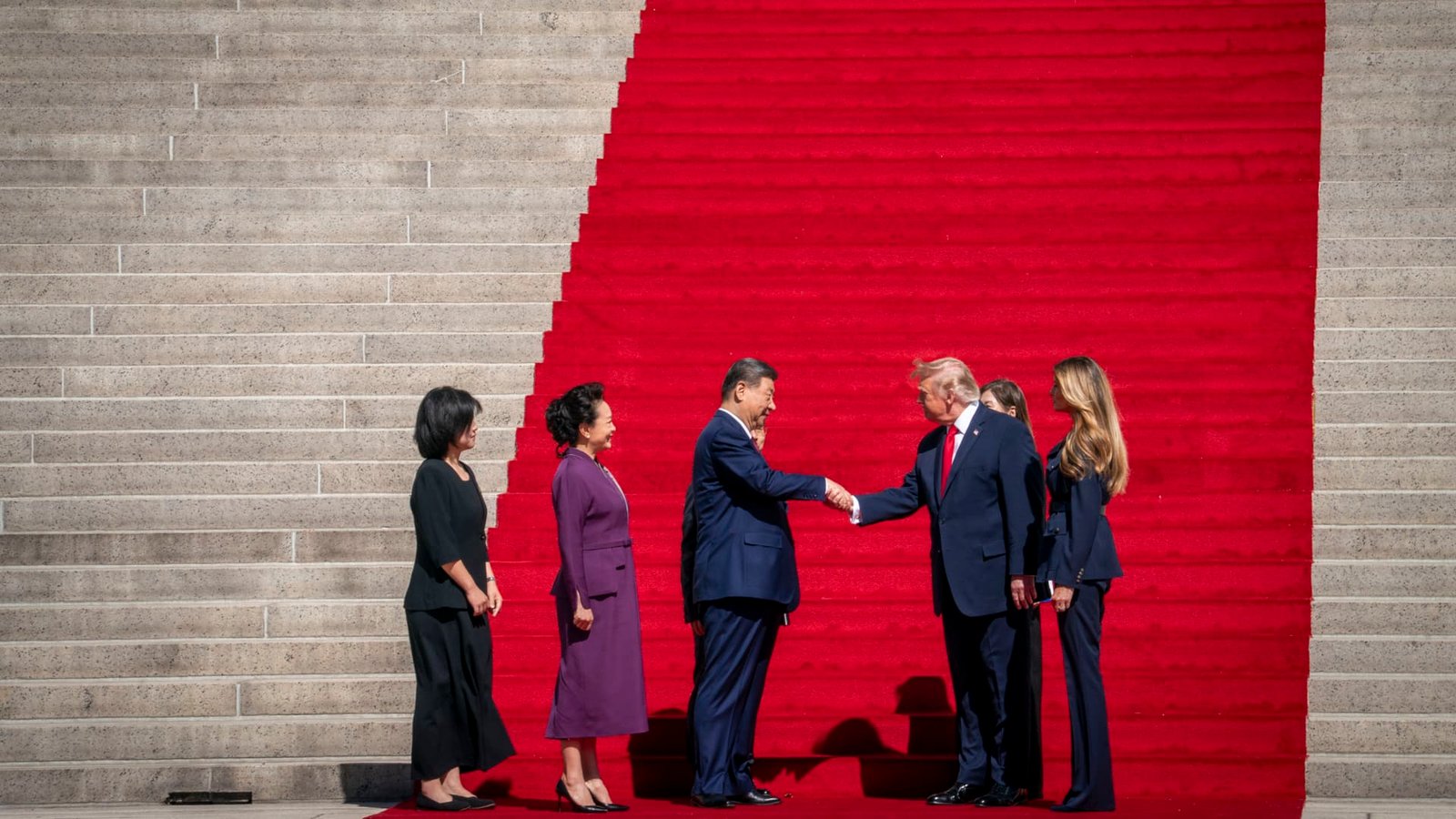
President Donald Trump and first lady Melania Trump pose for a photo with Chinese President Xi Jinping and his wife Peng Liyuan walk down the steps of the National Archives during President Xi Jinping’s state visit, Sept. 25 2026, in Washington, DC. The Washington Post | The Washington Post | Getty Images
The chairman of an influential congressional committee is urging the Federal Reserve to consider cutting off a potential financial lifeline extended to Hong Kong during Covid-era market turbulence.
The Fed should review the Hong Kong Monetary Authority’s access to the Foreign and International Monetary Authorities Repo Facility, Rep. John Moolenaar, R-Mich., said in a letter sent to the U.S. central bank last week and exclusively obtained by CNBC. Moolenaar chairs the Select Committee on the Chinese Communist Party.
The FIMA facility allows central banks to effectively borrow dollars from the Fed with those countries’ Treasury holdings as collateral. It was conceived as a means to ensure governments could get access to dollars in a crisis without having to sell Treasurys, which could create a downward spiral for prices.
The push to potentially limit Hong Kong’s access to a source of dollar liquidity comes as China is making efforts to promote its currency, the renminbi, as an alternative to the dollar as the bedrock of the global financial system. The U.S.-China relationship remains fraught despite the cheerful tone of President Donald Trump’s recent meeting in Washington with Chinese leader Xi Jinping.
The Fed is in receipt of Moolenaar’s letter and plans to respond, a spokesperson said.
A ‘very tenuous truce’ between the U.S. and China
Still, Fed Chairman Kevin Warsh is unlikely to take a step that could be seen as interfering with China policy at a sensitive moment, said Shehzad Qazi, managing director of China Beige Book, a research firm.
“That said, this is an example of the novel ways Congress could begin asserting its role in China policy,” Qazi said. The “very tenuous truce” between the two countries remains highly vulnerable, he said.
FIMA has been used only sparingly since its creation in 2020, though in August Treasury Secretary Scott Bessent urged Japan to use it to support the yen.
The dollar remains secure in its status as the premier global reserve currency. It makes up 56.7% of global central banks’ official foreign reserves, according to the International Monetary Fund, and is widely used to settle global trade. Investors treat short-term U.S. Treasurys as equivalent to cash.
Those attributes give Americans major advantages by lowering the cost of financing the outsized U.S. debt and allowing them to conduct business abroad in their own currency.
China has ambitions to edge out the U.S. dollar, though it is starting from a major disadvantage. The renminbi makes up 2.1% of reserve holdings, according to the IMF.
Still, Beijing is taking steps to change that, and is making Hong Kong its laboratory for the creation of an alternative global financial architecture.
As a longtime British territory, Hong Kong developed its own financial and legal systems in parallel to China. But China now has firm control over Hong Kong, a factor Moolenaar cited in his letter.
The Fed needs to take into account “the complete dismantling of the legal and institutional autonomy that has historically distinguished Hong Kong from mainland China and justified its preferential treatment under U.S. law,” he said.
The Fed should consider that shift in combination with China’s recent efforts to boost its currency as an alternative to the dollar, Moolenaar said.
The dollar’s prominence
The People’s Bank of China in June launched its own version of the Fed’s FIMA facility, to allow central banks to make short-term loans of Chinese government bonds. Hong Kong was its first user, PBOC Governor Pan Gongsheng said in July.
“The Federal Reserve’s own facilities should not be a passive participant in that process, nor should the Chinese Communist Party be allowed to copy and paste the U.S. system for its use,” Moolenaar said.
But removing Hong Kong’s access to a source of dollar liquidity could create its own risks, said Eswar Prasad, an economics professor at Cornell University. “FIMA’s repo facility, if anything, increases the prominence of the dollar in global finance and also bolsters U.S. Treasury securities’ role as a global safe asset,” Prasad said.
“So it is hard to imagine that restricting access to this facility would in any way bolster the dollar’s dominance or remove any threats to it,” he said.
The Fed’s protective umbrella helps the dollar’s appeal among global investors, who can’t be fully confident that funds invested into authoritarian China can be safely taken out of the country.
The FIMA facility was created to ensure authorities could get access to dollars in a crisis, on top of a network of swap lines that allow countries to trade their currencies for dollars. The Hong Kong Monetary Authority was one of the earliest central banks given access in 2020. Fed officials said then Hong Kong “could be a template for others.”
The Fed reports overall levels of usage of the FIMA facility but doesn’t reveal the breakdown of which central banks borrowed how much. The Fed’s most recent data show no one was using the facility as of Wednesday.
Hong Kong drew up to $1.4 billion from the facility in May 2020, but has not materially used it since, Moolenaar said in his letter.
“Precisely because the current financial stakes are modest, now is the appropriate moment for deliberate review rather than reactive action under crisis conditions,” he said.
The Hong Kong Monetary Authority didn’t respond to a request for comment.