At about 6 p.m. on August 21, 2025, the former Belarusian diplomat and sports official Anatol Kotau boarded a private yacht in northeastern Turkey. He said he would be home in a few days.
The yacht was officially bound for Russia — one of two countries with a warrant out for his arrest — but it is unclear whether Kotau knew its intended destination. What is known is that three hours into his journey, he stopped responding to messages.
He never returned home.
Using information from sources, documents, satellite imagery and leaked databases, DW and its partners, the Belarusian Investigative Center(BIC) and the Organized Crime and Corruption Reporting Project, have determined that Kotau was taken off the yacht by the Russian Coast Guard, a division of the FSB domestic intelligence agency, likely working in cooperation with Belarus. The monthslong investigation found that Kotau may have been lured to his fate by people he knew.
Kotau was wanted in Belarus
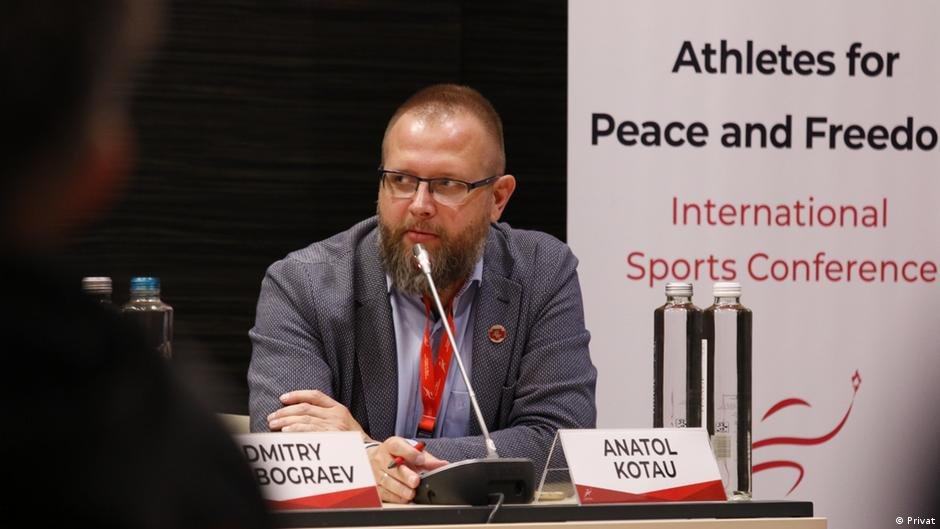
Kotau spent much of his early political career as a diplomat at the Belarusian Embassy in neighboring Poland. In 2015, he was appointed secretary-general of the Belarusian Olympic Committee, serving under Belarusian President Alexander Lukashenko, Europe’s longest-ruling autocrat. Kotau was also deputy director of the organizing committee for the 2019 multisport European Games in Minsk, a prestige project for Lukashenko.
He quit his job as government forces suppressed protests after Lukashenko declared victory in the 2020 presidential election. He fled to Poland, where he registered as a refugee, and, from Warsaw, began pushing for change in Belarus.
Kotau was an outspoken critic and was widely believed by fellow dissidents to be among those behind the “Nick and Mike” Telegram channel, which exposed the regime’s secrets. He was a key part of the Belarusian Sport Solidarity Foundation, a movement for athletes that actively lobbied to have Minsk stripped of the honor of co-hosting the 2021 Ice Hockey World Championship — in part on the grounds that Lukashenko could use the global spotlight on his favorite sport to rehabilitate his image following the bloody clampdown of 2020.
“He was a person who worked for many years in the state system,” said Ales Mikhalevich, a Belarusian human rights lawyer and former presidential candidate. “People like me, for example, are simply enemies for the regime, whereas people like him are traitors. And that is much more serious.”
In 2024, a Belarusian court sentenced Kotau in absentia to 12 years in prison after finding him guilty of conspiracy to seize power in an unconstitutional way and promotion of extremist activities. Arrest warrants were issued by the governments of Belarus and Russia.
“Without a doubt, this was a person the Belarusian authorities wanted to get back — legally or illegally,” Mikhalevich said.
Kotau’s travel tendencies
Friends said Kotau was often secretive about his travel plans. In April 2025, he traveled to Dubai, where he held at least two meetings. DW and its partners were unable to identify everyone he met on that trip.
Kotau had another visit to Dubai scheduled for July 2025, one month before he disappeared, but canceled the trip when he developed appendicitis, according to his wife.
“He usually didn’t say in advance where he was going or why,” Kotau’s friend and fellow opposition activist Ruslan Khazin said. “But we always knew that after he’d gone somewhere to meet someone, there would be some interesting news.”
Before Kotau disappeared in August, he told his wife that he was traveling to Turkey for business; his boss at a Polish events agency believed that he was going for personal reasons.
Several people told DW and its partners that, shortly before the trip to Turkey, Kotau indicated to various people that things were about to change in Belarus and that “soon we are all going home.”
“I just didn’t understand,” Khazin recalled. “I said: ‘What do you mean?’ He has this usual manner — he smiles and says: ‘Well, you’ll find out later.’ That’s it.”
A fellow Belarusian
After landing in Istanbul on August 21, Kotau flew to the northeastern port city of Trabzon, where the yacht awaited. The boat itself had departed from Istanbul earlier, carrying a small crew, two Russian passengers and Yuryy P., a Belarusian karate judge and instructor with connections to the Belarusian secret service, which still goes by its Soviet initials, KGB.
Social media photos indicate that Kotau could have met Yuryy P. at the Vozrozhdenie (Renaissance) sport club, which can be linked to the KGB during its four years in existence, from 2017 to 2021, according to information provided by the Belarusian civil society group Rabochy Ruch.
Yuryy P. was also employed by a company called Tres International, which is headquartered near Dubai but has a representative office in Minsk, according to leaked data from Cyber Partisans, a dissident hacker collective formed after the 2020 election in Belarus. Several people at Tres International were found to be affiliated with the KGB, according to more leaked documents. Yuryy P. did not reply to queries from DW and its partners.
Many of the company’s employees also work for BTS Global, which is in business and management consulting, according to the Belarusian Chamber of Commerce and Industry, but also sells weapons, according to military documents provided by Rabochy Ruch. Tres International and BTS Global are both registered at the same address on Smolenskaya Street in Minsk.
It is not clear whether Kotau and Yuryy P. crossed paths in Trabzon. However, when the yacht left the port city with Kotau on it, Yuryy P. was not on board.
Details about the yacht Kotau boarded
The last known image of Kotau, 45 at the time, is a CCTV capture of him at the Trabzon port, unshaven and wearing a dark T-shirt. He then would have boarded the 30-meter (100-foot) yacht named Shells, a $2.8 million (€2.4 million) private vessel with two dining areas, a bar and a top-deck jacuzzi.
According to the passenger manifest, which DW has obtained, the yacht was bound for Sochi, on Russia’s Black Sea coast, although it is unclear whether Kotau knew that. He may have been told a different destination or thought that the ship would enter international waters and then return to Turkey.
The yacht’s movements are difficult to trace. There is no record of its location in the Marine Traffic database in August 2025 or in satellite imagery over its route. The yacht was last recorded months earlier, in March 2025, in Istanbul.
The owners on paper in August 2025, MGA Yachting Ltd., insist that they sold it at the end of 2024 and know nothing about Kotau’s disappearance. DW and its partners confirmed that the boat was up for sale in early 2025.
By January 2026, the boat had been renamed the YS Legacy and registered to SSL Yachting Group Ltd. In March 2026, BTS Global bought the trademark for the same name: YSLegacy.
A Belarusian businessman, Yuryy S., is listed as the head of two BTS Global companies — the one registered in Belarus and another in the United Kingdom — and lives in the United Arab Emirates, where the yacht last appeared on the Marine Traffic database in March 2026.
He knew Kotau personally. There are photos of the two at the Vozrozhdenie sports club in 2019, at what appears to be an event connected to the Minsk 2019 European Games. Yuryy S. is identified in leaks as having worked for the KGB’s Operational Analytical Center and at the Belarusian Olympic Committee during Kotau’s tenure as secretary-general. He is connected to the Dubai-based Tres International. He did not reply to queries by DW and its partners, nor did BTS Global or Tres International.
Kotau’s mysterious shipmates
When Kotau boarded Shells, he was accompanied by a woman named Qahira E., whose nationality is listed as Jordanian in the passenger manifest. Qahira E. lives in Dubai and is originally from Azerbaijan. She and Kotau had known each other since at least 2023, according to information obtained by the BIC. The two had messaged about meeting, and appeared in a cozy photo in what looks like a bar.
She did not answer questions sent by DW and its partners.
The other passengers were two Russians who had entered Turkey on the same flight from Moscow on August 5, according to leaked passport data, and traveled on the yacht from Istanbul.
According to leaked databases, one of the men, Pyotr G., is former military and now works as a private security specialist. DW and its partners gathered little information about the other, Yuriy G., but could confirm that the two men traveled together shortly before and after the yacht trip. Neither man replied to queries by DW and its partners.
According to the manifest, the only other people on the vessel were the four crew members — none of whom could speak Russian.
Yacht intercepted off Russia-occupied Abkhazia
DW and its partners have learned from sources and a letter obtained from the Sochi port authorities that the yacht never arrived there.
Sources familiar with the operation told DW and its partners that the yacht instead headed toward Sukhumi, the capital of Abkhazia, a breakaway region of Georgia. The government of Georgia — as well as the US, EU and several other governments — considers the region to be occupied by Russia, which maintains a heavy military presence there.
Abkhazia is a “well-known gray zone,” the Georgian political analyst Mamuka Komakhia said. “There’s a lack of control in Abkhazia from an international point of view.
“Abkhazia is a very good place to do any illegal activity because it’s open sea. You do not need to register anything. If you don’t want to register something, you can do it.”
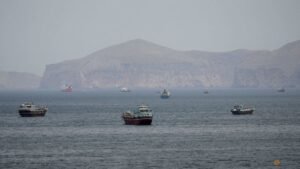
There, around 1:30 p.m., in waters where no vessel-tracking signals appear, the yacht was intercepted by Russia’s Coast Guard, a division of the FSB. Sources familiar with the operation say agents boarded the vessel and conducted a search of the yacht, at which point Kotau was removed.
Although there are no images covering the area at the time when the yacht was likely intercepted, there are images from the nearby port of Ochamchire, a coal transportation hub where Russia has had an FSB base since 2009.
According to the Georgian Foundation for Strategic and International Studies, also known as the Rondeli Foundation, the FSB has stationed up to 10 Sobol- and Mangust-class patrol boats at the Ochamchire port. Armed with machine guns and surface-to-air missiles, these vessels are tasked with securing Russia’s coastal borders.
In satellite images, a boat matching the size and shape of one of these Coast Guard vessels is seen leaving Ochamchire port and turning west toward Sukhumi about one hour before sources said Kotau was removed from the yacht.
“It is quite strange Belarusian opposition activists [would] visit Abkhazia,” Komakhia said. “It is quite clear [that] Abkhazia is in very good and close cooperation with Russian law enforcement. It is definitely not a safe place for such people.”
Neither the Russian FSB nor the Belarusian KGB replied to requests for comment.
About an hour after the time sources say Kotau was removed from the yacht on August 22, Pyotr G. and Yuriy G. also disembarked.
Although it is unclear exactly where and when they got off the yacht, the leaked passport data lists Pyotr G. as crossing the port border in Sukhumi at 2:42 p.m. and Yuriy G. four minutes later.
The boat returned to Turkey with only Qahira E. and the crew on board.
Did Russia and Belarus work together?
It would not be without precedent for Belarus, which has limited resources, to ask its primary ally for help securing Kotau’s return.
“Belarusian intelligence is not so well-developed, it’s not so skilled,” said Kamil Klysinski, a senior fellow at the Center for Eastern Studies in Poland. “They don’t have so many people, money [or] other assets to do such operations out of the region.”
Belarusian and Russian security agencies cooperate closely on intelligence sharing, border security and joint operations — including handing over political opponents.
“In case of more ambitious operations, as with Kotau, of course Russian support was needed, at least the support of FSB,” Klysinski said.
What authorities have said about Kotau’s disappearance
Kotau’s family and friends have sought answers for nearly 10 months.
Turkish authorities replied to DW, saying only that Kotau arrived in and left the country on August 21, 2025, and did not respond to questions about an investigation. The Polish authorities said they were not investigating Kotau’s disappearance.
“If the crime was committed in Poland, then the Polish prosecutor’s office would have jurisdiction,” a spokesperson wrote in an email.
Mikhalevich disagrees with that assessment: “The crime connected with his disappearance began on Polish territory.”
“The state system works the way it works,” Mikhalevich said. “No prosecutor, no civil servant, wants additional work. If there was the political will, initiating a criminal case on the disappearance of Anatol Kotau would be quite easy.”
For his part, Kotau’s friend Khazin says he thinks Kotau is still alive.
“If they wanted to eliminate him, it would have been much easier to do it here, in Warsaw, and stage an accident,” Khazin said. “The circumstances of his disappearance and those who could have carried out this operation … speaks to the fact that the forces who captured him needed him alive and well.”
To view this video please enable JavaScript, and consider upgrading to a web browser that supports HTML5 video
Additional research by: Halil Taskin
Edited by: Carolyn Thompson
Copyedited by: Milan Gagnon
Fact-checked by: Esther Felden
Legal consultation: Florian Wagenknecht
About The Author