Riverbeds reduced to tiny streams, asphalt melting like butter, dried-up fields — these are currently the images of drought in Central and Southeastern Europe. The record-breaking lack of rainfall in recent months and this summer’s heatwaves have caused severe damage to the region’s economy and infrastructure.
In the agriculture sector, it has been clear for some time that harvests in Southeastern Europe, especially maize and sunflower crops, will be significantly below average. The heatwaves are also repeatedly disrupting road, rail and, above all, shipping transport. But, most importantly, the drought has triggered an unprecedented crisis in electricity generation in several Central and Southeastern European countries, forcing companies to halt production due to the historically low water level of the Danube.
Hungary and Romania are currently most affected by the energy crisis. Other countries bordering the Danube — Austria, Slovakia, Serbia and Bulgaria — are also suffering from low water levels, although not as severely as Hungary and Romania.
DW outlines the situation in each country and explains why, despite facing similar weather conditions, some are more severely affected than others.
Hungary: Most severe energy crisis in decades
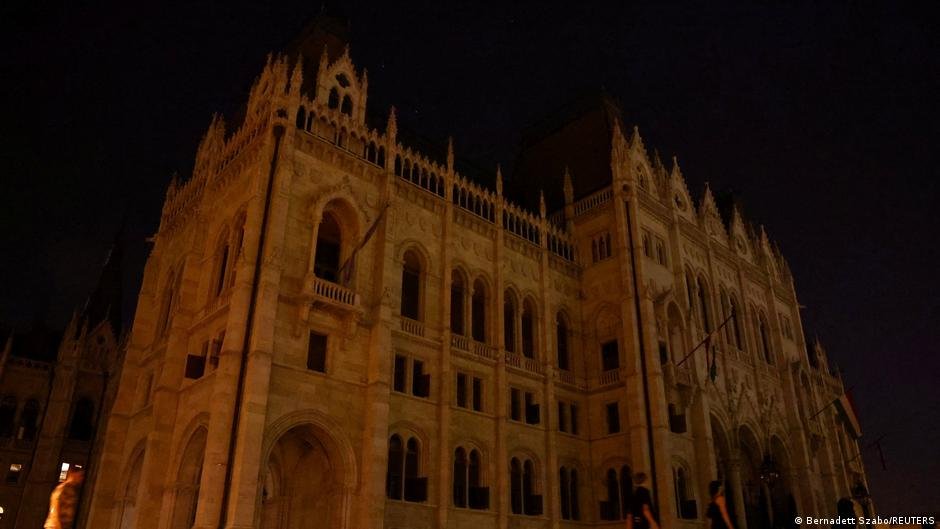
No country in the region is currently as severely affected by drought and heat as Hungary. For months, there has been little or no rainfall in large parts of the country. On Wednesday, temperatures reached 43 degrees Celsius (109.4 degrees Fahrenheit) in the capital Budapest, and exceeded 40 degrees in many places across the country.
Due to the record-low water levels of the Danube, the Paks nuclear power plant south of Budapest had to largely shut down operations, as there is no longer sufficent cooling water available and the temperature of the Danube water is too high. The plant is currently operating at around 12% of its capacity. If Danube water levels continue to drop, the plant will have to be shut down completely.
Due to the energy crisis, the Hungarian government has been urging large energy consumers to conserve electricity. As a result, several car manufacturers, including Audi Gyor, oil and gas company MOL and other large companies have scaled back production. Hungary’s energy crisis — the worst in decades — is so severe because of the country’s unfavorable energy mix. Paks generates around 50% of the electricity produced in Hungary and about one-third of the electricity consumed. Although Hungary has significant solar energy capacity, it lacks storage facilities, has too few modern gas-fired power plants and very little wind or hydropower capacity.
Even if the Danube water levels rise significantly again, the Paks nuclear power plant cannot simply be brought back online quickly — the process takes a considerable amount of time. Therefore, Hungary’s energy crisis will continue for at least several more weeks, during which the country will have to import electricity at high prices. In response to the crisis, the new government under Peter Magyar has announced a comprehensive review of Hungary’s energy development strategy.
Romania: Blasting rocks to redirect water
Romania is experiencing a similar, though somewhat less severe, energy crisis. The Cernavoda nuclear power plant, also located on the Danube in the southeast of the country, produces roughly one-fifth of Romania’s electricity. Due to the river’s exceptionally low water level, one of the plant’s two 700-megawatt reactors was taken offline last week.
Southwest of the Cernavoda plant, Romanian authorities blasted a rock formation this week to divert more water into the Danube’s eastern branch, where the nuclear plant is located. In addition, dozens of tons of rock were dumped into the river to channel more water into that branch.
Romania has a relatively balanced energy mix consisting of hydropower, nuclear energy, natural gas, coal and wind power. However, because hydropower accounts for around one-fifth of the country’s electricity generation — primarily through the Iron Gate hydroelectric plant on the Danube — Romania is particularly vulnerable to droughts such as the current one.
Due to the energy crisis, several major companies, including Dacia and Ford Romania, have scaled back production. The government has announced that it would, if necessary, issue a decree ordering large factories to suspend production.
Romania is also among the Southeastern European countries most affected by aridification — the long-term climatic process through which regions become increasingly dry — and desertification, as soils gradually become barren and take on desert-like characteristics.
Serbia: An unfavorable energy mix
Serbia, too, is suffering badly from drought and the Danube’s low water level. Its energy mix is similarly ill-suited to prolonged dry periods. Around 65% of its electricity is generated by coal-fired power plants, while about 25% comes from hydropower.
The two Iron Gate hydropower plants are currently generating only a fraction of their average electricity output. The coal-fired power plants Kostolac A and B east of Belgrade, which rely on Danube water for cooling, have also had to cut back production.
Serbia relies heavily on the Danube as a transport route for coal and petrochemical products. However, due to the low water level, cargo vessels can currently only carry a fraction of their normal loads. Nonetheless, the energy crisis has so far not been so severe that large industrial plants have had to scale back production.
Slovakia, Austria less affected
In Slovakia, some 60% of electricity is generated by nuclear power plants, with another 20% by hydropower. Unlike Hungary and Romania, Slovakia’s two nuclear power plants, Bohunice and Mochovce, are located on smaller rivers and use cooling towers rather than once-through cooling systems. Once-through cooling requires large quantities of river water that are drawn from the river and then channeled back to it at a higher temperature. In contrast, cooling towers recirculate water in a closed system, releasing heat mainly through evaporation. As a result, Slovakia’s nuclear plants require much less river water and are therefore less affected by the current drought.
In comparison, Slovakia’s Gabcikovo hydropower on the Danube has been significantly affected by the low water level. At present, only one of its eight turbines is in operation. Electricity generation in Gabcikovo, however, is only about 12% lower compared to the same time last year. So far, Slovakia has not experienced any major industrial production stoppages.
Austria, which generates around 60% of its electricity from hydropower, has also been less severely affected than Hungary. One reason is that part of Austria’s hydropower capacity comes from storage and pumped-storage plants rather than run-of-river facilities.
Run-of-river plants depend directly on the volume of water flowing through rivers, whereas storage and pumped-storage plants can generate electricity using water stored in reservoirs when needed, making them less vulnerable during prolonged heatwaves and droughts.
In addition, Austria generates some 30% of its electricity from other renewable energy sources.
Bulgaria: Large battery storage capacity
Unlike in neighboring Romania, drought and heat are not yet causing an energy crisis in Bulgaria.
The country generates up to 40% of its energy through the Kozloduy nuclear power plant, which is also located on the Danube. Its cooling system, however, is better designed to operate under low-water conditions than those of Hungary’s Paks plant and Cernavoda in Romania. As a result, it is currently operating at almost full capacity.
At the same time, Bulgaria depends only marginally on hydropower and has, in recent years, considerably expanded its solar and wind energy capacity.
The biggest difference to all the other countries lies in Bulgaria’s large-scale battery storage facilities. The country currently has storage systems with a capacity of 3.4 gigawatts and a storage capacity of 8.6 gigawatt-hours. This storage capacity corresponds to 16% of the country’s total installed power generation capacity — a figure unmatched by any other country in the world.
These storage facilities enable Bulgaria to balance supply shortages and peak demand, without relying on expensive imports. At the same time, the country is developing into a regional market leader in new energy concepts and as a hub for power grid stabilization and greater price stability in the electricity market.
About The Author