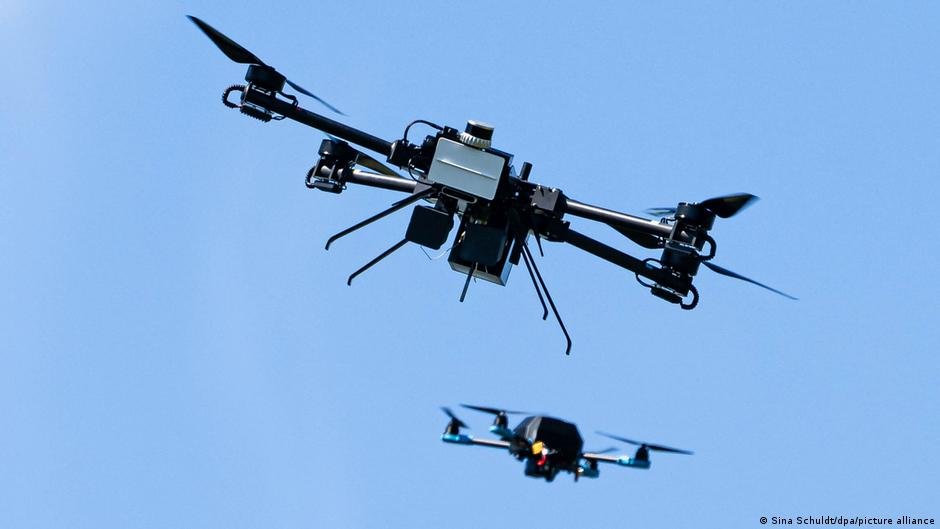
How could a drone laden with explosives fly unhindered into Leipzig/Halle airport, where it remained apparently unnoticed for several hours? After last week’s incident, German Interior Minister Alexander Dobrindt spoke of a “hybrid attack scenario” which he suspected came from “foreign powers.”
Suspicion has been directed at Russia, also because the drone was said to have been located near a Ukrainian Antonov cargo plane. The Federal Prosecutor’s Office has taken over the investigation.
The fact that the drone was loaded with explosives and able to reach the airport demonstrates a new level of threat. However, drone sightings over airports and ports, industrial sites and military properties have been increasing in Germany. In 2025, Germany’s Federal Criminal Police Office (BKA) recorded more than 1,000 suspicious drone flights.
Last October, drones disrupted air traffic in Munich for several hours, stranding numerous passengers. There is not sufficient drone protection at German airports, warned security expert Nico Lange.
“We do not possess the sensor networks and sensor beams needed to spot all types of drones, especially low-flying, slow drones,” he told DW.
To view this video please enable JavaScript, and consider upgrading to a web browser that supports HTML5 video
The European Association for Unmanned Aviation has also long pointed out weak points in Germany’s drone defense. “That a drone could apparently reach the airport tarmac and be discovered rather by chance, shows where the core of the problem is,” said chairperson Gerald Wissel in relation to the latest incident.
The association suggests “the establishment of real-time monitoring of the lower airspace as well as the mandatory tracking of all airspace participants via ADS-L” — a radio communications system that makes drones in an airspace electronically visible.
Coordinated response difficult for state, federal police
Germany has so far done little to address the issue of drone defense. Interior Minister Dobrindt wants to remedy this by setting up new institutions.
In December, he launched the Joint Counter Drone Center (GDAZ) in Berlin. There, information from the federal police, state police, secret service and armed forces is collated around the clock. But the incident at Leipzig airport shows that even a new hub is of little use if a dangerous drone at a large airport cannot be discovered and intercepted.
Drones move quickly, and any response must be decided within minutes. Doing so is made more difficult by Germany’s system of divided responsibilities. If a suspicious drone takes off somewhere in the country, it’s initially a matter for the state police. Germany has 16 police authorities, one for each of its 16 states. Only when the drone moves over a large airport or railway facility are the federal police allowed to step in.
To view this video please enable JavaScript, and consider upgrading to a web browser that supports HTML5 video
Unclear responsibilities
Security experts and opposition politicians in Germany’s Bundestag federal parliament have called for clear regulation and consolidation of responsibilities. “The muddle over responsibilities in drone defense is a substantial danger to our domestic security,” said Irene Mihalic, lawmaker with the opposition Green Party and herself a former police officer.
Many, including the Greens, suggest the federal police should take the lead when it comes to drone defense. The federal police set up a new special unit for drone defense in December, and Dobrindt now wants to expand the unit following the incident at Leipzig airport.
Originally, 130 staff positions across four locations were planned. In the future, there will be 300 personnel across eight locations, to “be on site quickly and flexibly when needed,” according to the Interior Ministry.
Who is allowed to shoot down a drone in Germany?
As so often happens following dramatic incidents, there have also been calls to deploy the Bundeswehr, Germany’s armed forces, to take care of drone defense efforts at airports. However, current German law maintains that police are responsible for upholding security in the country.
A Defense Ministry spokesperson warned that protecting its own facilities, with their “tens of thousands of kilometers of fencing,” is already a challenge for the Bundeswehr. Adding 24/7 protection of civilian infrastructure “would proclaim a false sense of security that we could never achieve,” he added.
In an emergency, the police are allowed to ask the army for assistance. To achieve legal clarity in this regard, Germany amended its air security law in March. For the first time, it allows the Bundeswehr to shoot down drones outside their own premises to prevent “a particularly serious disaster.”
To view this video please enable JavaScript, and consider upgrading to a web browser that supports HTML5 video
Airports, train stations still lack protection
There is also lot of catching up to do when it comes to the technical equipment used to defend against drones.
“There were big announcements at airports about positioning drone defense systems. They are more like detection systems,” Manuel Atug, a spokesperson for the independent Critical Infrastructure Working Group (Arbeitsgruppe Kritische Infrastruktur) told DW. “So far, they have not intercepted a single drone, and at some airports they have still not yet been put in place.”
The German Police Union (GdP) has also lamented the lack of resources for drone defense. “Unsafe train stations, unsafe airports and a police force which has to beg for money, law changes and the latest defense technology are really disconcerting,” criticized GdP federal chairman Jochen Kopelke.
An Interior Ministry spokesperson said large airports were steadily being equipped with drone defense technology. “The federal police have already procured a considerable amount of equipment. The eight large airports are prioritized: Frankfurt (Main), Munich, Berlin, Düsseldorf, Hamburg, Cologne/Bonn, Stuttgart and Leipzig/Halle,” she said.
The plan is for all of these airports to be equipped with mobile drone defense technology by the end of the year.
This article was originally written in German.
About The Author