https://p.dw.com/p/5PzcKPrefer DW on Google
Geopolitical crises seem to have become the new normal: the climate, energy security, the wars in Ukraine, in Iran and in Gaza. In the age of information overabundance, it often seems impossible to escape the intense debates about who is to blame and what the solutions should be.
Added to this are the domestic worries in most European countries and elsewhere: rising living costs, skyrocketing rents, education cuts, the future of employment and the growing power of artificial intelligence.
Some researchers refer to this uninterrupted perception of crisis as a “polycrisis”: Simultaneous crises without end or boundaries that reinforce one another. They affect European societies just as much as they do the US, India, Japan, as well as many countries in Africa and Latin America.
The new German word for this collective state of mind is Krisenmodus (“crisis mode”), which was voted “word of the year” by the Association for the German Language (GfdS) in 2023.
In its statement, the GfdS said that a state of crisis had long since become normal, and that “feelings such as uncertainty, fear, anger, helplessness and powerlessness shape the everyday lives of many people. It is difficult to find a balanced approach — between apathy and alarmism — to dealing with these ongoing exceptional situations.”
To view this video please enable JavaScript, and consider upgrading to a web browser that supports HTML5 video
An appetite for destruction
In 2026, many people feel like they are still in “crisis mode.” And this has consequences: Social scientists have observed that the longer this state lasts, the more people want radical changes, even a destruction of old institutions.
In Argentina and the US, Javier Milei and Elon Musk have become symbols of this “appetite for destruction” with their chainsaw-wielding appearances and their promises of far-reaching cuts to the state apparatus. In Europe, far-right parties have grown successful by claiming that the existing conditions are doomed to collapse, and promising radical change as a quick fix.
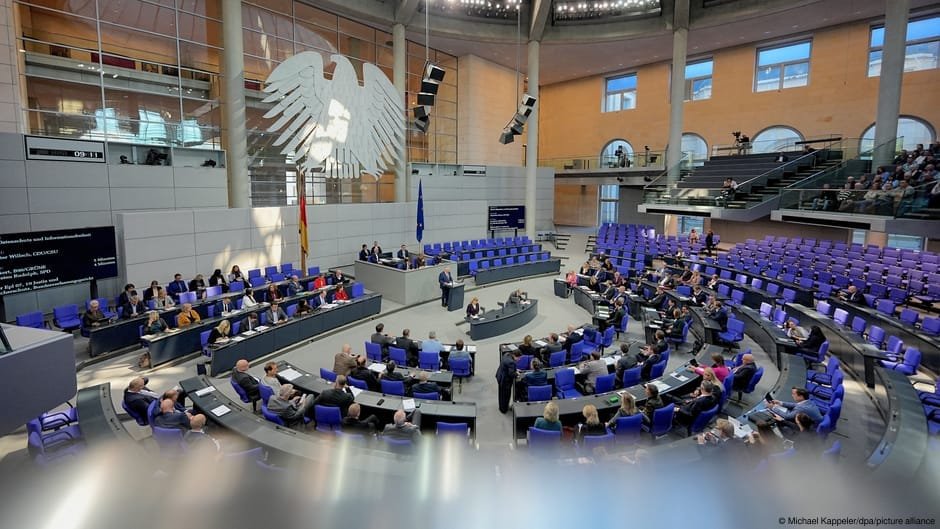
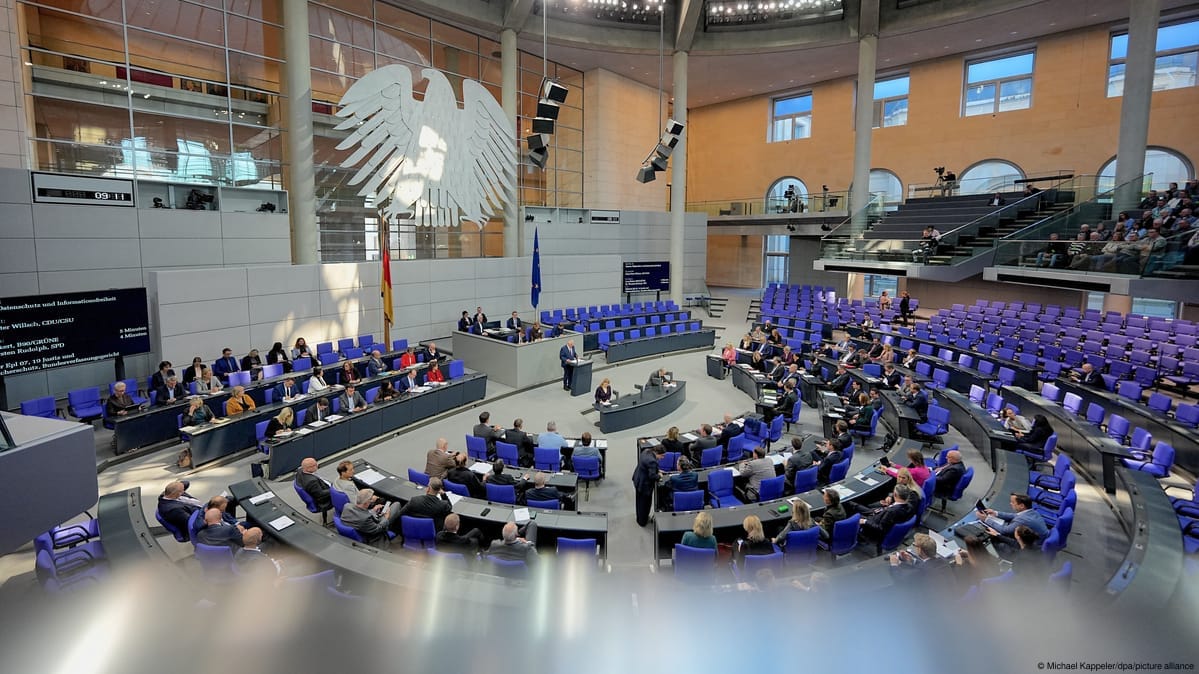
In Germany, this narrative is being most obviously promoted by the Alternative for Germany (AfD), whose co-leader Alice Weidel invoked impending doom on Wednesday in a speech before parliament: “Mass migration from all over the world is overwhelming our social systems and driving the costs of our crumbling domestic peace to unmanageable heights.”
A week earlier, perhaps the AfD’s most influential ideologue, Björn Höcke, head of the AfD in the eastern state of Thuringia, struck the same note: “Our Germany is a country teetering on the brink,” he warned at a public forum organized by his party in the town of Breitungen.
When Donald Trump ran for reelection as US president in 2024, he painted a similarly bleak scenario: “If we lose this election, we may no longer have a country,” he warned voters.
‘Politics of the apocalypse’
Sociologist Ulrich Bröckling calls this the “politics of the apocalypse,” and a new German study has found some revealing results about it.
The Leipzig Authoritarianism Study 2026is an influential sociological investigation into the political attitudes of Germans and their relationship to democracy. What makes it unique is that the researchers have been collecting extensive data every two years since 2002.
The latest study, published in November, shows a significant rise in far-right attitudes in society. It also reveals a growing yearning for social upheaval. Some 60% of respondents explicitly or implicitly agreed with the statement: “Something radical is needed to change the current state of affairs.”
According to the research findings, this is accompanied by rising antisemitism, growing support for authoritarian tendencies and a desire for destruction.
The far right benefits most from this, the study stated, because “it promotes an active apocalypse, drawing on the notion of a decisive struggle, because aggression appears legitimate when it comes to destroying the existing and the old in favor of a new order.”
AfD legitimizing ‘authoritarian aggression’
The study’s authors conclude that in Germany, this is most embodied by the AfD. They argue that, in times of economic stagnation, the party has responded to the “loss of credibility of the promise of economic prosperity” — that is, the promise that increased growth, higher productivity and the market economy will actually make people better off.
“On the one hand, [the AfD] renews the promise of growth with its neoliberal and antisocial program; on the other, it legitimizes authoritarian aggression by dividing society into ‘good’ and ‘evil’,” the Leipzig Authoritarianism Study 2026 said. “Our analysis highlights an overlooked aspect of crisis and apocalypse: The idea that what we know is supposed to come to an end so that a better era can begin. The destructive desire for doom is thus closely linked to a longing for a new beginning.”
To view this video please enable JavaScript, and consider upgrading to a web browser that supports HTML5 video
One of the study’s more surprising findings is that crises themselves are not the direct cause of this desire for destruction. Rather, they increase society’s propensity toward authoritarian attitudes, which in turn trigger a tendency toward destructiveness. According to the researchers, this indirect link makes a crucial distinction: Crises are not in themselves necessarily destructive.
The authors of the study also point to ways of dealing with crises. They emphasize that it is important for policymakers and society to take people’s feelings of fear and loss seriously and to provide them with the space to process these emotions.
Thus, democratic movements and parties should not deny that change also entails costs, the authors explain: “It is important to establish a political culture in which there is space to acknowledge and mourn losses, in order to give them a constructive direction and make them effective for a politics that is not based on authoritarian needs.”
The authors explicitly say that their aim is not to uncritically defend the status quo. Even if defending democracy is currently the most important task, democracy itself can very much be seen as work in progress. Not all of its promises have been fully implemented — the fundamental right to equal treatment, regardless of gender, race, language, origin, or religion. Only if society successfully fights to fulfill these democratic promises can authoritarian tendencies be overcome, the study concluded.
This article was originally written in German.