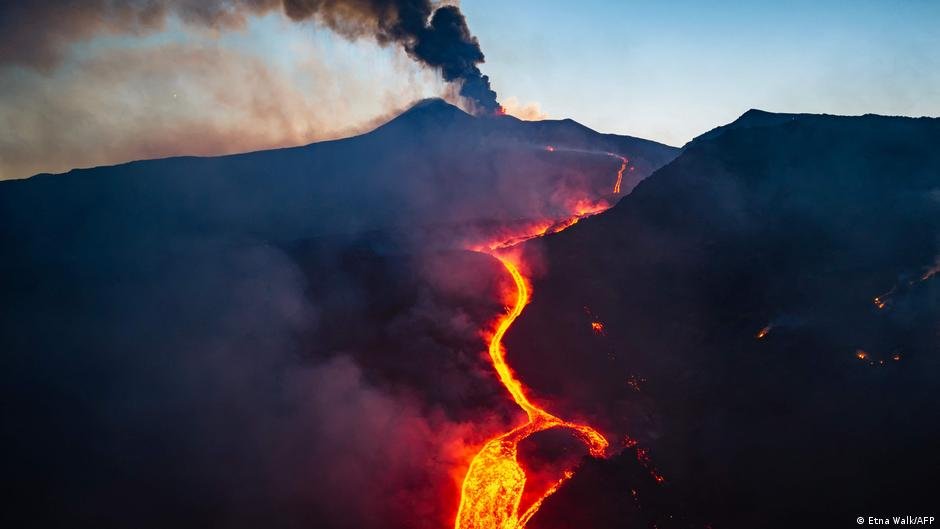
Sicily’s Catania airport on Wednesday suspended flights until at least 4 p.m. local time (1400 GMT/UTC) on Thursday, responding to fresh ash emissions from Mount Etna.
The volcanic ash can pose a danger to aircraft and so has forced regulators to restrict access to the airspace around eastern Sicily, disrupting the peak summer holiday season.
Where were flights affected?
“Passengers are advised to check the status of their flights with their airlines,” airport operator SAC said. “Further updates will follow in the coming hours.”
Travel disruptions have impacted eastern Sicily in particular since last Friday, when renewed rumblings from Europe’s most active volcano and shifting winds started carrying ash over the region. The airspace was fully closed only in recent days as the eruption continued.
The prolonged restrictions at Catania — on Sicily’s eastern coast just south of Mount Etna — have placed extra strain on Sicily’s other airports during one of the busiest seasons for vacationers.
Palermo Mayor Roberto Lagalla said that his city’s airport had taken in around 190 flights originally scheduled to land on the eastern side of the island in recent days.
Italy‘s ANSA news agency also reported on Wednesday that flights were resuming at Comiso airport, a smaller hub south of Catania, after it had suspended traffic late on Tuesday.
Some of the volcanic ash was also drifting south across the Mediterranean towards Malta, which had reported significant delays and some cancellations. On Wednesday, Malta International Airport continued to warn passengers of possible disruptions but said that conditions were improving.
What is Mount Etna?
Mount Etna is a roughly 3,400 meter (roughly 11,100 feet) stratovolcano on Sicily’s eastern coast. Its precise height is ever changing, particularly amid periods of high activity when it can shed a few meters.
The city of Catania is located in its foothills.
It is one of the tallest active volcanoes in Europe and Italy’s highest peak south of the Alps.
It’s in an almost constant state of low-level activity and erupts in a more pronounced manner fairly frequently. It has caused disruptions at Catania airport several times in recent years.
A UNESCO World Heritage Site, the first volcanic activity took place at Etna about half a million years ago.
Both Roman and Greek mythology asserted that the god of blacksmithing — either Vulcan or Hephaestus — had his forge beneath Mount Etna.
Edited by: Louis Oelofse
If you rely on our team for trusted reporting, please take a moment to select us as your Preferred Source on Google, so you’ll always see our verified news first.