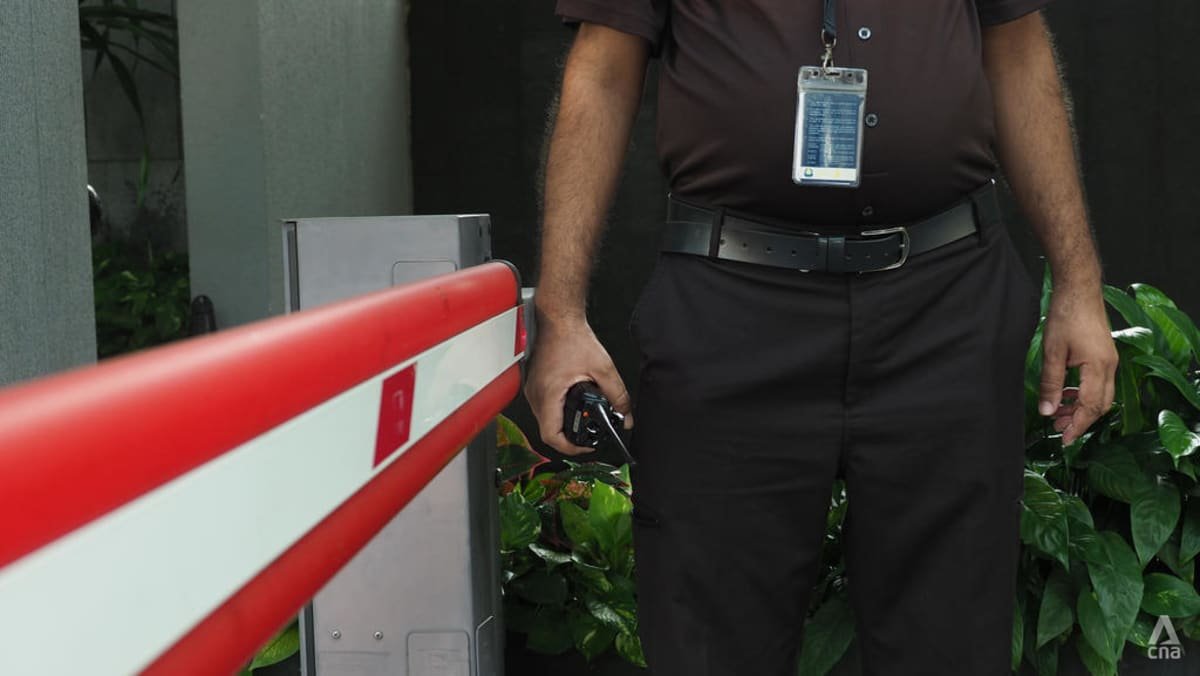
Late payments and financial penalties squeeze security firms, raising risk of wage delays, say industry players
The closure of a security agency has drawn attention to business practices that can strain companies’ cash flow and affect workers’ pay.
New: You can now listen to articles.

This audio is generated by an AI tool.


Read a summary of this article on FAST.
Get bite-sized news via a new
cards interface. Give it a try.
Click here to return to FAST
Tap here to return to FAST
FAST
SINGAPORE: The security industry is warning that business practices such as late client payments and financial penalties are putting pressure on companies’ cash flow, raising the risk of salary delays for security officers.
The issue has come under the spotlight following the closure of security agency TwinRock, where some officers went unpaid for months before the company ceased operations last October.
Several TwinRock officers, who spoke on condition of anonymity, said they did not receive their salaries for up to four months.
A Central Provident Fund (CPF) contribution record, seen by CNA, showed gaps in monthly CPF payments, indicating periods where contributions were not made.
The Union of Security Employees (USE) said many affected workers did not report the problem immediately because they had stayed with the company for years and hoped the situation would improve.
UNION PROVIDES MEDIATION, ASSISTANCE
USE general secretary Raymond Chin said the union first learnt of the salary issue in October 2025 after a security officer approached its mediation service for help over outstanding wages.
The union later engaged the company and affected workers to understand the situation and help recover the unpaid wages.
Mr Chin said 11 union members employed by TwinRock were affected.
USE represented them in three mediation sessions between November 2025 and February 2026.
It secured full payment of outstanding salaries for three workers and facilitated settlement agreements for the remaining eight. The union also provided relief vouchers where needed and helped affected officers find new jobs.
Since January, USE has handled about 352 cases involving issues such as salary and benefits disputes, dismissals, breaches of contract and workplace conflict.
Mr Chin noted that overall case numbers have been declining, and that salary disputes were not among the most common cases.

Guess Word
Crack the word, one row at a time

Buzzword
Create words using the given letters

Mini Sudoku
Tiny puzzle, mighty brain teaser

Mini Crossword
Small grid, big challenge

Word Search
Spot as many words as you can
TWINROCK CITES CASH FLOW PRESSURES
When CNA visited TwinRock’s registered business address on Jul 1 and Jul 6, another company was operating there. However, business records still listed TwinRock as an active company. Emails sent by CNA seeking comment also bounced.
In a statement on Wednesday (Jul 8), TwinRock said it ceased business with its clients in October 2025 and would be liquidated.
The company said late payments by clients and “crushing liquidated damages” were among the reasons for its closure, calling the situation “a crisis in the industry” that affects agencies’ ability to pay officers on time.
Liquidated damages are financial penalties set out in contracts when agreed obligations are not met.
AGENCIES SAY PENALTIES DELAY PAYMENTS
The Association of Certified Security Agencies says liquidated damages can significantly affect a security agency’s cash flow.
Its president V W Nathan said agencies are sometimes informed of contract breaches only at the end of the month, leaving little opportunity to rectify issues before deductions are made.
“For example, like a patrol route, where the officer has to go and clock in certain designated points to make a route, and if the officer doesn’t do this … they do not give us time to rectify,” he said.
“We only get to know at the end of the month … then we write in an appeal, and they take time to address that appeal. Because of that, there is a further delay in us getting our payment.”
Mr Nathan said some clients also take well beyond the standard 30-day credit period to pay agencies, with delays sometimes stretching to three or four months.
Security agencies typically have to pay officers weekly or monthly regardless of whether they have received payment from clients, said Mr Nathan.
“If you do not empower the agencies by paying them on time, how do you expect them to pay the officers?” he added.
However, some managing agents adopt better practices by paying agencies first and resolving disputes over liquidated damages in the following month’s billing, he added.
Such arrangements help ease cash flow pressures while appeals are being considered.
COMPETITION LEAVES LITTLE WIGGLE ROOM
Security agencies often bid for contracts through tenders, but industry players say there is little room to offer lower prices because they must comply with Singapore’s Progressive Wage Model (PWM).
Introduced in 2016, the PWM requires employers to meet minimum wage levels and training standards for security officers.
“There’s a bidding war for every contract that is up there,” said Mr Nathan.
“If your operating cost is high, you need to factor that in. If your operating cost is low, you may be able to quote slightly lower than your competitors.”
Mr Nathan said higher wage costs, coupled with late payments and contractual penalties, can leave many agencies operating on thin margins.
He said agencies facing cash flow problems also risk losing officers to competitors that can pay wages more reliably, putting further pressure on smaller firms.


AUTHORITIES INVESTIGATE, ASSIST WORKERS
On Thursday, the Ministry of Manpower (MOM), CPF Board and Tripartite Alliance for Dispute Management (TADM) said in a joint statement that TADM had received salary claims from 32 former TwinRock employees between June 2025 and February 2026.
The claimants comprised 21 local workers and 11 migrant workers.
TwinRock made full salary payments to 18 claimants. Due to the company’s financial difficulties, nine received only partial salary payments, while five did not receive any payment, the authorities said.
Eligible claimants who did not recover their owed salaries received financial assistance through the Short-Term Relief Fund or the Migrant Workers’ Assistance Fund.
The statement added that MOM is investigating TwinRock for possible offences under the Employment Act over the non-payment of salaries.
The CPF Board has also taken prosecution action against the company over outstanding CPF contributions. The case is before the courts, with the next court mention scheduled for Jul 28.
It added that it has recovered part of the CPF arrears and will continue following up with the company and its directors to recover the remaining arrears.
WORKERS URGED TO SEEK HELP EARLY
USE’s Mr Chin urged companies facing financial difficulties to communicate early and transparently with workers before wage problems worsen.
He also encouraged workers not to wait months before reporting unpaid wages, adding that early intervention gives the union a better chance of helping them before financial problems become more severe.
MOM, the CPF Board and TADM said they will continue assisting affected workers with their salary and CPF arrears.
They also reminded employers of their obligations to pay salaries and CPF contributions on time, and encouraged employees facing salary disputes to seek help through TADM, which can assist with mediation or refer cases to the Employment Claims Tribunals.
Source: CNA/mp(dn)
Sign up for our newsletters

Get the CNA app
Stay updated with notifications for breaking news and our best stories
Get WhatsApp alerts
Join our channel for the top reads for the day on your preferred chat app

Get bite-sized news via a new
cards interface. Give it a try.
Click here to return to FAST
Tap here to return to FAST
FAST
About The Author