Four German Air Force Eurofighter jets stand ready at Latvia’s Lielvarde military air base, just 60 kilometers from Riga. The aircraft are part of NATO’s efforts to strengthen Baltic air defenses on the alliance’s eastern flank ahead. Germany sent the jets amid repeated drone incursions, which have put Latvia on alert ahead of the country’s elections on October 3.
Security fears ahead of elections
Security has become one of the defining issues of this campaign — defense promises appearing on the programs of most of the leading parties in Latvia. And the Latvian public’s anxieties aren’t unfounded.
In recent months, several drones have entered Baltic airspace. The latest incident occurred on September 15 in Lithuania, when a drone believed to have crossed from Belarus was shot down by an NATO fighter jet.
On top of that there are hybrid threats, including migrant flows that Latvia and its neighbors say are being encouraged by Russia’s ally Belarus to pressure the EU and test border security. Intelligence officials of several European countries, including Latvia and the Czech Republic have warned that Russia could seek to test NATO in the upcoming “months, not years.”
“There are concerns in the West and also here in the Baltic states that Russia might be trying some further actions here in the Baltics,” says Maris Andzans, director of the Center for Geopolitical Studies in Riga. “If you want to test NATO, there is no better place than the Baltic states.”
Near-unanimous agreement on defense
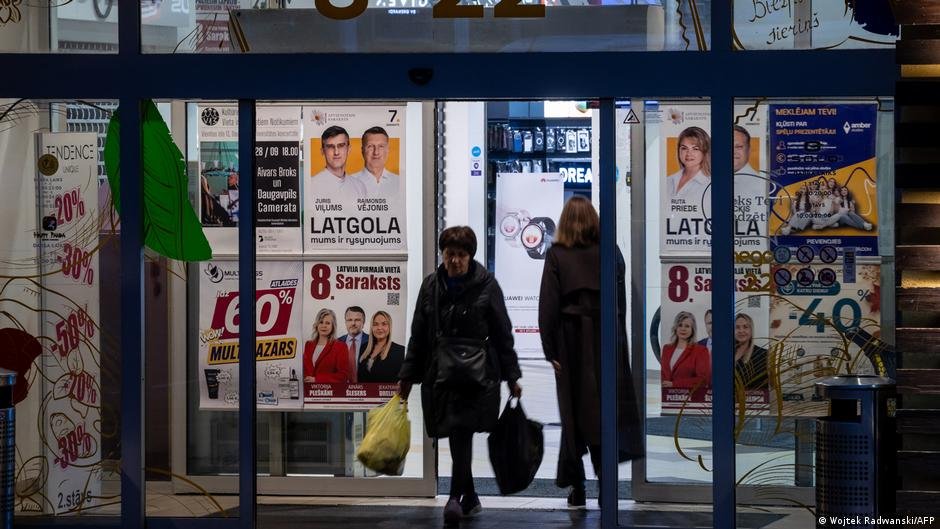
Latvia elects its 100-seat parliament, Saeima, through proportional representation, meaning coalition governments are the norm. Polls currently put the centrist United List, led by Prime Minister Andris Kulbergs ahead, followed by the populist alliance Sovereign Power/Young Latvians Alliance and Latvia First led by Ainars Slesers. The center-left Progressives and the conservative National Alliance are also expected to enter parliament.
Most of these Latvian parties view Russia as a security challenge.
“The biggest threat is our neighbors, Russia and Belarus,” says Agnese Kupca of the United List. “Our partners in the EU should understand: it is not only our border with Russia, but also EU and NATO border with aggressor.”
Latvia is one of the few NATO members that have committed by law to spending 5% of GDP on defense, and analysts say the country’s foreign policy orientation is unlikely to change regardless of which coalition emerges after the vote as there is nearly unanimous consensus on the importance of NATO. Which is backed by their voters: according to Friedrich Ebert Stiftung (FES) Security Radar 2025 Latvians generally have a positive view of NATO.
Economic concerns among voters
But while security policy enjoys broad agreement, the economic consequences of Latvia distancing itself from Russia remain contentious.
Before the full-scale invasion of Ukraine, Russia was among Latvia’s most important trading partners. Since 2022, Latvia has reduced imports from Russia and Belarus by more than 90% and introduced some of the toughest restrictions in the EU on goods from the two countries. Latvia’s economy has adapted, but businesses with strong pre-war links to Russia were among the hardest hit.
“This closeness to the theater of war has strongly influenced the investment climate,” says political analyst Filips Rajevskis. “So the big question is how to increase the investments and grow the economy.”
Many Latvians reject any economic cooperation with Russia on security grounds. Sixty percent said they want Latvia to reduce dependence on Russia, according to FES Security Radar 2025. “In the current situation, it’s absolute nonsense. We can’t watch what’s happening and still be friends with Russia,” one passerby in Riga told DW.
Not breaking up with Russia completely?
At the same time 20% of Latvians, according to FES, favor closer ties with Russia. Calls for a more pragmatic approach towards its eastern neighbor are not uncommon in the political debates.
Julija Stepanenko, leader of Sovereign Power/Young Latvians Alliance, has repeatedly argued against completely severing economic ties with Russia and Belarus.
Earlier this year, it emerged that Stepanenko has received gifts worth roughly €400,000 ($470,000) from her father, a Russia-based businessman whose company manufactures construction materials, including anti-tank fortifications known as “dragon’s teeth.” But despite that, her party remains in second place in the polls.
When DW met Lyubov Shvetsova, one of Sovereign Power/Union of New Latvians party candidates at a campaign stand just outside the center of Riga, she rejected accusations that the party is pro-Russian.
“Our approach is pragmatism oriented toward the interests of Latvian business,” she said.
Economic pragmatism
Another advocate of a more pragmatic economic approach is Ainars Slesers, former businessman and leader of Latvia First.
During an interview on Latvian public television earlier in September, Slesers argued that transit of goods with Russia should continue as long as it is not prohibited by EU sanctions.
His party has focused heavily on economic issues, arguing that Latvia should prioritize growth and investment over what it sees as excessive self-imposed restrictions. And this approach has found support: more than 9% are ready to vote for Latvia First, which is in third place in the polls.
However, discussions about fully restoring trade with Russia are premature, party member Edmunds Zivtins told DW. “As long as the war in Ukraine is ongoing, we cannot talk about it,” he said.
Language and identity dividing Latvia
Analysts say such parties may attract some voters who feel alienated by Latvia’s increasingly restrictive approach toward Russia.
The appeal is not necessarily driven by support for the Kremlin. Rather, it often comes from parts of the country’s Russian-speaking minority who feel overlooked by mainstream parties and uneasy about policies such as the phase-out of Russian-language school education and the reduced role of Russian in public life.
About one-third of Latvia’s population speaks Russian at home.
However, the outcome of these elections is hard to predict. Filips Rajevskis says many voters are hiding not only their party preference, but even their decision to go to vote ahead of elections.
As Latvians head to the polls, Moscow is shaping the campaign in ways both direct and indirect: as a security threat driving support for NATO and defense spending, and as an economic and cultural question that continues to divide parts of the electorate.