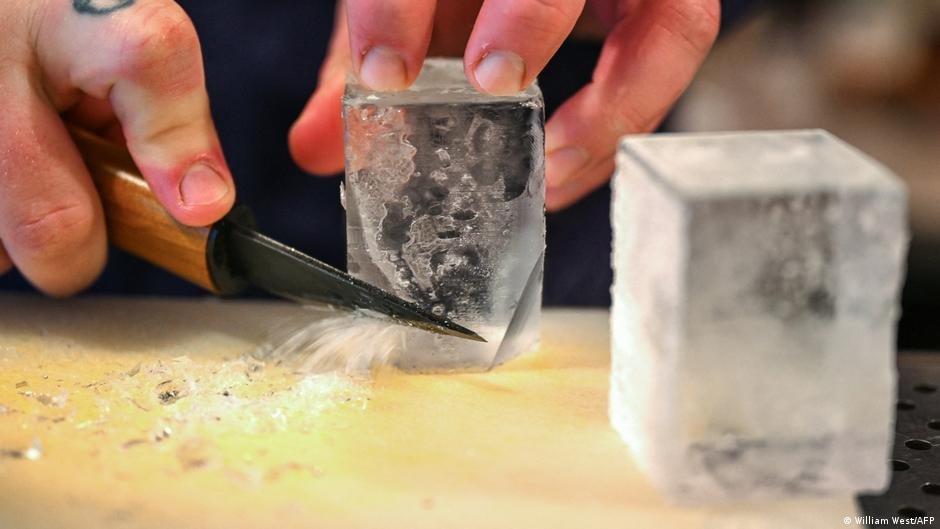
In the Japanese city of Kanazawa, crystal-clear ice is painstakingly crafted by hand. “Kuramoto Ice” produces ice blocks for high-end cocktails around the world. They are said to melt particularly slowly.
Image: William West/AFP
In Kanazawa, the historic capital of Ishikawa Prefecture on the Sea of Japan, massive blocks of ice are shaped and cut by hand. They are destined for Negronis and other cocktails in bars around the world. The crystal-clear ice is produced by “Kuramoto Ice,” a long-established local company.
Image: Yuichi Yamazaki/AFP
The high-quality ice is said to melt more slowly than conventional ice cubes and has long been an integral part of Japanese cocktail culture. Demand is also rising internationally: Bars from the US to Australia pay up to 200 yen ($1.25) per ice cube. Since it began exporting in 2019, “Kuramoto Ice” has more than doubled its revenue.
Image: Yuichi Yamazaki/AFP
“We take our time and freeze water slowly, keeping it in motion. That’s how we end up with good ice,” Kazuhiko Kuramoto, the company’s fifth-generation head, explains to the AFP news agency. “My heart leaps with joy when I see ice that looks like a jewel,” he says, gazing at a row of iced teas.
Image: Yuichi Yamazaki/AFP
Using a method that originated in the United States, Japanese ice specialists allow water to freeze slowly over a period of 48 to 72 hours. During this process, impurities migrate to the center of the forming block of ice, where they are removed and replaced with fresh water. Constant stirring also causes air bubbles to escape. The result is nearly perfectly clear ice, known in Japan as “Junpyo.”
Image: Yuichi Yamazaki/AFP
Although there is little scientific evidence to support this, the technique is said to produce colder, denser ice that cools cocktails rather than diluting them. The renowned “Native” bar in Singapore imports about 900 kilograms of ice from Kuramoto each year. “Local ice is more economical, but Kuramoto Ice is clearer, denser and melts more slowly,” co-owner Yong Wei told AFP.
Image: Yuichi Yamazaki/AFP
At the ice factory, workers haul large blocks of ice through the factory floor and carve them into spheres, cubes, and rectangular blocks. After packaging, the finished products are stored at minus 10 degrees before being shipped in sizes that fit various glasses. Company president Kuramoto is aware of the environmental costs of transportation, but he considers them manageable for small goods.
Image: Yuichi Yamazaki/AFP
“Ice really has a huge impact on the taste of a cocktail,” says bartender Shingo Miyachi. As it melts, it primarily affects the aftertaste. For Japanese bartenders, working with ice is an important skill. “A cocktail only really comes into being when the glass, the ice and the liquid become one as a single unified whole.”
Image: Yuichi Yamazaki/AFP7 images1 | 77 imageshttps://p.dw.com/p/5MN5Y