Lithuania is on NATO’s eastern flank, bordering Belarus and Russia’s Kaliningrad region. Since Russia launched its full-scale invasion of Ukraine in early 2022, security has become one of the country’s central political priorities.
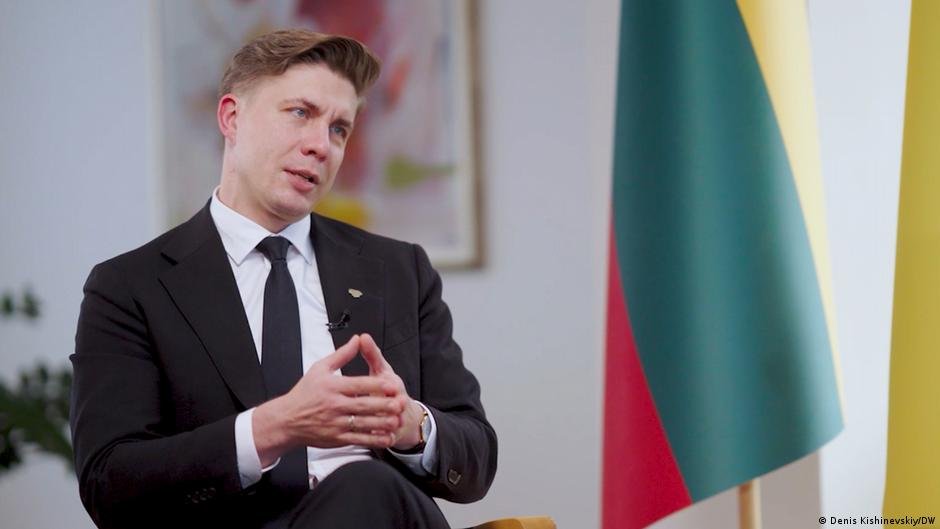
The 42-year-old Mindaugas Sinkevicius recently took over as prime minister and also leads Lithuania’s Social Democratic Party, a moderate center-left political force. In an exclusive interview with DW, he said he is concerned by the growing popularity of populist and far-right parties across Europe, particularly in Western Europe. But he also argued that the picture is more complicated, pointing to Social Democratic governments in several European countries and signs of renewed support for the center-left elsewhere.
For Lithuania, the war in Ukraine is closely connected to its own security. The country has experienced a series of incidents involving drones, instrumentalized migration and weather balloons entering its territory from Belarus. Sinkevicius said these developments have contributed to a broader sense of insecurity across Europe.
“As politicians, we have to tell society the truth,” he said, identifying air defense as Lithuania’s most urgent security priority.
“Lithuania’s airspace is NATO’s common airspace. Lithuanian skies are NATO skies,” he said. “If Lithuanian skies are safe, then NATO’s skies are largely protected as well.”
Drone incidents in Lithuania and beyond
Sinkevicius said Lithuania is seeking greater solidarity from its allies, pointing out that the threat goes beyond its national borders. A series of incidents involving drones have affected other European countries as well.
Sinkevicius stressed that NATO membership does not mean Lithuania can simply rely on its allies. Collective defense, he argued, works only when individual members are prepared to contribute.
To view this video please enable JavaScript, and consider upgrading to a web browser that supports HTML5 video
“Of course, there is Article 5. Of course, there is collective defense,” he said, referring to the NATO pact. “But at the same time, we need to do certain things ourselves, rather than relying solely on our partners, neighbors and alliances.”
For Lithuania, this means strengthening its own deterrence capabilities while continuing to work through NATO and regional partnerships. He also pointed to the Nordic-Baltic Eight, or NB8, as an important framework for cooperation between the countries of Northern Europe and the Baltic states.
National security climbs national agenda
Sinkevicius rejected the idea that European countries should choose between traditional military equipment and newer technologies such as drones.
“Sometimes we see these issues being pitted against each other: drones versus tanks,” he said. “I say we need both.”
But for the Lithuanian prime minister, military equipment only goes so far. “Neither drones nor tanks will protect us if society does not feel safe, if people do not feel a connection with the state,” he said.
To view this video please enable JavaScript, and consider upgrading to a web browser that supports HTML5 video
For Sinkevicius, that connection is linked to social policy as well as defense. He argued that a state must also support people who are unemployed, ill or otherwise vulnerable.
The argument reflects a broader challenge for Sinkevicius as leader of Lithuania’s Social Democratic Party. Traditionally, Social Democrats have focused more on social policy, education and healthcare than on defense. Russia’s war against Ukraine has changed the political environment, forcing center-left governments in Europe to place national security much higher on their agendas.
Sinkevicius said the challenge is to increase defense capabilities without abandoning the principles of social democracy.
‘We will continue to support Ukraine’
Sinkevicius recently traveled to Kyiv and Lutsk, some 400 kilometers (250 miles) west of the capital, where he met with Ukrainian political leaders. Lithuania has committed to allocating at least 0.25% of its GDP annually to support Ukraine. According to figures cited by the Ukrainian side, Lithuania’s support in recent years has amounted to around 0.3% of GDP.
The prime minister acknowledges that some degree of war fatigue exists in Europe. But he said European societies should consider the scale of what Ukrainians have experienced.
“I sometimes ask myself: if we Europeans feel tired, then what must Ukrainian society be feeling?” he said.
Sinkevicius also pointed to the key role of Western European countries, particularly Germany, in maintaining support for Ukraine.
“Support and assistance must continue,” he said. “Because if the Western front, figuratively speaking, weakens and falters, then on the eastern front — where Russia is fighting Ukraine — the risk of failure increases.”
Edited by: Jess Smee