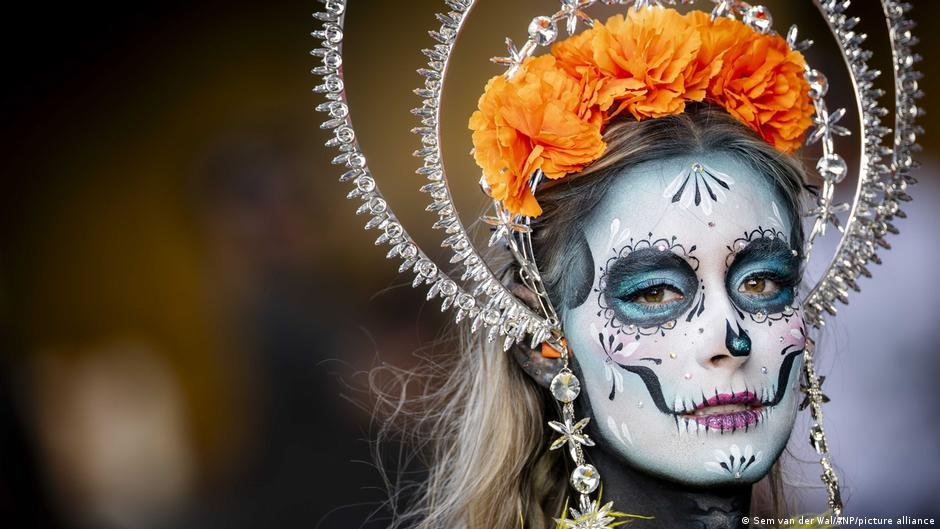
On Día de Muertos, or the Day of the Dead, Mexicans honor their deceased loved ones with decorated graves and colorful parades. The 2026 parade in Mexico City was watched by 1.6 million people.
Image: Sem van der Wal/ANP/picture alliance
Festively decorated floats and thousands of people in costume paraded through the center of Mexico City for Día de Muertos, or the Day of the Dead, accompanied by numerous musical groups. According to the Mexico City administration, about 1.6 million spectators watched the parade.
Image: Luis Cortes/AFP
A Catrina sculpture, standing over 30 meters (100 feet) tall, has been set up on Mexico City’s central Zócalo square. The elegantly dressed female skeleton figure, complete with a hat, represents equality in death —regardless of status or wealth. La Catrina was created in the early 20th century by the Mexican caricaturist José Guadalupe Posada and has since become a symbol of the Día de Muertos.
Image: Quetzalli Nicte-Ha/REUTERS
The street parade is a tourist attraction, yet it only came into existence 10 years ago. The procession was inspired by a scene from the 2015 James Bond film, “Spectre,” in which the British agent walks through such a procession in Mexico City — a parade that did not exist in reality at the time. In response, the then mayor, Miguel Ángel Mancera, organized the first parade in 2016.
Image: Javier Lira Otero/Clasos/ZUMA/picture alliance
The Day of the Dead is one of the most important Mexican holidays, traditionally taking place from October 31 to November 2. It combines Indigenous customs from the precolonial era with the Catholic observances of All Saints’ Day and All Souls’ Day. According to belief, the souls of the departed return to Earth for a brief period on the Day of the Dead to visit their relatives.
Image: Daniel Cardenas/Anadolu/picture alliance
Flowers play a central role in this, especially the marigold — known in Mexico as “cempasúchil” — which glows in vibrant shades of orange or warm yellow. The flower symbolizes the connection between the living and the dead: Its strong scent is said to guide the departed back to the world of the living.
Image: Ulises Ruiz/AFP
The roots of Día de Muertos reach back to the time of the Maya and Aztecs. In 2008, this Indigenous festive tradition was inscribed by UNESCO on the Representative List of the Intangible Cultural Heritage of Humanity.
Image: Yuri Cortez/AFP
In contrast to more somber demonstrations of mourning, the Day of the Dead in Mexico is a colorful, vibrant public celebration: Families decorate altars in their homes — and, as seen here, the graves of their loved ones in the cemetery — with garlands, photographs and offerings. Here, death is not viewed as an end, but rather as a natural part of the cycle of life.
Image: Antonio Ojeda/ZUMA/picture alliance
Over the past few decades, the Día de Muertos has spread well beyond the borders of Mexico; driven by migration, pop culture and global media, the celebration has evolved into an international cultural phenomenon. In many Latin American countries, similar festivals honoring the dead — with roots in Indigenous traditions — are observed around the same time.
Image: Juan Perez Puente/JNA Press/Sipa USA/picture alliance
The festival is firmly anchored in the culture of the United States because of the US’s large Mexican population and is often mixed with Halloween. Mexican influences and motifs such as Catrina costumes also play a central role in the NYC Village Halloween Parade, the largest Halloween parade in the world.
Image: M10s/TheNews2/IMAGO9 images1 | 99 imageshttps://p.dw.com/p/5OxlF