


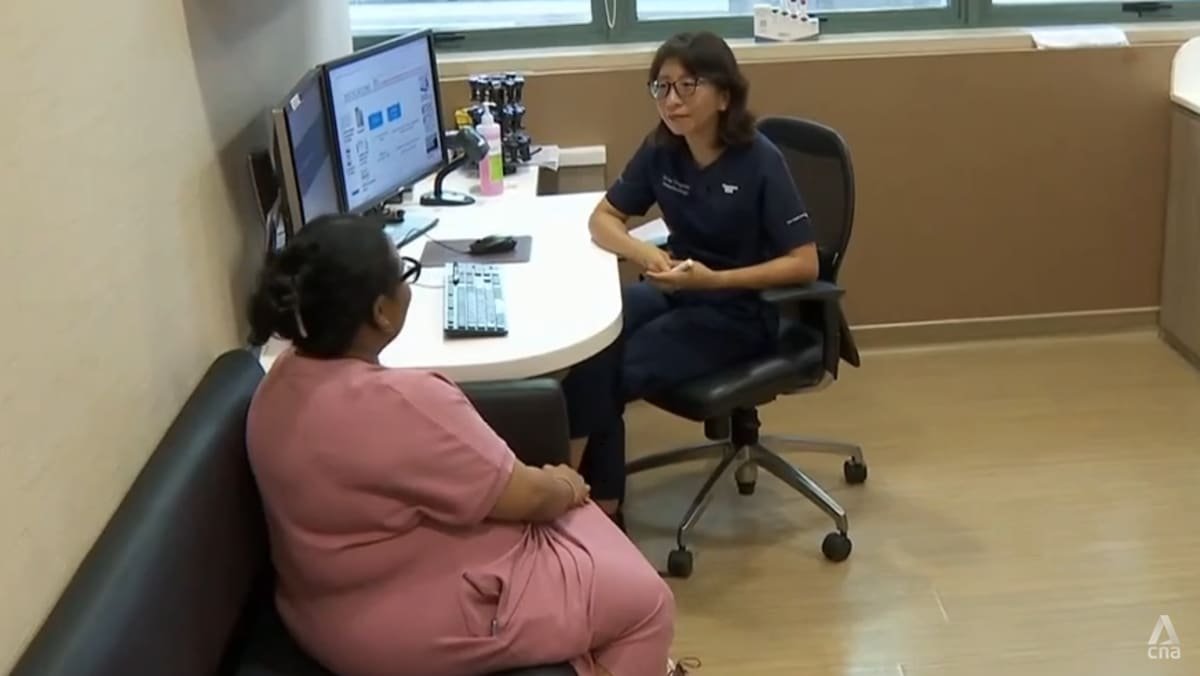
Obesity clinics see surge in patients amid greater awareness of condition
Healthcare providers say factors such as genetics, hormones and metabolism can make weight loss difficult despite efforts to adopt healthier lifestyles.
Dr Lee Yingshan, a senior consultant at Tan Tock Seng Hospital’s endocrinology department, speaks to a patient about weight management. (Image: CNA)
New: You can now listen to articles.

This audio is generated by an AI tool.
Read a summary of this article on FAST.
Get bite-sized news via a new
cards interface. Give it a try.
Click here to return to FAST
Tap here to return to FAST
FAST
SINGAPORE: More people are seeking professional help to manage obesity, with some healthcare providers reporting a surge in demand amid growing awareness that the condition involves more than just diet and exercise.
Tan Tock Seng Hospital (TTSH) has seen a 50 per cent increase in referrals to its obesity clinic over the past two years, prompting it to expand its services and double the number of doctors, nurses and pharmacists.
Healthcare providers say the growing demand reflects greater recognition of obesity as a complex medical condition influenced by a range of factors.
GROWING DEMAND FOR MEDICAL INTERVENTION
Among those seeking professional help is Ms Nurul Aini Mohammad Ali, who has long faced a frustrating struggle to shed the kilos by herself.

Guess Word
Crack the word, one row at a time

Buzzword
Create words using the given letters

Mini Sudoku
Tiny puzzle, mighty brain teaser

Mini Crossword
Small grid, big challenge

Word Search
Spot as many words as you can
Over the years, she tried various approaches including the Atkins diet and intermittent fasting, and physical activities such as brisk walking, stair climbing and weight training. But she saw little success.
“Like, I see (no change) or else I gain weight. There were cases when I actually gained even more weight (during my diets),” she told CNA.
Earlier this year, she was diagnosed with polycystic ovary syndrome (PCOS), a hormonal and metabolic condition often worsened by obesity. The condition can also make weight management more challenging.
She subsequently sought help at TTSH’s obesity clinic, where healthcare professionals helped her understand how underlying medical conditions can affect her ability to lose weight.
“The nurse explained about obesity as an illness rather than it’s my fault and that (made me feel like) I have hope,” Ms Nurul Aini said. “It does give me a little bit of healing … because there’s that personal blame even though I tried so hard (to lose weight).”
She was prescribed medication to support weight management, alongside a personalised nutrition and exercise plan.
After nearly two months of treatment, Ms Nurul Aini has begun noticing improvements. She said: “I do feel lighter and more mobile.”
Her experience is not uncommon. About seven in 10 patients at TTSH’s obesity clinic have tried losing weight through dieting and exercise before seeking medical help.
Dr Lee Yingshan, a senior consultant at TTSH’s endocrinology department, attributed the rise in patients seeking treatment to greater awareness as well as improved access to medications and specialised treatment services.
“Heightened awareness of obesity as an important health condition has really allowed people to be able to come forward to seek medical help,” she said.
MORE THAN JUST DIET & EXERCISE
Dr Lee said misconceptions about obesity often lead individuals to blame themselves for their condition.
“Most of our thinking about obesity is that it’s simply due to an individual’s choice that perhaps they’re consuming too much unhealthy calories and not moving enough,” she said.
But the condition is far more complex, said Dr Lee, who is also vice-president of the Singapore Association for the Study of Obesity.
Genetics, biological processes, hormonal changes and environmental factors can all influence weight gain and how individuals respond to attempts to lose weight. Modern lifestyles, including irregular mealtimes, late-night eating and stress, can further contribute to the problem.
“It’s beyond just an individual’s actions. Obesity is quite complex. There’s genetics and epigenetics involved. On top of that is human biology. And as we go through different stages of life, individuals may gain weight differently,” she said.

The growing demand for obesity treatment is also being felt in the private sector.
Trimly, a telehealth clinic specialising in medical weight management, has recorded a 30 per cent increase in patients since the start of the year, despite having opened only in late 2025.
Its co-founder and medical director Zac Yeo said medical intervention is important as everyone’s body responds differently – two people with similar approaches to weight loss could see vastly different results.
“They can be putting in the same effort, eating the exact same food, and one person is able to lose weight and (the other) is unable to lose weight,” Dr Yeo said.
“That’s where medical treatment comes in to assist people with those other factors that are limiting them to achieve the results.”
To meet growing demand, the clinic plans to increase office space and manpower by February next year.
TACKLING A GROWING HEALTH CONCERN
Obesity has become an increasingly pressing health concern in Singapore, with its prevalence rising from 10.5 per cent in 2019 to 2020 to 12.7 per cent in latest figures in 2024, according to the Health Ministry.
TTSH’s Dr Lee noted that 22.3 per cent of the population falls into a high-risk body mass index (BMI) category, meaning they are at greater risk of weight-related health problems.
Meanwhile, 43.6 per cent have abdominal obesity, defined as a waist circumference exceeding 90cm for men and 80cm for women. This is particularly relevant for Asian populations, who tend to accumulate more fat around the abdomen compared with Caucasians.
Beyond clinics, NHG Health also runs community programmes to help individuals manage their weight and prevent complications. These initiatives have also seen sign-ups double over the past two years.
Its Fitter Life programme targets overweight people who do not yet have chronic conditions, helping them adopt healthier lifestyle habits to reduce their risk of developing such diseases.
Meanwhile, its Lighter Life programme helps individuals with existing chronic conditions better manage their health and improve their overall well-being.
Dr Lee stressed that treating obesity is not simply about achieving a lower number on the weighing scale.
Excessive and unhealthy body fat can increase the risk of chronic conditions such as type 2 diabetes, high blood pressure, high cholesterol, metabolic liver disease and obstructive sleep apnoea.
“It’s not the weight that we’re treating. We are really hoping to improve the health through treating the obesity,” she said.


Source: CNA/dn(oc)
Sign up for our newsletters

Get the CNA app
Stay updated with notifications for breaking news and our best stories
Get WhatsApp alerts
Join our channel for the top reads for the day on your preferred chat app

Get bite-sized news via a new
cards interface. Give it a try.
Click here to return to FAST
Tap here to return to FAST
FAST







