Singapore-China FTA upgrade, financial cooperation key outcomes of bilateral talks: DPM Gan
The planned upgrade to the free trade agreement would facilitate trade between both countries, particularly in digital trade and cross-border data flows, says Deputy Prime Minister Gan Kim Yong.
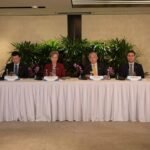
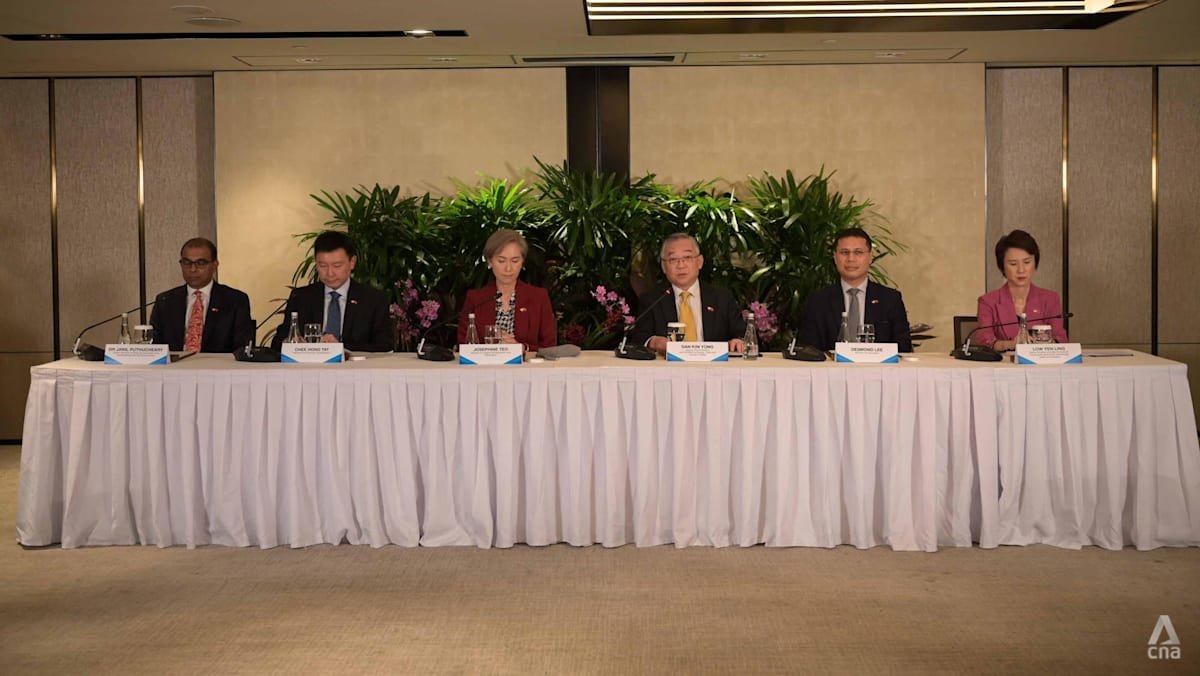
(From left) Senior Minister of State for Education and Sustainability and the Environment Janil Puthucheary, Minister for National Development Chee Hong Tat, Minister for Digital Development and Information Josephine Teo, Deputy Prime Minister Gan Kim Yong, Minister for Education Desmond Lee and Senior Minister of State for Culture, Community and Youth and Energy, Trade and Industry Low Yen Ling at a press conference on Nov 23, 2026. (Photo: CNA/Lim Li Ting)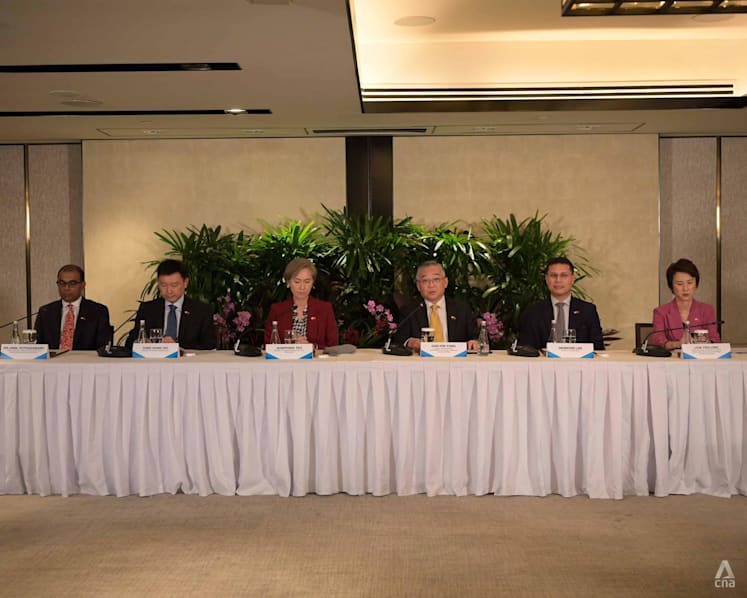
New: You can now listen to articles.

This audio is generated by an AI tool.

Read a summary of this article on FAST.
Get bite-sized news via a new
cards interface. Give it a try.
Click here to return to FAST
Tap here to return to FAST
FAST
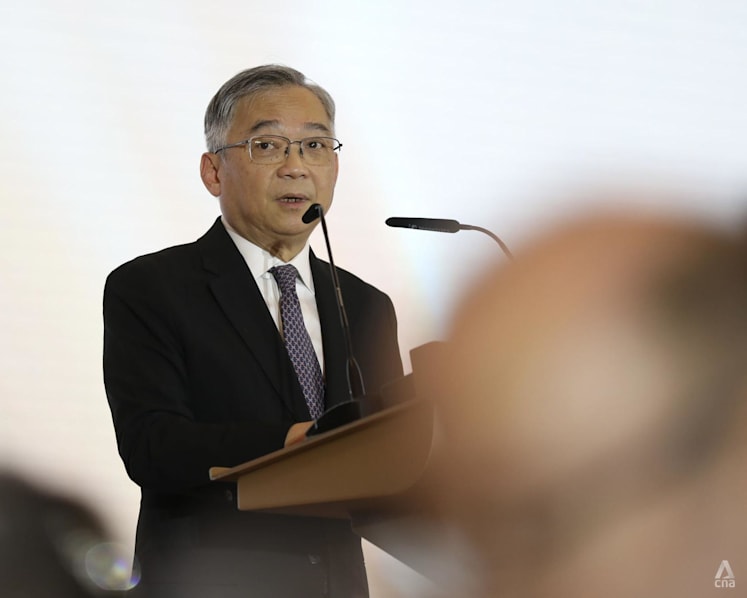
SINGAPORE: An upgrade to the China-Singapore Free Trade Agreement (CSFTA) and deeper financial connectivity are among the key outcomes of this year’s bilateral meetings that could bring significant benefits to Singaporeans, Deputy Prime Minister Gan Kim Yong said on Monday (Nov 23).
The planned upgrade to the free trade agreement, known as CSFTA 4.0, would facilitate trade between both countries, particularly in digital trade and cross-border data flows, he said.
Mr Gan spoke to the media following his bilateral meeting with Chinese Vice Premier Ding Xuexiang and the 22nd Joint Council for Bilateral Cooperation (JCBC), the apex bilateral platform convened annually to review cooperation between Singapore and China. Both leaders co-chaired the meeting.
At the JCBC, both countries announced 29 agreements spanning digital trade, innovation, sports and healthcare. Singapore also approved new imports of poultry, pork and eggs from China’s Hainan province.

Guess Word
Crack the word, one row at a time

Buzzword
Create words using the given letters

Mini Sudoku
Tiny puzzle, mighty brain teaser

Mini Crossword
Small grid, big challenge

Word Search
Spot as many words as you can
Asked which of the agreements held the most significance for Singapore, Mr Gan said all were important, but singled out the free trade agreement upgrade as a major undertaking that could take one to two years to complete.
Negotiations on the upgrade were launched during Prime Minister Lawrence Wong’s visit to China last week, when he met Chinese President Xi Jinping.
The planned collaboration between the two countries’ financial sectors and central banks would bring about “groundbreaking” financial connectivity, said Mr Gan.
As part of the agreements, the Monetary Authority of Singapore will introduce a new renminbi corporate facility to support a wider range of business financing needs, such as trade financing, working capital and capital expenditure.
The facility would allow businesses to tap renminbi funding over longer tenures.
Mr Gan said the wide-ranging agreements reflected the “multifaceted” nature of ties between Singapore and China, which extend beyond economic cooperation to people-to-people exchanges, cultural ties and sports partnerships.

Apart from the JCBC, three Joint Steering Council meetings were also held to review the progress of Singapore and China’s three flagship government-to-government projects – the Suzhou Industrial Park, Tianjin Eco-City and China-Singapore (Chongqing) Demonstration Initiative on Strategic Connectivity.
Five other political office holders joined Mr Gan at a media conference following the day’s bilateral discussions: Minister for National Development Chee Hong Tat, Minister for Digital Development and Information Josephine Teo, Minister for Education Desmond Lee and Senior Minister of State for Energy, Trade and Industry Low Yen Ling, and Senior Minister of State for Sustainability and the Environment Janil Puthucheary.
They outlined developments in the government-to-government projects and the areas of cooperation under their respective portfolios.
DEEPENING COOPERATION IN AI
Mr Gan said the CSFTA 4.0 upgrade will include a digital economy component, with both countries looking to explore cooperation in areas such as artificial intelligence (AI), its applications and governance.
Asked which areas of AI collaboration held the greatest potential, Mrs Teo highlighted robotics, industrial automation, smart manufacturing and healthcare.
She said AI-enabled robots could help with quality inspection, predictive maintenance, and other labour-intensive tasks that are challenging for Singapore companies.
“Such uses of AI could help to overcome our manpower constraints,” she said.
She added that small and medium enterprises in Singapore could benefit from adopting AI solutions that have been tested in China, to make better use of their limited resources.

Another area of potential cooperation is AI governance, including how AI systems are assessed and tested, as both countries place importance on the responsible deployment of technology.
Such things can “help to strengthen public trust in use of AI”, said Mrs Teo, adding that Singapore will be pursuing joint testing as well as technical exchanges with China.
Mrs Teo also pointed at AI’s potential to facilitate cross-border trade by reducing processing time on paperwork.
GOVERNMENT TO GOVERNMENT PROJECTS
Beyond the free trade agreement, Singapore and China are also refreshing their longstanding government-to-government projects.
One of them is the Suzhou Industrial Park, the first such project between both countries.
Looking ahead, Mr Lee said both countries will seek to expand cooperation in biomedical sciences, green development and the digital economy.
He added that embodied AI was an emerging sector where both countries saw good opportunities for deeper collaboration.
Separately, Mr Chee said Singapore and China were also exploring ways to expand cooperation under the Tianjin Eco-City project beyond sustainable urban development to areas such as economic development, research and development, housing and people-to-people exchanges.

SINGAPORE AS GATEWAY TO ASEAN
Ahead of Singapore assuming chairmanship of the Association of Southeast Asian Nations (ASEAN) in 2027, Mr Gan also highlighted opportunities for greater cooperation between ASEAN and China.
Mr Gan said the subject had come up during bilateral discussions with China, including how ASEAN and China could work together beyond bilateral partnerships.
Noting that next year will also be designated as the ASEAN-China Year of AI Cooperation, Mr Gan added that Chinese companies were interested in Singapore not just as a market, but also as a gateway to the wider Southeast Asian region.
Mr Chee added that more work was needed to strengthen economic integration within ASEAN, which would be a focus of Singapore’s chairmanship.
He also highlighted the importance of enhancing financial services linkages within ASEAN to encourage more companies to set up operations in Singapore before expanding into the wider region.
Singapore and China are also looking to strengthen connectivity between western China and Southeast Asia through the Chongqing Connectivity Initiative (CCI).
Mrs Teo said that the opening of China’s Pinglu Canal in September has shortened shipping routes by more than 500km.
The canal can facilitate greater cargo flows to the Beibu Gulf, while the CCI’s rail and logistics networks provide connections deeper into Western China.
Source: CNA/wt/ml
Sign up for our newsletters

Get the CNA app
Stay updated with notifications for breaking news and our best stories
Get WhatsApp alerts
Join our channel for the top reads for the day on your preferred chat app

Get bite-sized news via a new
cards interface. Give it a try.
Click here to return to FAST
Tap here to return to FAST
FAST