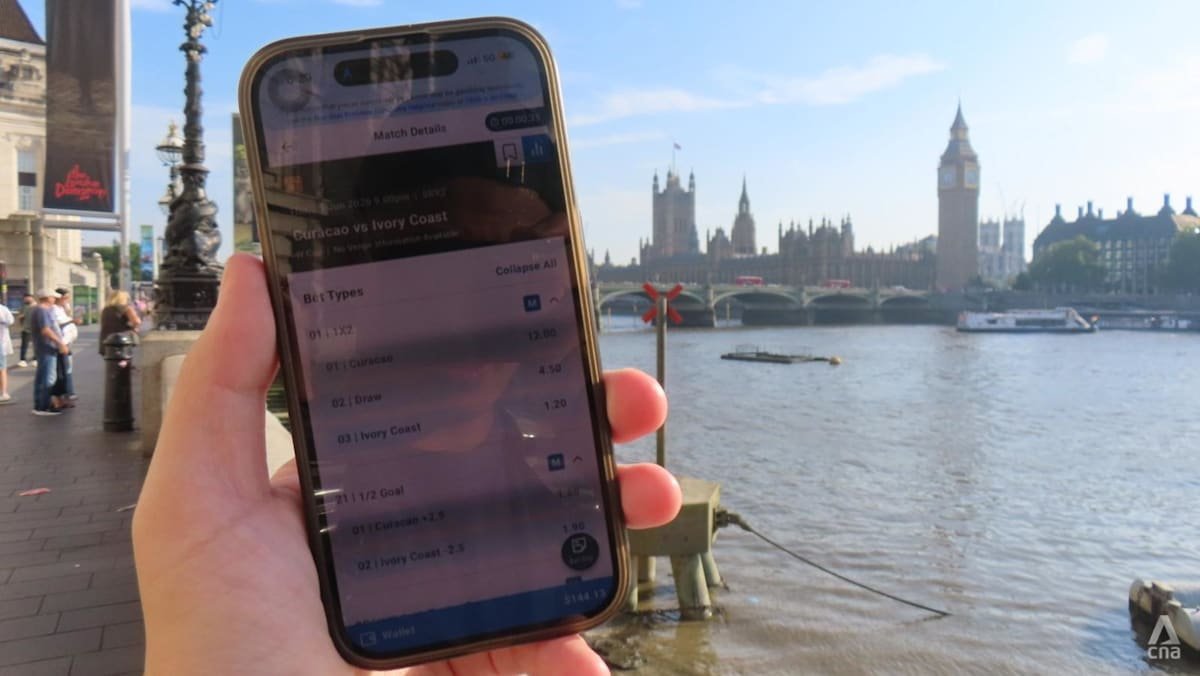
Singapore Pools app can be used to bet from overseas, despite rules against it
CNA tested the app in the UK and Italy and placed bets successfully; other users report similar workarounds from countries such as Thailand, Malaysia and China.
The Singapore Pools app being accessed on a smartphone in London. (Photo: CNA/Fabian Koh)
New: You can now listen to articles.

This audio is generated by an AI tool.

Read a summary of this article on FAST.
Get bite-sized news via a new
cards interface. Give it a try.
Click here to return to FAST
Tap here to return to FAST
FAST
SINGAPORE: The Singapore Pools app can be used to place bets from overseas, despite a requirement that betting stay within Singapore, CNA found.
CNA tested the app in the United Kingdom and Italy during the World Cup and placed bets successfully. Seven users also described to CNA similar experiences in countries such as Thailand, Malaysia, Indonesia, Japan and China dating back to 2020, using roaming data through various Singapore telcos.
While users can access the Singapore Pools app overseas, they are not allowed to place bets, said the Gambling Regulatory Authority of Singapore (GRA).
“GRA requires that Singapore Pools implement measures to ensure users can only place bets with Singapore Pools while they are in Singapore,” it said, adding that the requirement reflects the country’s regulatory framework governing remote gambling.

Guess Word
Crack the word, one row at a time

Buzzword
Create words using the given letters

Mini Sudoku
Tiny puzzle, mighty brain teaser

Mini Crossword
Small grid, big challenge

Word Search
Spot as many words as you can
“Any instance of potential non-compliance would be assessed based on the relevant facts and circumstances.”
The Remote Gambling Act was repealed and replaced by the Gambling Control Act in 2022, though the relevant provisions remain unchanged, the GRA noted.
Under Section 88 of the Act, non-compliant licensees can face a range of penalties, including a written warning, a licence suspension of up to six months, a fine of up to S$1 million, or having their licence revoked.
The loophole works when users connect through the roaming data of Singapore telcos – despite Singapore Pools stating on its website that “you will not be able to access our app from overseas”.
The restriction still holds over foreign Wi-Fi networks, where the app displays: “Login has been denied. Singapore Pools online betting service is only available in Singapore.”
Singapore Pools told CNA its online betting services are intended solely for local use and that geofencing measures restrict access from overseas IP addresses. Other safeguards include verifying that account holders are Singapore residents or valid Foreign Identification Number holders.
Betting from overseas breaches Singapore Pools’ terms and conditions, and accounts found doing so can be frozen, suspended, terminated or closed.
“As technologies evolve, we will continue to review and strengthen our safeguards to prevent improper use of our app,” said Singapore Pools.
It did not comment on the loophole itself.
Singapore Pools launched its app in 2018, two years after the country legalised online betting. It lets users place bets on lottery draws and sports competitions such as football, motor racing and horse racing.
HOW THE LOOPHOLE WORKS
Some forms of internet routing can make an overseas user appear to be connecting from Singapore, said Professor Chan Mun Choon of the National University of Singapore’s Department of Computer Science, who also directs the NUS-NCS Joint Laboratory for Cyber Security.
With mobile data roaming, telcos may route traffic so the user appears to be on a Singapore IP address while physically overseas, he said.
“As such, the app owner is generally better placed to implement additional safeguards,” he added, noting that telcos cannot always determine the true origin of internet traffic or which applications a user is accessing.
Such safeguards could include supplementing IP address checks with other forms of geolocation verification, including a device’s GPS location, to confirm whether a user is physically in Singapore, Prof Chan said.
As for whether users placing bets on the app could fall foul of the Gambling Control Act, legal experts said the law does cover users, such as through provisions preventing minors from gambling, but that these do not apply here.
Dr Ben Chester Cheong, law lecturer at the Singapore University of Social Sciences, said that since Singapore Pools is a licensed operator, provisions concerning gambling with an unlawful operator would not apply.

LEGAL GREY AREA
While the requirement to bar the placing of bets overseas stems from Singapore’s remote gambling protocols, legal experts flagged that the loophole could raise regulatory concerns in other countries where remote gambling is banned, such as China, Indonesia, Malaysia and Saudi Arabia.
Singapore Pools did not comment on queries about the regulatory concerns in other countries.
Even if users bypass the geofencing, the operator is unlikely to be liable, since it has shown efforts to secure this aspect of its service, they said.
Lawyer Luo Ling Ling said standard “governing law” and “user responsibility” clauses typically serve as a contractual shield to pass liability to the consumer.
“More importantly, from a criminal or regulatory standpoint in foreign jurisdictions, these T&Cs, combined with active measures like geofencing, help establish that Singapore Pools does not have the mens rea – or guilty intent – to actively target, market to, or operate within those restricted foreign markets,” she added.
Mr Pang Khin Wee, partner at IRB Law, said terms prohibiting overseas use “shouldn’t completely immunise an entity, as in some cases they can be just ‘lip service’”, Singapore Pools’ measures should be judged in their entirety, including account controls and geofencing.
Dr Cheong said operators like Singapore Pools are generally not obliged to report proactively to every foreign regulator.
But if investigated, it would likely need to produce evidence of steps taken, such as overseas login restrictions, IP blocking, monitoring for circumvention and enforcement against breaching accounts, he said.
“The key issue would be whether those measures were genuine and reasonably effective, rather than whether circumvention was technically impossible,” he added.

Source: CNA/fb(cy)
Sign up for our newsletters

Get the CNA app
Stay updated with notifications for breaking news and our best stories
Get WhatsApp alerts
Join our channel for the top reads for the day on your preferred chat app

Get bite-sized news via a new
cards interface. Give it a try.
Click here to return to FAST
Tap here to return to FAST
FAST