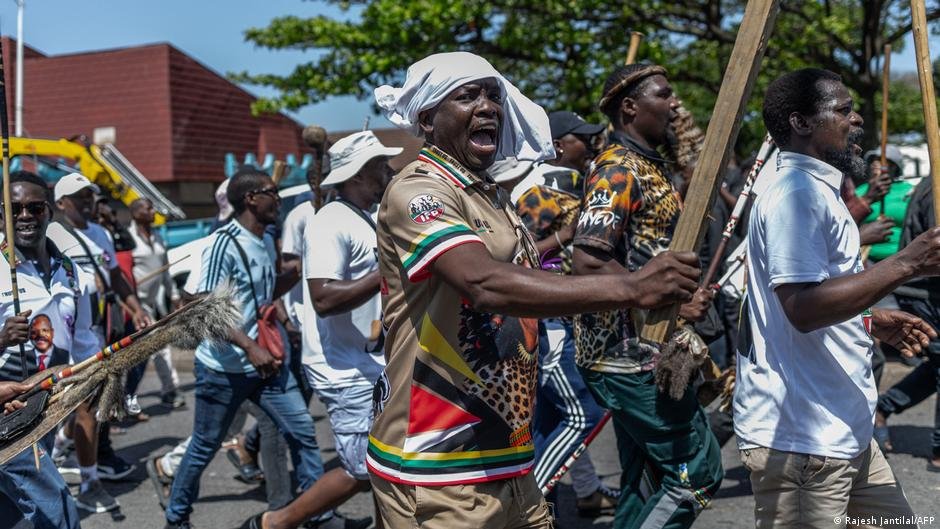
Anti-migrant protests erupted in South Africa on Thursday as tensions over immigration were reignited by a court order requiring the government to resume processing asylum applications.
Some of the protests turned violent, according to local media reports. This included incidents in the coastal city of Durban and the Soweto township of Johannesburg, where cars were set on fire and gunshots were heard.
What do we know about protests in South Africa?
The unrest in Durban reportedly followed a protest by a group demanding that a refugee center stop processing asylum applications. About 10 vehicles were overturned and set on fire. Foreign-owned shops were also looted.
Meanwhile, in Soweto, residents clashed with foreign shop owners, and gunshots were heard, according to the broadcaster Newzroom Afrika.
At least nine vehicles were torched, said Johannesburg Metropolitan Police Department spokesman Superintendent Xolani Fihla in an interview with SABC television.
“It’s reported that there were clashes between foreign nationals in the area and South African nationals,” he said. “At the present moment, I can confirm that no injuries have been reported.”
What has the court decided?
The court ruling that sparked the flare-up of xenophobic tensions deemed certain provisions of the government’s refugee policy to be unconstitutional.
The court explained that this was because the provisions prevented individuals from accessing the asylum system on procedural grounds, such as entering the country illegally.
Recently, this ruling has led hundreds of people, reportedly including those who do not qualify for asylum, to flock to government refugee centers.
On Wednesday, the government emphasized that the judgement “does not grant refugee status or permanent residence automatically to anyone who enters South Africa”.
To view this video please enable JavaScript, and consider upgrading to a web browser that supports HTML5 video
Xenophobic sentiment in South Africa
South Africa has experienced months of anti-immigrant protests this year. Populist and anti-immigrant groups have demanded that undocumented foreign nationals leave by June 30.
Amidst international criticism, tens of thousands of people have fled the country, while some were repatriated by their governments.
Although South Africa has a third of its population unemployed, it remains the largest economy in Africa and continues to attract migrants.
Migrants are often blamed for taking jobs, fueling crime, and straining public services. However, social scientists have said these accusations are not supported by evidence.
Edited by: Sean Sinico
Don’t let the algorithm hide the news. If you rely on our team for trusted reporting, please take a moment to select us as your Preferred Source on Google by clicking here and hitting the “star” or “preferred” button, so you’ll always see our verified news first.