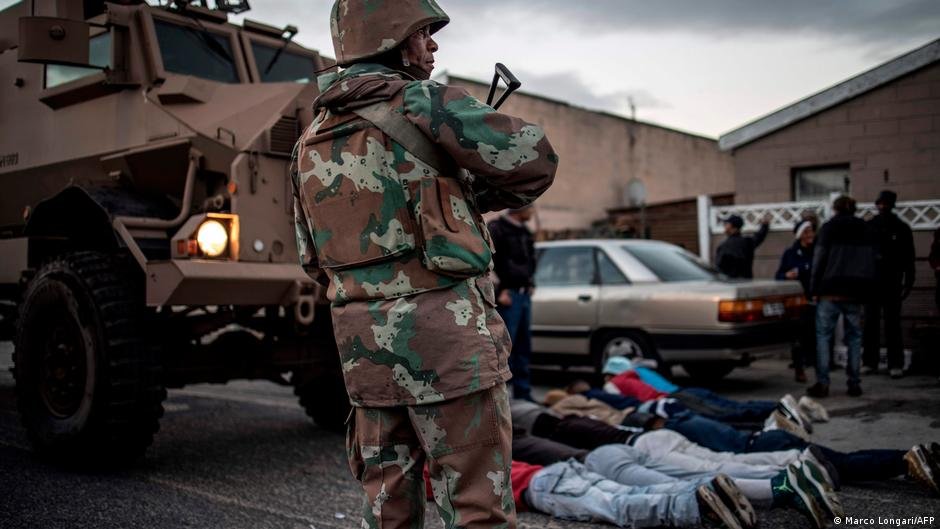
Last week, a violent scene took place in Dunoon, on the outskirts of Cape Town: Armed robbers entered a small township shop and ransacked every single shelf, while the owners hid for cover behind the counter.
Before leaving, one of the attackers leaned over the counter and shot the shopkeepers dead at point-blank.
Elsewhere in the country, similar events have also been making headlines of late: Last weekend, gunmen opened fire at a tavern in Wedela, southwest of Johannesburg, killing 18 people.
The same night, gunmen opened fire at an entertainment venue in Lwandle outside Cape Town, killing 10.
Both attacks followed another mass shooting near Durban earlier in September, which claimed 11 victims.
As these tallies keep adding up, locals wonder whether this is the start of a new wave of violence in South Africa, and how it can be stopped.
To view this video please enable JavaScript, and consider upgrading to a web browser that supports HTML5 video
A culture of fear
Lizette Lancaster, head of the Justice and Violence Prevention program at the Institute for Security Studies in South Africa, told DW that locals now “feel insecure about living in this country” — understandably so.
Lancaster explains that in many impoverished urban areas, residents hear gunshots on an ongoing basis, especially on weekends, adding that this fear is particularly pronounced in areas where gang violence is entrenched.
However, murder rates are actually declining in South Africa by 5.9%, according to the latest official crime statistics. But still, each day roughly 60 South Africans continue to be killed.
Retaliation for xenophobic attacks
Thapelo Tselapedi, a political expert at Rhodes University, told DW that the shootings might be intrinsically linked to South Africa’s ongoing battle with xenophobia, and that this phenomenon needs to be understood in order to look at the current situation:
Foreign nationals, in particular migrants from other African countries, have repeatedly been blamed for South Africa’s problems, including unemployment, crime and growing pressure on public services.
According to media reports, at least 350 foreign nationals have been killed in the last 20 years as a result of xenophobic violence; just this year alone, 11 foreigners are known to have died in deliberate attacks.
According to Tselapedi, the recent attacks are therefore strongly suspected to be the “result of undocumented foreign nationals retaliating against groups who have been complaining about the presence of undocumented immigrants.”
However, the motive of retaliation for xenophobic attacks might only play a small part in the bigger picture of the current crime crisis.
To view this video please enable JavaScript, and consider upgrading to a web browser that supports HTML5 video
South Africa’s battle against GBV
The role of gender-based violence (GBV) can hardly be ignored in the context of these current developments: In the first quarter of 2026 alone, police registered 50,511 cases related to GBV and femicide.
South Africa’s femicide rate is estimated to stand at nine per 100,000 women — around five times the global average.
Instances of rape meanwhile have fallen by nearly 6% in the first quarter of 2026 compared to last year, though this might not be a reflection of fewer sexual assaults taking place, but rather fewer cases being reported.
The issue of violence against women has taken center stage again as in recent weeks, the bodies of twelve women were found in Gauteng Province since mid-July, stoking rumors about a serial killer.
Police continue to arrest suspects, though there is little faith in their work among many South Africans.
No more trust in the police
Lancaster believes that “trust in law enforcement and in the police” has declined sharply over the years, despite South Africa boasting one of the biggest police forces per capita in the world.
The Human Sciences Research Council puts public trust in the police at only around 22%.
Lancaster explains that much of the mistrust is linked to reports of law enforcement being infiltrated by criminal networks, as widespread corruption appears to have undermined the police for more than a decade.
In some cases, she adds, people within law enforcement have been accused of “doing the bidding of these gangs.”
Lancaster highlights that this weakening of the criminal justice system has, in turn, allowed organized crime to become even more entrenched in the communities, which already were affected by poverty and unemployment.
In recent years, the problem has even taken on global dimensions, said Lancaster: “Especially since COVID, we see connections not just with different gangs operating here but also connections with other syndicates across the world” with these rings operating in drug trafficking, arms smuggling and illegal mining.
A culture of violence
The roots of violence in South Africa, however, run deep and largely predate the country’s current ills.
To play this audio please enable JavaScript, and consider upgrading to a web browser that supports HTML5 audio
“Almost all the conditions that lead to violence in society have been present in South Africa through colonialism and apartheid,” Lancaster told DW.
Under the segregation policies of apartheid, families of color were forcibly removed from their homes and relocated to underdeveloped and often remote areas.
Over the years, these districts became heavily affected by gang violence, she explains, while offering young men “a sense of belonging, purpose and employment,” as many struggled to put bread on the table.
The issue of unemployment has, if anything, become even worse for youths in recent times:
According to Statistics South Africa, nearly 50% of all South Africans under the age of 34 are unemployed, spreading resentment and discontent among an entire generation.
‘Everyone must take accountability’
However, unemployment or poverty alone do not explain the country’s deep relationship with violence: research points to a combination of factors converging, including historical patterns of violence, ongoing inequality, high corruption, organized crime, availability of firearms, weak policing and limited economic opportunities.
Every last South African must take personal responsibility for their share in perpetuating this complex interaction, says Lancaster:
“We need to work together to report any corruption, any illicit activities. This also means not accepting stolen goods, not buying illicit gold or things that are gained from supporting criminal actors in our communities. South Africans need to understand that violence starts in our households.”
However, she also stresses that this accountability also needs to extend to the top tiers of politics:
As South Africa prepares to hold municipal elections in five weeks’ time, which are widely seen as a test of the country’s overall direction, Lancaster highlights that “(w)e also need to hold our government to account.”
To view this video please enable JavaScript, and consider upgrading to a web browser that supports HTML5 video
Edited by: Sertan Sanderson