South Korea minister pushes longer R&D hours to keep pace with China
“If we cannot apply an exception to the 52-hour workweek even for semiconductor R&D, what are we going to be able to do in other industries such as robotics and biotechnology?” Industry Minister Kim Jung-kwan says.
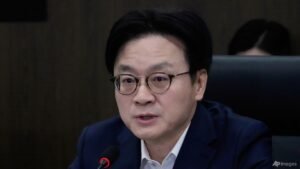
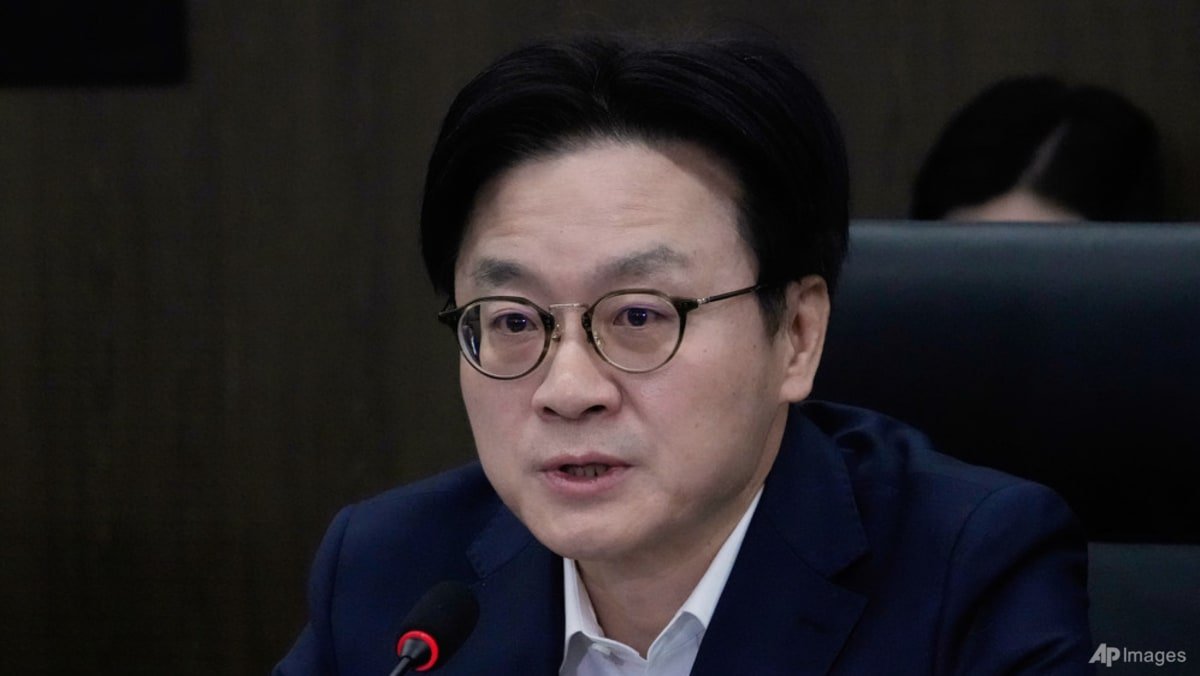
South Korean Trade Minister Kim Jung-kwan speaks at the headquarters of the Korea Chamber of Commerce and Industry in Seoul, South Korea, on Feb 23, 2026. (Photo: AP/Ahn Young-joon)
New: You can now listen to articles.

This audio is generated by an AI tool.
Read a summary of this article on FAST.
Get bite-sized news via a new
cards interface. Give it a try.
Click here to return to FAST
Tap here to return to FAST
FAST
SINGAPORE: South Korea should exempt semiconductor researchers from its 52-hour weekly working limit to prevent the industry from falling behind China, local media reported Industry Minister Kim Jung-kwan as saying on Wednesday (Nov 25).
Seoul Economic Daily reported Kim at a media briefing in Sejong, where he recalled how he was told during his recent visit to Shenzhen for the Asia-Pacific Economic Cooperation (APEC) summit that research and development (R&D) projects that take a year in South Korea can be done in three months in China.
The minister said that unlike their South Korean counterparts, China’s R&D staff face no restrictions on working hours while working within a more efficient organisational culture.
South Korea currently has a 52-hour workweek.

Guess Word
Crack the word, one row at a time

Buzzword
Create words using the given letters

Mini Sudoku
Tiny puzzle, mighty brain teaser

Mini Crossword
Small grid, big challenge

Word Search
Spot as many words as you can
Kim argued that restrictions on research hours could affect South Korea’s ability to develop new technologies in advanced industries, including artificial intelligence, robotics and biotechnology.
“When you travel around China, the government, companies and academia really are moving as one,” Kim was quoted as saying.
“If we cannot apply an exception to the 52-hour workweek even for semiconductor R&D, what are we going to be able to do in other industries such as robotics and biotechnology?”
Kim said the government has held talks with businesses over whether to include an exception to the 52-hour workweek for semiconductor R&D in legislation.
Among the items being discussed is a proposed exemption for researchers earning around 100 million won (US$68,000) a year, rather than low-wage employees.
However, differences of opinion persist in discussions with the Ministry of Employment and Labor, the government body with primary jurisdiction over this issue, Yonhap reported.
“I fully understand the position of the Minister of Employment and Labor – that ensuring a certain total volume of working hours should suffice,” Kim was quoted as saying in Korean.
“The Ministry of Trade, Industry and Resource, however, maintains that for the R&D sector, we should allow for flexible working arrangements so that research can be conducted precisely when it is needed. We are working toward finding common ground, but the two sides remain at odds.”
Kim said existing protections for workers’ health would remain in place and that the proposed changes would not result in pay cuts, according to a separate report by Newsis.
He also opposed relying on the existing system for special overtime approvals, arguing that requiring semiconductor companies to disclose details of sensitive projects to obtain government permission would impose an additional burden on them.
Beyond semiconductors, Kim also called for greater support for South Korea’s automotive industry, warning that Chinese electric vehicle manufacturers were advancing rapidly.
He said Chinese companies did not face the same costs of shifting from conventional vehicles to electric vehicles as manufacturers in South Korea, Japan and Germany.
The minister also backed a proposed tax credit for domestic electric vehicle production, saying it was being designed to benefit suppliers and other partner companies rather than just large manufacturers.
He added that the government would monitor changes in the US trade environment following the midterm elections and assess their possible implications for South Korea.
Source: CNA/ec
Sign up for our newsletters

Get the CNA app
Stay updated with notifications for breaking news and our best stories
Get WhatsApp alerts
Join our channel for the top reads for the day on your preferred chat app

Get bite-sized news via a new
cards interface. Give it a try.
Click here to return to FAST
Tap here to return to FAST
FAST