https://p.dw.com/p/5Q2liPrefer DW on Google
Skip next section What you need to know
What you need to know
- Spaniards came out in numbers to vote in snap election on Sunday
- Opinion polls point to change in government
- Prime Minister Pedro Sanchez could lose power after 8 years
- Alberto Nunez Feijoo’s People’s Party (PP) leads polls
- PP would likely need support from far-right Vox party to form government
Follow along for the latest news regarding Spain’s snap election on November 29, 2026:
Skip next section Voter turnout reaches historic 68% prior to polls closing11/29/2026November 29, 2026
Voter turnout reaches historic 68% prior to polls closing
Jenipher Camino Gonzalez
According to preliminary Interior Ministry data, turnout in Spain’s Sunday parliamentary election was the highest in 40 years.
Turnout reached 68.1% by 6 p.m. (17:00 UTC/GMT) on Sunday, up from 53.1% recorded at the same time in the last parliamentary election in July 2023.
The final turnout rate in that election was 66.6%, where conservative Partido Popular won the most votes but failed to secure enough parliamentary support to form a government.
Edited by:Rana Tahahttps://p.dw.com/p/5Q3hDSkip next section Divide among voters ‘hard to miss,’ DW correspondent says11/29/2026November 29, 2026
Divide among voters ‘hard to miss,’ DW correspondent says
Nicole Ris Madrid
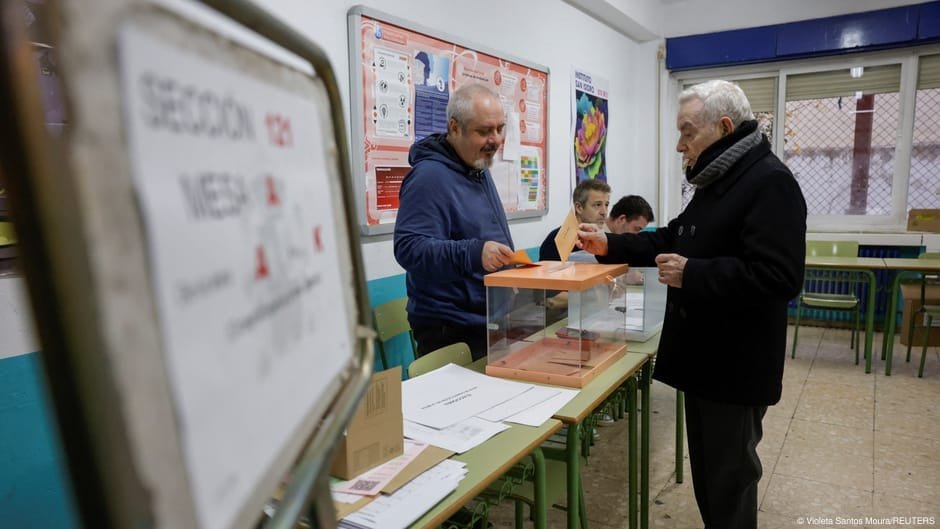
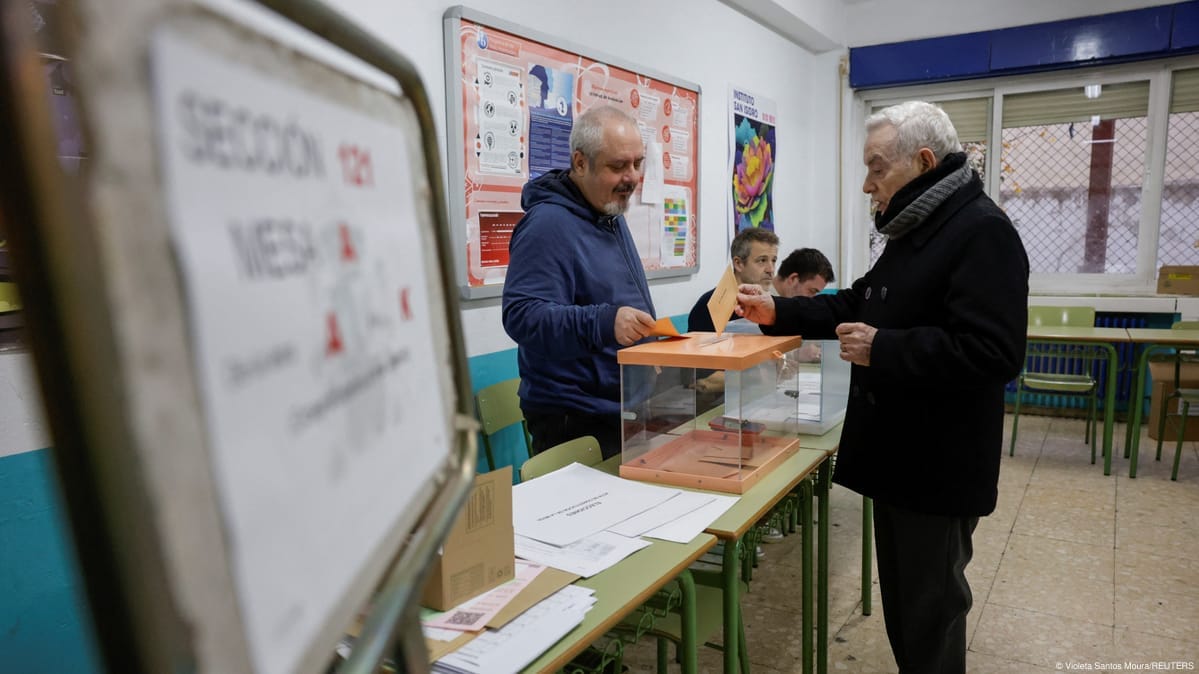
There is a steady stream of people coming in to cast their ballots at this polling station in Madrid’s Chamberí district.
Voters also include those who have obtained Spanish citizenship. Many are arriving with family members, saying they plan to go about their Sunday as usual until the polls close.
But the clear divide among voters is hard to miss.
“The people who deserve to win the most will win. In my personal opinion, that won’t be Pedro Sanchez. I don’t like the way he governs,” one woman tells DW when asked who should form a government in Spain.
Another voter takes the completely opposite view.
“I want the current government to continue because I don’t want us to go backward on rights or resources. And I don’t want a fascist country.”
Edited by:Rana Tahahttps://p.dw.com/p/5Q3NWSkip next section Voters queue outside polling stations in Andalusia11/29/2026November 29, 2026
Voters queue outside polling stations in Andalusia
Jan-Philipp Scholz Seville
In Andalusia, queues have been forming outside some polling stations as citizens cast their ballots.
With nearly 9 million inhabitants and 60 seats in the Spanish Congress, the southern Spanish region holds particular importance in the election.
It was traditionally a stronghold for the Spanish Socialist Workers’ Party (PSOE,) but in recent years, the Conservatives and the far-right party VOX have made significant gains there.
Regional President Juan Manuel Moreno, of the conservative People’s Party (PP), urged Andalusians to cast their votes, reminding them of their “special responsibility.”
Edited by:Rana Tahahttps://p.dw.com/p/5Q3FISkip next section Voter turnout reaches 45.7% — Interior Ministry11/29/2026November 29, 2026
Voter turnout reaches 45.7% — Interior Ministry
Jan-Philipp Scholz Seville
Voter turnout in the Sunday election has already reached 45.7% by 2:00 p.m. (1300 GMT), according to Interior Ministry figures.
That is 5 percentage points higher than in the previous election in 2023.
Edited by:Rana Tahahttps://p.dw.com/p/5Q3EhSkip next section IN PICTURES: Spaniards vote in snap electionPublished 11/29/2026Published November 29, 2026last updated 11/29/2026last updated November 29, 2026
IN PICTURES: Spaniards vote in snap election
Edited by:Kieran Burkehttps://p.dw.com/p/5Q36VSkip next section Far-right leader Abascal votes in Madrid11/29/2026November 29, 2026
Far-right leader Abascal votes in Madrid
The leader of the far-right Vox party, Santiago Abascal, has now also voted, meaning the leaders of the four main contestants in the election have now all cast their votes.
Abascal called on voters to turn out in “massive numbers so that they don’t have any regrets tomorrow.”
Vox is hoping to beat the 33 seats it won in the last election, a result that put them shy of preventing another term for Sanchez.
Polls have forecast a better result this time around, putting the far-right party in line with other such parties across the continent. Although with less than 20% support in pre-election polls, they remain below the likes of Alternative for Germany, who have closer to 30%.
A coalition with the center-right Partido Popular would bring the far-right to power for the first time since the end of Spain’s fascist dictatorship.
Edited by:Kieran Burkehttps://p.dw.com/p/5Q331Skip next section IN DEPTH: How a Spanish swing to the right could affect Europe11/29/2026November 29, 2026
IN DEPTH: How a Spanish swing to the right could affect Europe
Tessa Clara Walther
A loss for Pedro Sanchez and a shift to the right in Madrid could affect how one of the EU’s largest countries approaches migration, defense and the war in Gaza, writes DW’s Tessa Clara Walther.
Read the full report on what a right-wing victory in Spain could mean for Europe.
Edited by:Kieran Burkehttps://p.dw.com/p/5Q2oMSkip next section Leftist leader Colau votes in Barcelona11/29/2026November 29, 2026
Leftist leader Colau votes in Barcelona
Ada Colau, the leader of the left-wing Broad Front and former mayor of Barcelona, has cast her vote in the Catalan city.
“Today we have to vote for the social working majority,” she said, according to Catalan public TV 3Cat.
She also said that “women will have the final word in these elections.”
The Broad Front is the main party that would likely back Sanchez’s PSOE to stay in power, alongside several smaller regional parties. However, according to the polls, the Broad Front isn’t forecast to get enough votes to hold up another Sanchez government.
Edited by:Kieran Burkehttps://p.dw.com/p/5Q32pSkip next section Opposition leader Feijoo casts vote11/29/2026November 29, 2026
Opposition leader Feijoo casts vote
Alberto Nunez Feijoo, the leader of the center-right Partido Popular and possible new prime minister, has also voted in Madrid.
Feijoo urged voters not to cast their ballots “with fear,” in reference to the accusations that Sanchez had campaigned on fears of the far right coming to power for the first time since the death of ultranationalist dictator Francisco Franco in 1975.
He also said Sunday’s election would “decide the future of Spain for the next decade.”
The center-right leader also confirmed that he would accept the result of the vote
Edited by:Kieran Burkehttps://p.dw.com/p/5Q30fSkip next section Sanchez votes in Madrid11/29/2026November 29, 2026
Sanchez votes in Madrid
The Spanish prime minister has cast his vote in the capital Madrid.
Speaking to the press, he said: “Today is the day when Spain will decide what future it wants for the next four years,” adding that in democracy “there are many powers” but the biggest is voting.
Urging as many people to come out to vote as possible, Sanchez said that a higher turnout would mean a greater reflection of the public sentiment in the next parliament.
“I see a historic mobilization and I have a good feeling,” he said, expressing optimism that polling may be proven wrong.
Sanchez wife Begona Gomez did not accompany the prime minister, amid her own corruption scandal, instead voting by post.
Edited by:Kieran Burkehttps://p.dw.com/p/5Q2yhSkip next section How does the Spanish electoral system work?11/29/2026November 29, 2026
How does the Spanish electoral system work?
The Spanish electorate are voting for both the Congress of Deputies and the Senate, with the former being the more important chamber.
Congressional seats are awarded based on the D’Hondt system, which is somewhat complicated.
Votes are cast across 52 constituencies which coincide with the 50 Spanish provinces plus the autonomous cities of Ceuta and Melilla in North Africa.
Each constituency sends a minimum of two deputees to the congress, although Melilla and Ceuta send one each. However, this doesn’t bring us to the total 350 seats in congress.
The remaining seats are spread across the constituencies based on population, meaning Madrid sends 38 deputees and Barcelona sends 32. For this election, Madrid gained an extra seat at the expense of Cadiz.
Voters vote for a party list rather than specific candidates. The D’Hondt system shares out seats by first giving one seat to the party with the most votes. That party’s votes are then divided by two and whichever party now has the most votes gets a seat and in turn that party’s vote is divided by two, or however many seats it has already won, plus one. This process continues until all of a constituency’s seats have been awarded.
While this process is largely representative, because of the minimum two seats per constituency, the number of votes needed per province can vary. For example, in some of the smallest constituencies, each seat needs an average of around 30,000 votes, whereas in Madrid, this is closer to 130,000.
Once all the votes have been counted, it is up to the largest parties to try to put together a government, with their leader becoming prime minister. In the last election, Sanchez’s center-left PSOE was able to form a government despite the center-right PP winning more seats because the latter was unable to put together a coalition with a majority of 176 seats or more.
To view this video please enable JavaScript, and consider upgrading to a web browser that supports HTML5 video
Edited by:Kieran Burkehttps://p.dw.com/p/5Q2xsSkip next section Polls open in Spain’s snap election11/29/2026November 29, 2026
Polls open in Spain’s snap election
It is 9 a.m. (0800 GMT) in Spain, meaning polls have opened and voters can begin casting their votes to decide on whether Pedro Sanchez will extend his eight years in power, or whether a coalition of right and far-right parties takes control.
Polls will remain open until 8 p.m., with almost 36 million people eligible to vote across almost 22,500 polling stations.
The first results will start coming in shortly after and it is expected that we will have a good idea of the outcome before midnight.
Edited by:Kieran Burkehttps://p.dw.com/p/5Q2tjSkip next section Spain elections: What are the main issues?11/29/2026November 29, 2026
Spain elections: What are the main issues?
Spain’s election matters because it could bring an end to Pedro Sanchez’s leftist leadership at a time when right-wing populist parties have gained traction in Europe.
The elections are also the first in a round of elections across the continent through next year, including in Poland and France.
Here’s what’s on voters’ minds ahead of the election.
Housing
There’s perhaps no other issue that has concerned Spaniards more than unaffordable housing.
Economic growth and an expanding labor market have driven a boom in demand for additional housing in metropolitan areas and tourist regions.
But new construction remains stuck near levels seen in previous decades and wages haven’t kept up.
Rental and home costs have soared, and voters said it’s their top concern for over a year, according to the state pollster CIS.
Sanchez aimed to capitalize on the frustration when he called early elections last month, hoping to frame the race around affordability issues.
Both Sanchez and his main opponent, conservative Popular Party leader Alberto Nunez Feijoo, have promised to enact measures to help first-time homebuyers if elected, and improve conditions for renters.
Immigration
Sanchez’s immigration-friendly policies have made the 54-year-old leader an outlier in Europe amid a rise in far-right populism and anti-immigration sentiment.
Spain has taken in millions of people from Latin America and Africa, and Sanchez has defended his government’s stance by citing the country’s economic boom having been spurred by those who have legally entered the workforce.
Feijoo and Santiago Abascal, the leader of the far-right Vox party that would likely join the PP in a coalition government, have advocated for tougher immigration policies.
Feijoo has promised stronger border management, while Abascal favors a much stricter approach, with Vox having advocated for mass deportations.
To view this video please enable JavaScript, and consider upgrading to a web browser that supports HTML5 video
Corruption
Sanchez’s latest term has been overshadowed by numerous corruption investigations involving people in his inner circle and family.
Those legal cases have implicated a former minister and top officials as well as Sanchez’s brother and wife — who denies wrongdoing.
Sanchez has linked the cases against his family to a smear campaign but has apologized for proven corruption cases involving his former cohorts.
Voters list corruption and bad behavior by politicians as a concern, but they factor lower than affordability issues, working conditions and immigration, according to the CIS survey.
To view this video please enable JavaScript, and consider upgrading to a web browser that supports HTML5 video
Train safety
Two fatal train accidents this year on Spain’s extensive high-speed rail network have put safety issues at the center of the election.
Sanchez, whose transport minister resigned after the second crash, has stressed to voters that the right-wing government would cut social spending, which is necessary to maintain public services and the rail network.
Feijoo has excoriated Sanchez’s record, vowing to “return quality to public services.”
Spain’s vast train network has been a source of pride for Spaniards, but accidents this year have raised greater questions about Spain’s aging infrastructure.
Climate
Spain is highly exposed to natural disasters that are affected by climate change, including ferocious forest fires, long-term drought, and sometimes deadly flash floods.
The country is also a leader in renewable energy, generating more than half its electricity from non-carbon sources, mainly from solar and wind.
Under Sanchez, Spain’s government has pledged to generate all its energy from renewable sources by 2050 and to shut down the country’s remaining nuclear reactors by 2035.
Feijoo said he would “realistically reformulate” Spain’s climate commitments, while keeping nuclear power in the mix with renewables, energy storage and sufficient backup capacity.
Vox, like other far-right parties, has pushed climate skepticism.
To view this video please enable JavaScript, and consider upgrading to a web browser that supports HTML5 video
Edited by:Sean Sinicohttps://p.dw.com/p/5Q2n4Skip next section Spain elections: Who are the top candidates and what are the top parties?11/29/2026November 29, 2026
Spain elections: Who are the top candidates and what are the top parties?
Pedro Sanchez (PSOE)
Prime Minister Pedro Sanchez first came to power in 2018, making him one of Europe’s longest-serving leaders.
He called early elections after parliament rejected his minority Socialists (PSOE) government’s decrees that sought to address growing anger about rising rents.
Sanchez hopes that the prospect of the far right entering parliament will mobilize left-leaning voters.
He has denied wrongdoing in corruption investigations involving members of his inner circle and family.
Alberto Nunez Feijoo (PP)
Alberto Nunez Feijoo of the People’s Party is a lifelong civil servant-turned-politician who has avoided scandals and projects himself as a sensible center-right administrator.
Feijoo, the former president of Galicia, has led the People’s Party since April 2022.
The PP won the most seats in the 2023 electionbut fell short of the majority needed to form a government.
Polls put it ahead of the Socialists, though it will possibly need to govern in a coalition with the far-right anti-immigration Vox party.
Its manifesto promises tax cuts, tighter borders and a slower climate transition plan.
Santiago Abascal (Vox)
Santiago Abascal co-founded Vox in 2014 after building his profile in the Basque Country opposing separatism as a legislator for the PP in the regional parliament.
The party has become Spain’s third-largest, advocating tougher immigration control, recentralization of state powers and lower taxes.
Opinion polls suggest that a PP government would depend on Vox, potentially giving a far-right party a Cabinet role for the first time since right-wing dictator Francisco Franco’s death in 1975.
Ada Colau (Frente Amplio)
The former Barcelona mayor leads the Broad Front, a new platform that replaces Sumar, the leftist coalition partner in Sanchez’s last government.
Talks on a joint list with Podemos, led by former Equality Minister Irene Montero, collapsed in October, leaving the left to run on separate tickets.
Edited by:Sean Sinicohttps://p.dw.com/p/5Q2m6Skip next section Welcome to our blog11/29/2026November 29, 2026
Welcome to our blog
Spaniards are heading to the polls Sunday morning in a general election that could spell the end of Prime Minister Pedro Sanchez’s Socialist government.
Sanchez beat the odds in 2023 and formed a minority government.
He called for early elections in October after parliament rejected a series of housing measures that came after his government was confronted with public anger over rising rents.
Sanchez hoped early elections would hand his Socialist Party a parliamentary majority, but opinion polls say that a right-wing bloc might take the reins this time.
There’s also a possibility of a hung parliament where neither the right coalition nor the left bloc win an absolute majority.
We’ll have the latest in the blog, thank you for joining us.
Edited by:Sean Sinicohttps://p.dw.com/p/5Q2ljShow more posts