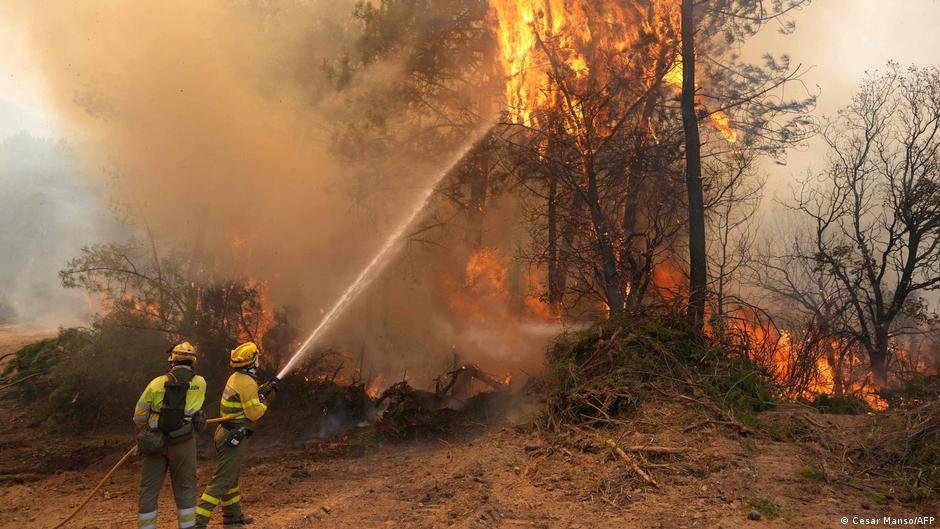
Charred tree stumps, melted asphalt, burned-out cars and destroyed buildings: The wildfires in southern Europe are leaving a trail of devastation and causing billions of euros in damage.
Spain‘s economy in particular is at risk of being choked by clouds of ash. According to the EU’s Copernicus Earth observation system, some 206,000 hectares of forest in Spain have already gone up in flames this year.
“According to the European Commission, the economic impact of wildfires in Spain in 2022 amounted to approximately €7.1 billion ($8.1 billion), representing around 4.5% of the country’s GDP. This figure reflects not only the direct costs of firefighting but also the long-term economic consequences of recovering the affected areas,” Emilio Vizuete Luciano, an economist at the University of Barcelona, told DW.
The fires often devastate the local economy and disrupt trade in the affected regions, Luciano says. “Tourism is also severely affected. Given Spain’s strong dependence on tourism, the disappearance of this activity in fire-affected regions has particularly significant economic repercussions.”
To view this video please enable JavaScript, and consider upgrading to a web browser that supports HTML5 video
Wildfires slow economic growth
Climate economist Sarah Meier of Swiss public research university ETH Zurich has taken a closer look at the economic losses caused by wildfires in southern Europe. Her findings show that in regions affected by at least one wildfire, the growth rate fell by between 0.11% and 0.18%.
According to a 2023 study she co-authored, the decline in growth was even greater when several wildfires occurred simultaneously, rising to as much as 4.5% depending on the extent of the fires. “Our calculations are an average for the period from 2011 to 2018,” she explains.
And she issues a stark warning: “The costs become particularly high when wildfires reach larger cities, something that has so far been very rare in southern Europe.”
The European Environment Agency (EEA) has also calculated the economic losses caused by wildfires in previous years. In 2017, when nearly 990,000 hectares burned across southern Europe, the losses amounted to almost €10 billion.
Europe is burning
According to the European Commission, the EU loses around 500,000 hectares of land to wildfires every year. Spain, Greece and France are among the countries where wildfires are most widespread.
The economic damage goes far beyond losses to tourism. It also includes the loss of biodiversity, declining forestry revenues, soil erosion, destroyed infrastructure and property, as well as the costs of fighting the fires.
A heated debate has erupted in Spain over the cost of fighting wildfires. Since 2009, investment in prevention has actually been declining — even though the number and scale of wildfires have reached alarming levels over the past decade.
According to official figures, spending on wildfire prevention in Spain fell from €364 million in 2009 to €144 million in 2024. Over the same period, annual spending on actually fighting and extinguishing fires remained stable at around €417 million.
For economist Luciano, there is “a certain irony” to this because prevention has been proven to be the best long-term investment. “It is far cheaper than fighting wildfires once they have already broken out.”
Spain’s high cost of firefighting
The Spanish forestry services company Forescat has estimated that fighting and extinguishing wildfires costs around €19,000 per hectare. Nearly 400,000 hectares of forest went up in flames in Spain in 2025, amounting to costs of around €7.6 billion.
It’s still too early to say how much fighting this year’s fires will cost Spain; however, Maria Inmaculada Marmol Tardaguila of MATS, a social organization representing public-sector healthcare workers, says things cannot continue this way.
“Continuing to rely on the heroic efforts of firefighting crews to keep our forests safe is both ecological recklessness and fiscal irresponsibility,” she notes on the organization’s platform, which has also warned of an increase in respiratory illnesses caused by wildfire smoke.
“The solution is not to keep buying more and more firefighting aircraft, but, for example, to remove combustible material such as deadwood from forests before the first spark catches,” she points out.
Unless public officials understand this, she warns, Spain will continue to “burn through its budget at the same rate as its forests burn.”
This piece was originally published in German.
To view this video please enable JavaScript, and consider upgrading to a web browser that supports HTML5 video
About The Author