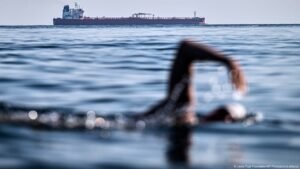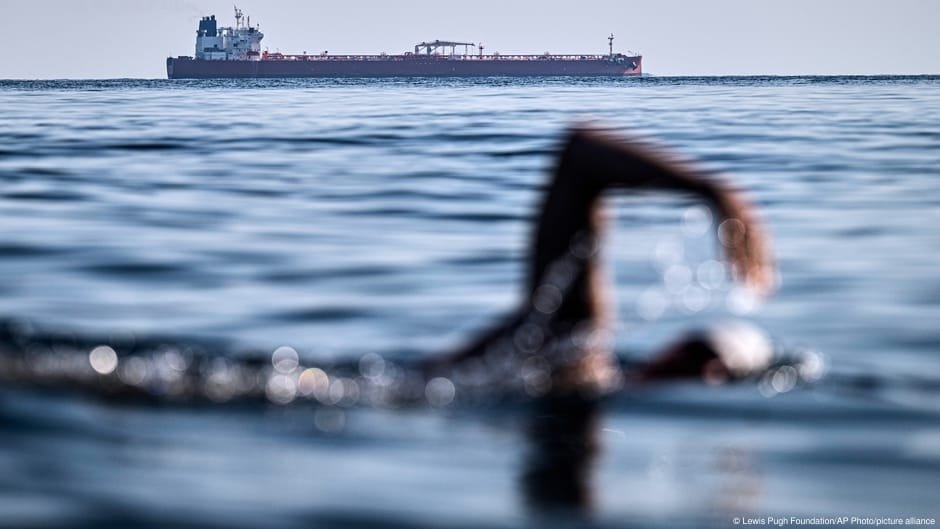
British long-distance swimmer and environmental activist Lewis Pugh swam across the Strait of Hormuz to warn of the environmental consequences of the war with Iran and the dangers to marine life.
Image: Lewis Pugh Foundation/AP Photo/picture alliance
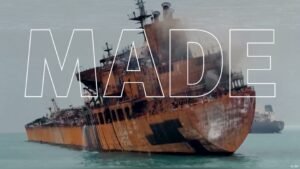
Extreme swimmer Lewis Pugh, who serves as the UN Special Envoy for the Oceans, has already drawn attention to environmental issues at the North Pole and in Antarctica. But even extreme cold and harsh conditions could not prepare him for his latest challenge: crossing the Strait of Hormuz while oil tankers were being attacked and set on fire in the immediate vicinity.
Image: Lewis Pugh Foundation/AP Photo/picture alliance
The Strait of Hormuz connects the Persian Gulf to the Gulf of Oman and is a key route for global oil and liquefied natural gas transport. Since the outbreak of the Iran War, Tehran has severely restricted shipping traffic there and has repeatedly attacked merchant ships. In response, the U.S. imposed a naval blockade on Iranian ports.
Image: REUTERS
Wearing only swim trunks, goggles, and a swim cap, Pugh set out from the Musandam Peninsula in Oman and completed the journey by circling the Strait of Hormuz, covering roughly 15 kilometers (9.3 miles). He is the first person since the start of the war to have swum across the strategically important strait, which has become a central point of contention between Washington and Tehran.
Image: Lewis Pugh Foundation/AP Photo/picture alliance
“Just 30 minutes after I began swimming, an oil tanker was struck a few kilometers away. The explosions rocked the sea around me,” the 56-year-old environmental activist reported later. Pugh was accompanied by a support boat and a kayak. His message was simple: “Stop the fighting. Open the Strait. Clean up the pollution.”
Image: Lewis Pugh Foundation/AP Photo/picture alliance
At its narrowest point, the strait is only about 39 kilometers wide and forms a narrow passage between Iran and Oman. “The Strait of Hormuz is far more than a vital shipping route. It is one of the most beautiful places I have ever visited,” explained Pugh. “Dolphins, sea turtles and dugongs live in these waters. It is one of the great natural wonders of the world.”
Image: Alastair Grant/AP Photo/picture alliance
“With all these ships being sunk, this area is under severe threat and it is going to take decades for this area to recover,” said Pugh. The oil leaking from the tankers is endangering wildlife as well as coastlines, coral reefs and mangrove forests. Greenpeace has already documented oil slicks in satellite images and is warning of an ecological disaster resulting from the war.
Image: European Union/Copernicus Sentinel-2/Handout/REUTERS
Pugh is accustomed to extreme temperatures and encounters with predators such as great white sharks. In 2006, he claimed to be the first person to swim long distances in all five oceans. Swimming in a war zone, however, presented him with entirely new challenges. For safety reasons, he spread the swim out over three days. In total, he spent about six and a half hours in the water.
Image: Lewis Pugh Foundation/AFP
Over the past few decades, Pugh has used his swimming achievements around the world to advocate for the protection of the oceans. According to his foundation, his efforts have helped place more than 3.5 million square kilometers of endangered marine areas under protection.
Image: Lewis Pugh Foundation/AP Photo/picture alliance8 images1 | 88 imageshttps://p.dw.com/p/5Pl7l