Skip next section What you need to know
What you need to know
- Israelis voting to elect Knesset
- Israel election committee reports highest voter turnout on record as of 2 p.m., halfway through the voting day
- Benjamin Netanyahu, Israel’s longest-serving prime minister, faces a staunch challenge to his grip on power
- His chief rival is former military chief Gadi Eisenkot
- Eisenkot’s Yashar party has polled higher than Netanyahu’s Likud party
Follow below for all the latest on the Israeli election on October 27, 2026, and its aftermath:
Skip next section WATCH — Author, politician Avraham Burg on why a Palestinian peace process barely featured in the campaign10/27/2026October 27, 2026
WATCH — Author, politician Avraham Burg on why a Palestinian peace process barely featured in the campaign
While security remained the dominant issue for Israeli voters, one topic was largely absent from the election campaign: a peace process with the Palestinians.
After years of conflict and failed negotiations, that debate has been pushed to the political margins.
Has Israeli society abandoned the idea of coexistence?
Avraham Burg, an Israeli writer and former Speaker of the Israeli Parliament, shares his insights with DW.
To view this video please enable JavaScript, and consider upgrading to a web browser that supports HTML5 video
https://p.dw.com/p/5Ok6fSkip next section Turnout reaches highest level on record at halfway point10/27/2026October 27, 2026
Turnout reaches highest level on record at halfway point
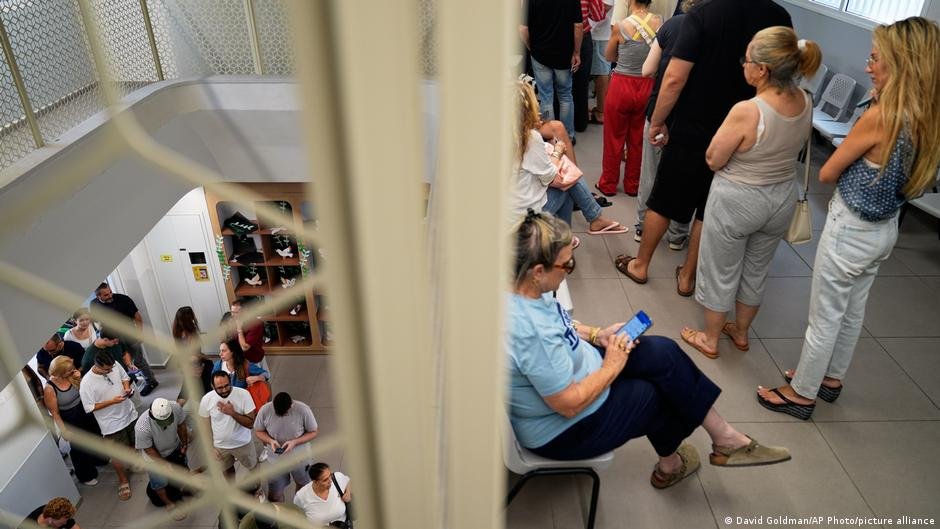
Turnout in Israel’s election keeps rising. It reached a record 44.9% by 2 p.m. (1200 UTC), the Central Elections Commission said.
Some 3.29 million Israelis had cast their ballots by that point, commission head Dean Livne said.
It was the highest turnout recorded at that hour since the commission began collecting comparable statistics in 1973.
https://p.dw.com/p/5OjqmSkip next section Eisenkot promises ‘change’ after casting his vote10/27/2026October 27, 2026
Eisenkot promises ‘change’ after casting his vote
Gadi Eisenkot, the main challenger to Israeli Prime Minister Benjamin Netanyahu, urged voters on Tuesday to oust what he called the “worst government” in Israel’s history and promised a more responsible style of leadership.
“There is a wind of change blowing in Israel, and this change will come into effect tonight at 10 p.m.,” at which point polls close, he said after casting his own vote at a polling station in Holon, just south of Tel-Aviv.
“We will not lead Israel through division and scaremongering, but through unity and true love,” he said. “We will win!”
Ahead of election day, Israeli pollsters had predicted a close race between Netanyahu’s right-wing conservatives and Eisenkot’s opposition bloc, with neither expected to win an outright majority.
“I call on all citizens of Israel to vote, not to buckle under the heat or the disruptions, to stick to the mission,” said Eisenkot. “To replace tonight the worst government since the state was established.”
https://p.dw.com/p/5OjZnSkip next section WATCH: How Israel’s PM Netanyahu holds on to power10/27/2026October 27, 2026
WATCH: How Israel’s PM Netanyahu holds on to power
Three years after the Hamas-led October 7 attacks exposed major flaws in Israeli security, Prime Minister Benjamin Netanyahu remains the dominant figure in Israel’s political landscape. DW examines how many Israeli voters judge him more on his response to the crisis than on the failures that preceded it.
Experts point to security concerns, fear, Israel’s conflicts on multiple fronts, and the absence of a clear challenger as key factors behind Netanyahu’s resilience. The report also explores why international criticism can strengthen his support ahead of Israel’s upcoming Knesset election.
To view this video please enable JavaScript, and consider upgrading to a web browser that supports HTML5 video
https://p.dw.com/p/5OTdRSkip next section Netanyahu casts ballot, while accusing Arab-Israeli parties of fraud 10/27/2026October 27, 2026
Netanyahu casts ballot, while accusing Arab-Israeli parties of fraud
Israel‘s Central Elections Committee said on Tuesday that “there are currently no indications of systematic tampering with ballot slips” after Israeli Prime Minister Benjamin Netanyahu accused Arab-Israeli parties of “trying to steal the election.”
Netanyahu made the allegation after casting his own ballot in Jerusalem while urging voters to choose his Likud party.
“We know what is at stake … We cannot leave this battle here in the hands of the left and the Arab parties that want to bring an end to the Jewish state,” he said.
Netanyahu has used Arab-Israeli parties throughout the election to stoke fears of a Palestinian state and mobilize voters for Likud.
“So no barbecues, don’t go to the beach — go to the polling station and vote Likud.”
Netanyahu had said that three senior officials from the opposition Ra’am party, which has an Arab Muslim voter base, had been arrested in southern Israel with envelopes full of cash.
The acting director general of the Central Elections Committee, Dean Livne, referred to the “unusual” incident with the envelopes in a press conference Tuesday morning but said that “police, even before people arrived at the polling stations, caught individuals who tried to bribe voters.”
He said the unidentified suspects were not actually at polling stations and were caught near their homes, adding the matter was under investigation.
“There are no similar incidents of this kind across the country,” he concluded. “This was a localized case.”
Opposition parties, including that of Netanyahu’s main challenger, Gadi Eisenkot, have also complained that ballot papers were being defaced and stolen at polling stations.
https://p.dw.com/p/5OjLBSkip next section Early Israel election turnout highest in decades10/27/2026October 27, 2026
Early Israel election turnout highest in decades
Voter turnout in the first three hours of the Israeli general election was the highest in decades, Israel‘s Central Elections Committee said on Tuesday.
According to the committee, nationwide turnout by mid-morning was already at 16.68%, the highest at this stage of the vote since 1981 and up from 15.9% at the same time in the 2022 election.
“By 10 a.m., more than 1,200,000 Israelis had voted,” said the committee’s acting director general, Dean Livne.
Total voter turnout in Israeli general elections approached 80% the 1990s but hasn’t been higher than 72.3% since the turn of the century. Turnout at the last general election in 2022 was 70.6%.
Turnout among Arab Israelis is expected to be particularly important given the role Arab parties could play as potential kingmakers in coalition talks.
“Our vote will change the government,” predicted Mansour Abbas, head of the Islamist Ra’am party as he cast his vote, adding that he hoped turnout would surpass 70% in Arab communities.
Arabs in Israel make up about 18% of the electorate, and pre-election surveys have suggested a sharp increase in voter participation.
Data from the Midgam Research Institute cited by the Qatar-owned The New Arab indicates that turnout within the Arab community could rise to between 62% and 63%, up from approximately 53% in previous elections. The National, based in the United Arab Emirates, said its sources were predicting an “astronomical” Arab turnout.
To view this video please enable JavaScript, and consider upgrading to a web browser that supports HTML5 video
https://p.dw.com/p/5Oir4Skip next section How does Israel’s election work?10/27/2026October 27, 2026
How does Israel’s election work?
Who is eligible to vote?
Around 7.3 million Israelis (including around 1.2 million Palestinian citizens of Israel) are eligible to vote on Tuesday.
More than 640,000 young Israelis will be eligible to vote in a general election for the first time.
Around 3.1 million Palestinians living under Israeli occupation in the West Bank do not have the right to vote in Israeli elections, but 500,000 illegal settlers in those territories do.
A further 350,000 Palestinians live in Israeli-occupied East Jerusalem and also cannot vote, whereas around 230,000 Israelis living there can.
The US-based non-profit America-Israel Democracy Coalition (AID Coalition) has organized a “Fly&Vote” initiative, with as many as 67,000 voters returning to Israel to participate in the election, based on surveys of expatriates and registration data.
The coalition said half are coming from the US, with others from Europe, Canada, Australia and New Zealand. Israel does not have postal voting.
How does the voting system work?
Israel is a parliamentary democracy and voters elect a legislature rather than choosing their prime minister directly. Voters choose a party “list.”
Israel uses a proportional representation system under which 120 parliamentary seats are distributed roughly in proportion to a party’s share of the vote.
To enter parliament (known as the Knesset), parties must receive at least 3.25% of valid votes, which is equivalent to roughly four seats.
The party which can command a majority of at least 61 seats is called upon to form a government. No single party has ever won an outright majority, so Israel has always been governed by coalitions. Polls suggest this year will be no different.
Unlike many other democracies around the world, Israel is not divided up into geographic electoral districts.
Rather than electing individual lawmakers to represent local areas, voters in Tel Aviv, Jerusalem and Haifa all choose from the same party lists in one, single, nationwide constituency.
When polling stations close at 10 p.m. local time (9 p.m. CET), broadcasters will publish their first exit polls, offering an initial indication of the results. Official results are scheduled to be published on November 4.
To view this video please enable JavaScript, and consider upgrading to a web browser that supports HTML5 video
https://p.dw.com/p/5OiXISkip next section Arab-Israeli parties: Potential kingmakers in Israel’s future ruling coalition?10/27/2026October 27, 2026
Arab-Israeli parties: Potential kingmakers in Israel’s future ruling coalition?
While the main competition for the largest number of seats is between Benjamin Netanyahu’s Likud and Gadi Eisenkot’s Yashar, the Arab parties are projected to play a key role in determining Israel’s next ruling coalition.
For a party or coalition to rule, it needs to secure 61 seats in the Knesset.
As per a recent Channel 12 poll, Eisenkot’s bloc is hovering around 55 seats, while Netanyahu’s bloc is trailing behind with some 51 seats. This means that either bloc would need to form coalitions in order to rule, should the election results come out similar to the polls.
The most likely parties to tip the scales are the Joint List (projected to win around 9 seats) and the Ra’am (projected to win around 5 seats). The Arab minority, who are Palestinian by heritage but Israeli by nationality, make up around a fifth of Israel’s eligible voters. Polls suggest a higher turnout rate for the Arab voters than seen in previous elections.
Netanyahu’s Likud and Ben-Gvir’s Otzma Yehudi parties attempted last month to ban the Joint List and Ra’am from running in the race, but Israel’s Supreme Court reversed the parties’ disqualification earlier in October.
Both Eisenkot and Netanyahu have ruled out an alliance with the Arab parties. But analysts suggest such stances are not set in stone and can shift amid coalition talks, a move Netanyahu himself has resorted to in the past.
https://p.dw.com/p/5OTYwSkip next section Gadi Eisenkot: Who is Netanyahu’s main opponent?10/27/2026October 27, 2026
Gadi Eisenkot: Who is Netanyahu’s main opponent?
The Israeli general election is considered by many to be a verdict on the country’s longest-serving prime minister, Benjamin Netanyahu.
But who is the opposition, and what do they stand for?
The main opposition force is a so-called “change bloc,” a mixed group of center-right and some left-wing parties led by the newly formed Yashar (honesty) party and its leader Gadi Eisenkot.
A relative political newcomer, Eisenkot is the son of Moroccan immigrants who rose to become the chief of the staff of the Israel Defense Forces (IDF) between 2015 and 2019.
Eisenkot has positioned himself squarely in opposition to Netanyahu in terms of his personality — an unpolished man of the people in contrast to the highly stylized and controlling prime minister.
Campaigning on accountability, political reform, and national unity, Eisenkot has sharply criticized Netanyahu’s leadership before and after the October 7 Hamas attacks.
But his politics don’t differ massively and, although he has emphasized equal rights for all Israeli citizens, he has been ambiguous on the idea of a two-state solution since October 7.
While backing Israel’s military operations, he argues the government lacks a clear strategy and has called for an independent inquiry into the failures surrounding the attacks. His military record and the death of his son in the Gaza war have strengthened his standing among many voters
The parties in Eisenkot’s bloc all have ideological differences but are united by their goal of removing Netanyahu from power.
To view this video please enable JavaScript, and consider upgrading to a web browser that supports HTML5 video
https://p.dw.com/p/5OiT7Skip next section Polls open in Israel electionPublished 10/27/2026Published October 27, 2026last updated 10/27/2026last updated October 27, 2026
Polls open in Israel election
Voting began in Israel at 7 a.m. local time (6 a.m. CET) on Tuesday in the first general election since the deadly Hamas attack on October 7, 2023, and the devastating war in Gaza unleashed by Israel in response.
Some 7.3 million Israeli citizens are eligible to vote, with polls showing a bloc led by right-wing Prime Minister Benjamin Netanyahu, the country’s longest-serving premier, neck and neck with Gadi Eisenkot’s centrist opposition alliance.
Most polling stations will close at 10 p.m. local time (8 p.m. UTC).
https://p.dw.com/p/5OiJjSkip next section WATCH: Netanyahu’s final campaign? — Israel heads to the polls10/27/2026October 27, 2026
WATCH: Netanyahu’s final campaign? — Israel heads to the polls
Emily Gordine
There’s a lot at stake in this election: The fallout and questions of political accountability for the attacks of October 7, 2023; mandatory military service for ultra-Orthodox men and sharing the burden of national defense; along with Israel’s standing in the international community.
Nowhere can the division within Israeli society be more felt than in debate over Benjamin Netanyahu.
For the past four years, Israel’s long-standing prime minister has led what has been described as the most right-wing government in the country’s history. He broke with political convention by forming an alliance with ultranationalist politician Itamar Ben-Gvir.
Many Israelis want to see an end to this government. They blame it for the failures surrounding Hamas’ terror attack and for the country’s growing isolation internationally. Many are placing their hopes in Gadi Eisenkot, who has emerged as a leading opposition figure to challenge Netanyahu.
To view this video please enable JavaScript, and consider upgrading to a web browser that supports HTML5 video
https://p.dw.com/p/5OTcfSkip next section Security fears and domestic divides define Israel’s election battle10/27/2026October 27, 2026
Security fears and domestic divides define Israel’s election battle
Israeli Prime Minister Benjamin Netanyahu and his top challenger Gadi Eisenkot are both against the creation of an independent Palestinian state, meaning the election is not expected to lead to major policy changes that could revive the long-stalled peace process.
Here are some of the other major campaign issues:
- Security and the War: Voters are focused on the management of the Israel-Hamas war, the future of Gaza, and handling threats from Iran and Hezbollah.
- Military Service: There is an intense debate over whether the exemption for ultra-Orthodox (Haredi) men should be extended or whether they should be required to serve in the military like other Jewish citizens.
- The Justice System: There are deep disagreements over proposed judicial reforms that would change the balance of power between elected politicians and the Supreme Court.
- The Economy: Voters are highly concerned about the cost of living, housing prices, inflation, and war-related spending, although these are not the primary campaign issues.
https://p.dw.com/p/5ObQpSkip next section Welcome to our coverage10/27/2026October 27, 2026
Welcome to our coverage
Israelis head to the polls today to elect a new Knesset in what is expected to be a tightly contested race.
Incumbent Benjamin Netanyahu, the country’s longest-serving prime minister, is fighting to stay in power, with several court cases awaiting him if he loses office.
Polls suggest his opponent, former military chief Gadi Eisenkot, is in the lead.
Stay tuned as we closely follow the election, its results and the wider implications for the region.
https://p.dw.com/p/5OTFmShow more posts