Skip NavigationMarketsBusinessInvestingTechPolitics & PolicyVideoWatchlistInvesting Club PRO
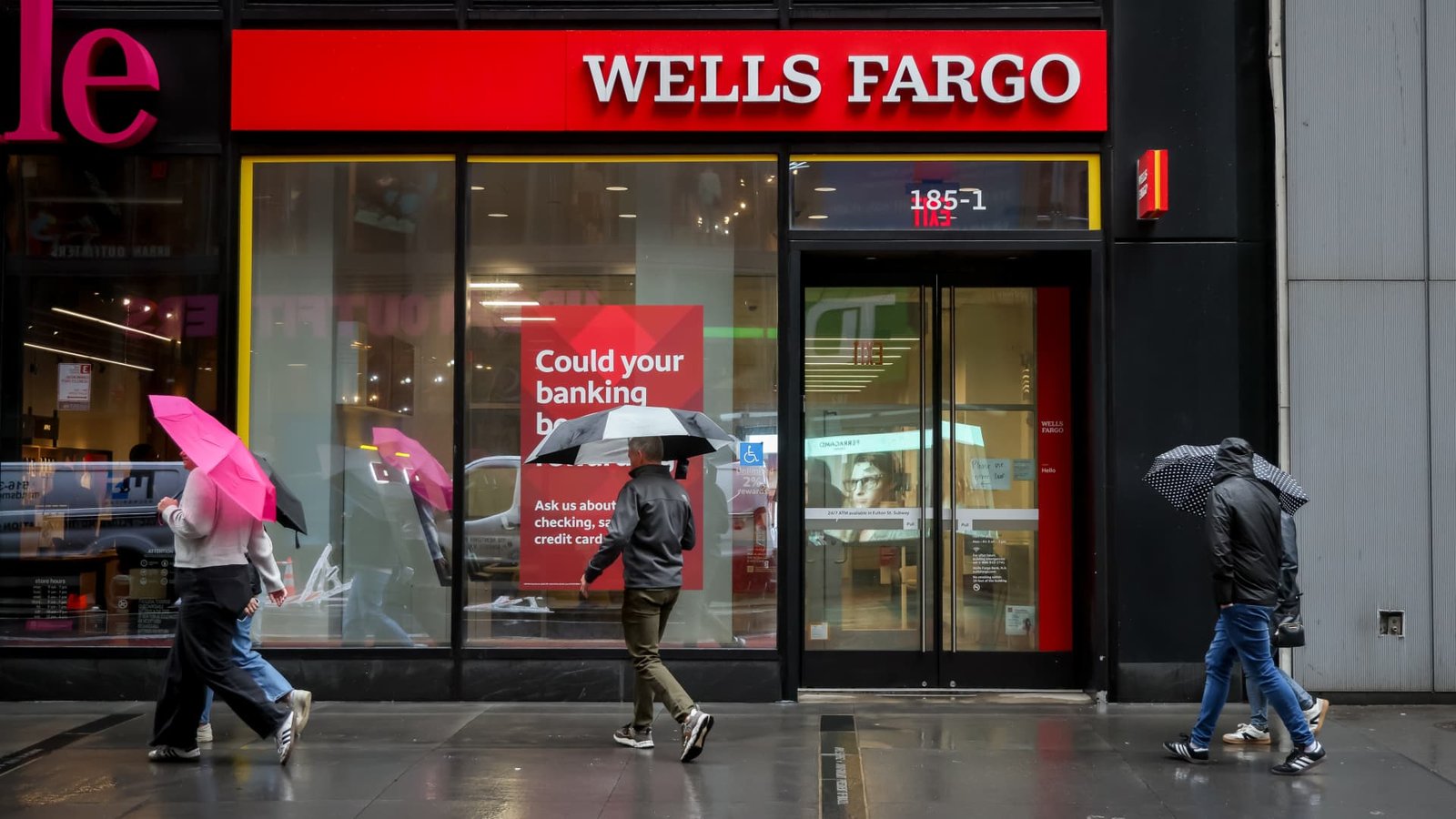
PRO LivestreamMenuWells Fargo shares dipped 2% Tuesday after the bank reported mixed third-quarter results. However, we think better days are ahead as management’s efforts to improve returns take hold, and we’re upgrading the stock as a result. Total revenue at the bank increased 2% year over year to $21.9 billion in the third quarter, missing the LSEG-compiled consensus estimate of $22.3 billion. Earnings per share (EPS) for the three months ending Sept. 30 rose 13% to $1.87, beating the $1.85 consensus estimate. Bottom line We’re not surprised to see a bit of weakness on Tuesday due to misses on key operating lines. Revenue missed expectations by $430 million, with shortfalls from both net interest income (NII) and non-interest income, a collection of Wells’ fee-based businesses. Non-interest expenses came in below expectations, which is encouraging, but the $112 million beat versus the FactSet consensus didn’t make up for all of the top-line softness. Given the bank’s sensitivity to interest rates, we should start to see NII trend higher in this higher-rate environment. Net interest margin (NIM) — a key measure of a profitability, measuring the spread between what a bank earns on loans and pays out on deposits — stabilized quarter over quarter at 2.43%. This is in keeping with what CFO Michael Santomassimo said at a Barclays conference last month . The stabilization was a big deal because it ended four straight quarters of sequential declines, and the trend is expected to continue into the fourth quarter. It also beat expectations of 2.41%, which is notable because the bank entered today with misses in nine of the past 10 quarters. The bank said the better-than-expected performance was driven by slightly higher cash and securities balances, slightly lower funding costs, and additional efficiency in the deployment of its markets balance sheet. For Wells, a lot of attention is placed on NII and how the bank’s NIM performs relative to the yield curve. However, we do not think investors should ignore the progress being made in building out a competitive investment bank — a big priority for CEO Charlie Scharf. Within investment banking, Wells Fargo’s dedication to strengthening its client coverage is paying off through improved equity capital market share — up 84 basis points to 3.9% — and an improvement in the announced U.S. M & A volume ranking, going to No. 6 from No. 9 one year ago. Markets revenue within investment banking fell 1% year over year, mostly due to a decline in fixed income, currencies, and commodities, or FICC. Goldman Sachs also experienced a year over year decline in FICC revenue, although its decline was less pronounced than Wells Fargo’s. We upgraded Goldman earlier Tuesday. More broadly in fees, non-interest income declined about 1% year over year despite growth across investment advisory, deposit-related fees, investment banking, and card fees. Lower net gains in trading activities, lower lease income after the sale of its railcar-leasing business , and lower gains from equity securities weighed on the result. Finally, the company isn’t seeing any issues on the consumer credit side. The bank’s charge-off ratio fell from the second quarter and year-ago period, while early-stage delinquencies are at historically low levels. Corporate credit is also strong with only 18 basis points of losses in the third quarter. All in, we’re not surprised to see Wells Fargo shares move lower after a revenue miss. But Tuesday’s decline — combined with the stock’s 6% pullback since the start of September — could present a buying opportunity as the bank begins to see the benefits of stabilizing net interest margins and higher net interest income from elevated interest rates. This will flow through to its return on tangible common equity, another key metric for evaluating bank performance. An improved ROTCE over time will help the stock re-rate to a higher multiple on tangible book value per share. We are upgrading our rating on Wells Fargo to buy-equivalent 1 from 2, while keeping our $95 price target. Quarterly commentary Wells Fargo’s Efficiency Ratio was a little worse than expected, falling 200 basis points year over year to 63%. The consensus estimate was 62.1%, according to FactSet. Remember, this is one of those key metrics where lower is better because it’s a measure of how much non-interest expense goes into each dollar of revenue generated. Return on Tangible Common Equity (ROTCE) increased nicely year over year to 16.3% from 15.2% in the year ago period. It also exceeded expectations of about 16%. The year-over-year improvement moved the bank closer to management’s stated target of 17% to 18%. The bank’s ROTCE last quarter fell within that range. Tangible Book Value Per Share (TBVPS) increased slightly to $44.46, missing what the Street was expecting. Common Equity Tier 1 Ratio (CET1), which measures capital versus risk-weighted assets, came in a tick below expectations, but still well above bank’s 8.5% regulatory minimum. As a result, the bank remains well-positioned with the capital needed to invest in the business while returning cash to shareholders. On that note, Wells Fargo repurchased $2.5 billion of stock in the quarter. That is down from the $3 billion repurchased in the second quarter, and it may have been disappointing to some looking for a larger buyback. Segment commentary Consumer Banking and Lending revenue increased 5% year over year. Consumer, Small and Business Banking (CSBB) revenue increased 7% year over year due to higher deposit balances, wider deposit spreads, higher deposit related fees, investment advisory fees, and higher volume on debit card fees. Credit card revenue growth was 3% on higher NII on higher loan balances and card fees. Home lending fell 15% due to lower mortgage services income and lower NII on lower loan balances. Commercial Banking saw revenue advance 6% year over year. Net interest income grew 9% on higher deposit and loan balances. Corporate and Investment Banking revenue increased 3% year over year. Banking revenue, which includes lending, treasury management and payments, and investment banking, was up 8% year over year. All three lines of business grew revenue year over year. Commercial real estate revenue dipped 1% year over year due to lower capital markets activity. Non-interest expense grew faster than revenues at 4% year over year due to higher personnel expense and professional and outside services expense. Wealth and Investment Management revenue increased 12% year over year with a balanced mix of Net Interest Income growth and Non-Interest Income growth. Non-Interest expense increased 9% year over year on higher revenue related compensation expense. 2026 guidance Wells Fargo kept its NII outlook for the year unchanged at plus or minus $50 billion. For the fourth quarter, the bank expects NII to be about $13 billion, which is better than the consensus estimate of $12.86 billion, according to FactSet. Fourth-quarter NIM is also expected to remain stable from the third quarter, implying 2.43% versus Street expectations of 2.41%. Non-interest expenses in 2026 were also reiterated to be about $55.7 billion, which is in line with the consensus estimate, according to FactSet. (Jim Cramer’s Charitable Trust is long WFC, GS. See here for a full list of the stocks.) As a subscriber to the CNBC Investing Club with Jim Cramer, you will receive a trade alert before Jim makes a trade. Jim waits 45 minutes after sending a trade alert before buying or selling a stock in his charitable trust’s portfolio. If Jim has talked about a stock on CNBC TV, he waits 72 hours after issuing the trade alert before executing the trade. THE ABOVE INVESTING CLUB INFORMATION IS SUBJECT TO OUR TERMS AND CONDITIONS AND PRIVACY POLICY , TOGETHER WITH OUR DISCLAIMER . NO FIDUCIARY OBLIGATION OR DUTY EXISTS, OR IS CREATED, BY VIRTUE OF YOUR RECEIPT OF ANY INFORMATION PROVIDED IN CONNECTION WITH THE INVESTING CLUB. NO SPECIFIC OUTCOME OR PROFIT IS GUARANTEED.Read More
We’re upgrading our rating on Wells Fargo as the stock’s pullback offers a nice entry point
Wells Fargo’s third-quarter results were not perfect, but CEO Charlie Scharf’s turnaround should bear more fruit ahead.

by
Read Time
About the Author

Previous Post
Next Post
Leave a Reply
Latest News






Stay Connected
Categories
BBC News CNA CNBC CNN International Deutsche Welle (DW) Euronews France 24 General Global & European Specialized & Regional
Tags
amp Artificial intelligence Asia Breaking News: Business Breaking News: Markets Breaking News: Politics Breaking News: Technology Business business news cent china cup Donald J. Trump Donald Trump economy European Union fast football France germany india Investment strategy iran Iran war markets People per politics return russia S&P 500 Index said Singapore spain Sport Stock markets technology trump ukraine United States US-Israel attack on Iran 2026 video War in Ukraine World World Cup 2026
About the Author

AF themes
Easy WordPress Websites Builder: Versatile Demos for Blogs, News, eCommerce and More – One-Click Import, No Coding! 1000+ Ready-made Templates for Stunning Newspaper, Magazine, Blog, and Publishing Websites.

Search the Archives
Access over the years of investigative journalism and breaking reports