27 minutes agoShareSaveAdd as preferred on GoogleRobert Greenall

 EPA
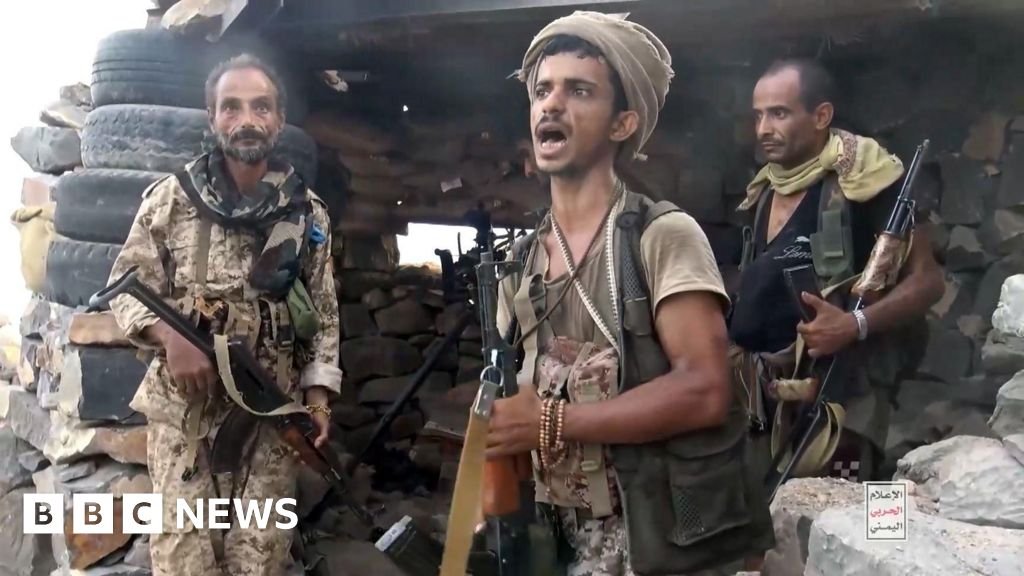
EPAYemen’s civil war has flared up in recent weeks as the Iran-backed Houthi movement, which controls much of the country’s north-west, seized large strategically important stretches of the Red Sea coast in a rapid offensive.
The territory includes the port of Mokha, which overlooks the Bab al-Mandab Strait, a chokepoint for global shipping.
Oil prices have risen on fears of further disruption to the global economy, following six months of war between the US, Israel and Iran.
Hundreds of people have reportedly been killed on both sides during the Houthis’ advance, which came after the collapse of a four-year informal ceasefire. The UN says more than 120,000 people have been displaced by the escalation.
Neighbouring Saudi Arabia, which opposes the Houthis and backs Yemen’s internationally-recognised government, has launched air strikes, while the Houthis have fired drones and missiles at south-western Saudi Arabia. The group has also targeted commercial vessels linked to Saudi Arabia in the Red Sea.

The Houthis are an armed political and religious group from northern Yemen which champions the country’s Shia Muslim minority, the Zaidis.
They declare themselves to be part of the Iranian-led “axis of resistance” against Israel, the US and the wider West – along with armed groups such as Hamas and Lebanon’s Hezbollah movement.
Formally known as the Ansar Allah (Partisans of God), the group emerged in the 1990s and takes its name from the movement’s late founder, Hussein al-Houthi. His brother, Abdul Malik al-Houthi, has been its de facto leader since 2004.
In the early 2000s, the Houthis rebelled against Yemen’s long-time authoritarian president Ali Abdullah Saleh. They wanted greater autonomy for the group’s homeland in the north of Yemen. The group seized the capital Sanaa after the 2011 Arab Spring, when a popular uprising forced Saleh to hand power to his deputy.
The Houthis have continued to grow in strength, with troop numbers estimated to have risen to 350,000 last year, and now control between one-quarter and one-third of Yemen’s territory, but 70-80% of its population – about 30 million people.
The group wants an end to a Saudi blockade, control of the whole of Yemen and access to Yemen’s oil and gas revenues.
 EPA
EPANeighbouring Saudi Arabia feared the Houthis would take over Yemen and make it a satellite of its regional rival, Iran.
In 2015 Saudi Arabia formed a coalition of Arab countries that intervened on behalf of Yemen’s internationally-recognised government.
But years of air strikes and ground fighting were unable to dislodge the Houthis from most of the territory they seized, and also triggered one of the world’s worst humanitarian crises. A temporary ceasefire was brokered in 2022.
Soon after the start of the Gaza war in October 2023, the Houthis began firing drones and missiles towards Israel and at merchant vessels in the Red Sea and Gulf of Aden, saying they were acting in support of the Palestinians.
Western countries deployed warships and the US, UK and Israel carried out air strikes. An Israeli strike killed senior Houthi figures including the prime minister of its self-declared government.
In 2025 the US and the Houthis agreed to stop targeting each other. However the Houthis resumed missile attacks on Israel after the US and Israel attacked Iran in February 2026, having paused them after the October 2025 ceasefire in Gaza.
The informal ceasefire between the Houthis and the Saudis began to unravel in July.
The Houthis announced a “maritime embargo” against Saudi Arabia and began missile and drone attacks on Saudi airports, oil facilities and tankers in the Red Sea. They said they were retaliating for what the Houthis say is a years-long Saudi blockade, and for an air strike on Sanaa airport.
This was followed by a rapid Houthi advance in September that captured as much as 130km (81 miles) of the country’s Red Sea coastline as well as the island of Perim.
The move gave the Houthis significant control of the strategic Bab al-Mandab Strait, but they have insisted that they pose no threat to international shipping, except for Saudi-linked vessels.
The Houthis’ actions have caused renewed concern about disruption of world oil supplies. Bab al-Mandab has become an increasingly important route for oil exports from Saudi Arabia since shipping through the Strait of Hormuz, on the other side of the Arabian Peninsula, was curtailed due to the US and Israel’s war with Iran.

The situation has also been exacerbated by Houthi attacks on Saudi oil installations, as well as an attack on the East-West Pipeline blamed on Iran-backed Iraqi militias, and the escalation threatens to again draw in Western powers.
Media reports said both the Yemeni government and Saudi Crown Prince Mohammed bin Salman had urged President Trump to strike the Houthis following the offensive. Trump did not do so, saying the Houthis had agreed not to hit US targets.
The UK meanwhile agreed to a Saudi request to deploy a military aircraft to help refuel Saudi Arabian fighter jets for “purely defensive missions”.
Saudi Arabia and Western powers say Iran smuggled weapons – including drones, and cruise and ballistic missiles – to the Houthis during Yemen’s civil war in violation of a UN arms embargo.
A panel of UN experts concluded in 2024 that the Houthis had been transformed into a powerful military organisation due to the transfer of materiel, assistance and training from Iran’s Revolutionary Guards, Lebanon’s Hezbollah movement and Iraqi specialists.
And a report in May 2026 by Conflict Armament Research (CAR) – after the start of the Iran war – found that whereas in the past Tehran shipped finished weapons to the Houthis, it was now increasingly sending parts which its proxies were able to assemble and was also sharing increasingly advanced missile technologies.
Iran has denied supplying weapons to the Houthis and says it only supports them politically.
 US Central Command