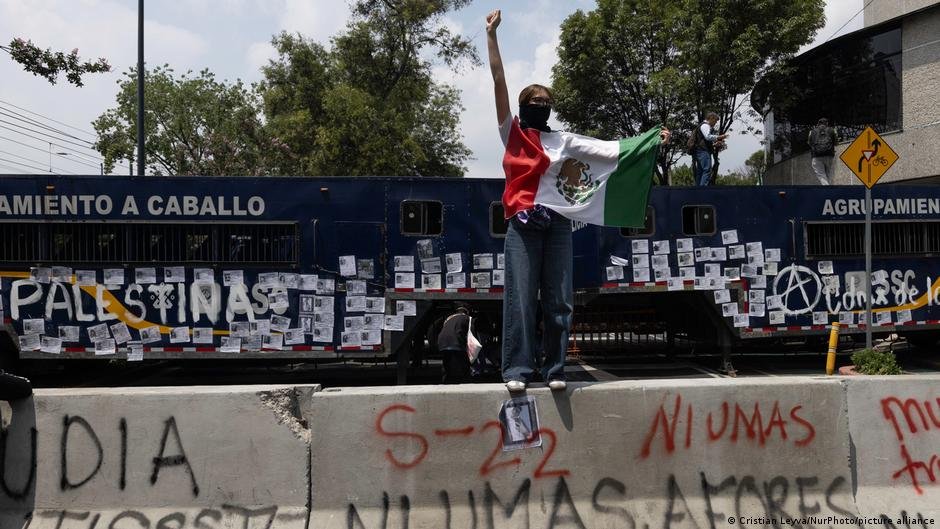
As the men’s World Cup begins, relatives of missing persons, women’s collectives and the teachers’ union are protesting in Mexico.
Image: Cristian Leyva/NurPhoto/picture alliance
Seizing the moment: With the World Cup being hosted in Mexico alongside Canada and the USA, the world is turning its attention to the Latin American nation. Various groups are capitalizing on this interest to draw attention to political and social grievances; for weeks, the country has seen repeated blockades and demonstrations, some of which have turned violent.
Image: Gerardo Vieyra/NurPhoto/picture alliance
On Tuesday, members of the CNTE teachers’ union blocked the main entrance to Mexico City’s Azteca Stadium, where the World Cup opening match was taking place. The educators criticize the fact that funds are available for the major event but not for them. President Claudia Sheinbaum opposes a harsh crackdown on the protesters but criticizes the “provocation.”
Image: Paola Garcia/REUTERS
In the wake of the protests, the police established a security zone accessible only to those with a valid World Cup ticket. A massive police presence has cordoned off the Azteca Stadium and the fan zone at the Zócalo, Mexico City’s main square. Yet this has not stopped the protests: Demonstrators repeatedly attempt to break through the barriers.
Image: Daniel Cardenas/Anadolu/picture alliance
The protesting teachers made headlines as early as last week after using ropes to pull down giant statues of footballers in the capital and setting some of them on fire. The educators are demanding better working conditions, the repeal of a controversial pension reform, and significantly higher salaries.
Image: Oswaldo Ramirez/AFP
It is not just teachers who are protesting: At the start of the World Cup, relatives of missing persons demanded a swifter resolution and justice for their loved ones during a protest march. More than 130,000 people are considered missing in Mexico. It is believed that a large number of them have fallen victim to organized crime.
Image: Daniel Cardenas/Anadolu/picture alliance
Activists are bringing images of missing women to fan zones, using the major sporting event to denounce violence against women in the country. According to official statistics, 10 to 11 women are murdered in Mexico every day, and thousands vanish without a trace — either to cover up femicides or because the victims are forced into prostitution.
Image: Marco González/AFP
Mexican authorities fail to solve around 90% of all femicides; and the justice system is widely regarded as overwhelmed, incompetent and corrupt. Widespread impunity further fuels violence against women. Yet Mexico is attempting to present itself as safe and modern for the World Cup — a provocation to protesters, given that their loved ones remain missing.
Image: Rolando Ramos/REUTERS
The protests are causing disruptions nationwide: An airport in the state of Chiapas was partially blocked by demonstrating teachers, while protesters in Tijuana obstructed a border crossing into the US. Both teachers and the relatives of missing persons intend to continue their protests during the World Cup.
Image: Gerardo Vieyra/NurPhoto/picture alliance8 images1 | 88 imageshttps://p.dw.com/p/5FISX