On September 8, 2023, a devastating earthquake struck the Al Haouz region in Morocco, killing over 2,900 people, injuring more than 5,500 and causing widespread destruction.
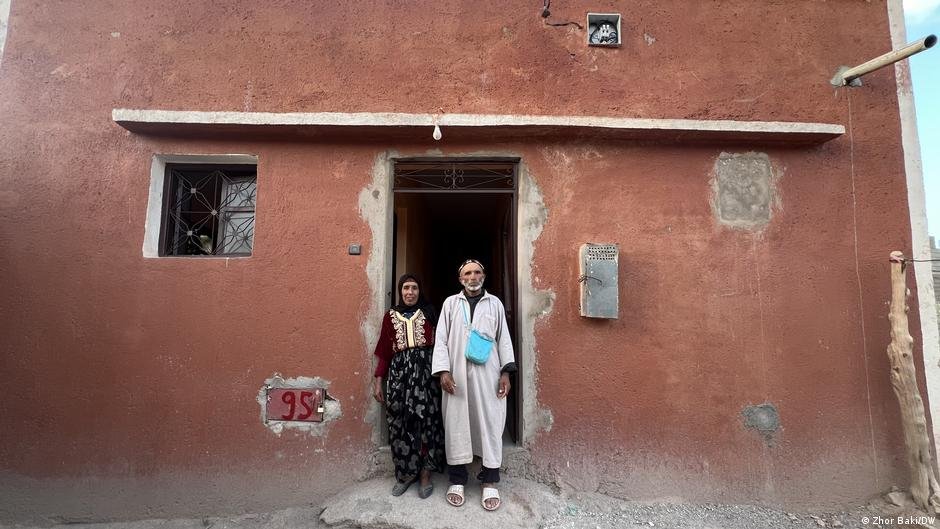
In the village of Ighermane in the High Atlas Mountains, about 50 kilometers (30 miles) southwest of Marrakech, Mohamed Ait Belaid, 72, feels like things are actually going pretty well for him three years later.
He had been living in a tent after the earthquake but now resides in a newly built house, even though it’s smaller than the one destroyed in the earthquake.
“I benefited from partial [state] support and received 80,000 dirhams [around €7,300] for rebuilding,” he told DW. “I added about 100,000 [€9,110] dirhams from my own pocket. And thanks to God, I like my new house and I’m comfortable in it. I’m at peace because my wife, my children and I are all healthy and I haven’t lost any of them.”
Around 40 kilometers away, in the town of Azgour, it’s a different story. Larbi Ait Jelloulat, also 72, is sitting in front of a pile of rubble that was once his house.
“I want to know where my rights have gone,” he said angrily. “Who took what’s rightfully mine? For three years, I’ve been going from one department to another, from one complaint to another, from one petition to another, just looking for an answer. Why have I been excluded? Am I not a Moroccan citizen?”
Ait Jelloulat was formerly a council employee and saved for years in order to build the large home that was destroyed in the 2023 earthquake. As far as he can tell, bureaucratic issues mean he must prove he was a resident in the area.
“My only dream was to spend the rest of my life in my own home, a rest after years of service,” he explained. “Now they say I’m not a resident … Where’s the logic in that?”
Why such different experiences?
Reconstruction seems to be happening faster in Ighermane, the village where Ait Belaid lives. About 90% of the village is rebuilt and most residents’ lives are back to normal, said Omar Saeed from the Ighermane Association for Development and Solidarity.
Of the village’s around 150 families, 114 received state support of some kind, although most also had to contribute some of their own money to rebuild.
Meanwhile, in Azgour, where Ait Jelloulat lives, there’s been more to do. Azgour was the village most impacted by the earthquake in the area.
There, about 76 families have had help with reconstruction, Ait Jelloulat said, while 56 others are still waiting for help. “What’s more, the 76 families who rebuilt their homes in a different location are also having problems connecting to water and electricity,” he added.
Rebuilding difficult in remote mountain villages
According to a March statement from the High Atlas Development Agency, or ADHA, which was established in October 2023 to bring help to affected areas, 54,425 homes have been built or rehabilitated and more than 3,000 homes are still under construction. The government has given out more than 7.2 billion dirhams (€656 million/$770 million) to affected families. The sum includes funds to help rebuild as well as monthly emergency aid payments.
In terms of the pace of construction, Marrakech-based architect Mohamed Belmejjad believes the state is actually doing fairly well. “I believe the progress so far, relative to the timeframe, to be positive,” he told DW.
Given the circumstances, it would be hard for things to have gone much faster, he suggested.
Immediately after the earthquake, it was difficult to reach affected locations, especially remote mountain villages and towns. Then rubble had to be cleared before building could begin.
After that, other factors complicated reconstruction, including the distance of some villages from paved roads, the difficulty of transporting building materials in and debris out, problems with connecting water and power, and the need to relocate whole villages and construction sites to avoid dangers like landslides. There’s also a need to respect local building traditions, ensuring that construction materials are solid and will last.
“We also lack the necessary expertise here, whether that’s in terms of architects, design offices, contractors or even the labor required for construction,” Belmejjad pointed out. Given all that has happened reconstruction could actually be considered ahead of schedule, he suggested.
‘No one has remembered us’
Despite that, the National Coordination for Al Haouz Earthquake Victims reports receiving complaints from more than 3,000 families who haven’t had any state help.
Montasser Itri, a member of the organization, explains that some of these families were excluded because they had moved to other parts of the country to work and their national identity cards then show them as residents of places unaffected by the 2023 earthquake.
“The government is trying to make us, the victims of the Al Haouz earthquake, into mere statistics linked to the progress of construction and the removal of tents,” Itri told DW, “rather than treating us as human beings and with dignity.”
That’s why the coordinating committee is already demanding an independent and transparent investigation into how local authorities have handled the payouts. In the past they’ve organized demonstrations outside parliament buildings in the capital, Rabat, to demand compensation and rehousing solutions and to accuse local authorities of failing to honor commitments.
Other impacted locals are hoping the upcoming general election, slated for September 23, might make a difference.
“[Prime Minister Aziz] Akhannouch promised us a solution to the issue and God knows we are waiting,” said Fawzia Aliban, whose home in Amizmiz was damaged in the earthquake. “We hope the problems will be resolved because I was denied benefits even though my house is on the verge of collapse.”
“Three years have passed, and no one has remembered us […] but recently some political figures turned up and promised to solve the problem,” added Mohamed Belkaid, who is still living in a tent in the Amizmiz area with his four children.
He hasn’t received any aid to rebuild because he is listed as a tenant, not an owner, and is not optimistic things will change.
“They promised to review our files, asking us to trust them and to vote for them,” he complained. “But this is exploitation. If they truly wanted to solve the problem, they would have done so before the elections. Where have they been all these years?”
This article was originally written in Arabic.