Trump’s Board of Peace planning pilot ‘humanitarian zone’ in south Gaza: Official
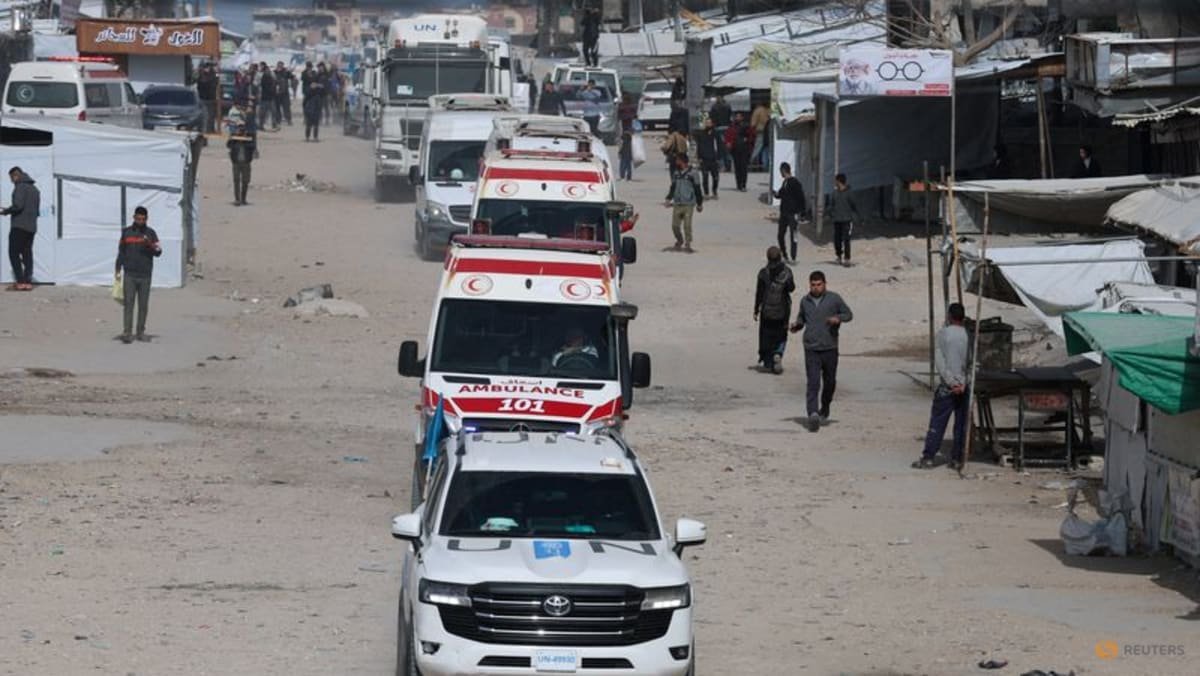
A file photo shows a UN vehicle leading ambulances carrying war-wounded people and patients through the Rafah border crossing between Gaza and Egypt in Khan Younis in the southern Gaza Strip, Mar 19, 2026. (Photo: REUTERS/Ramadan Abed)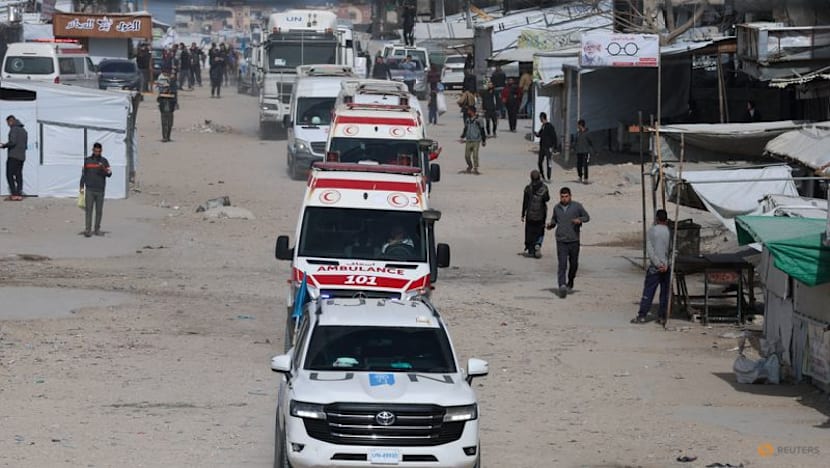
Read a summary of this article on FAST.
Get bite-sized news via a new
cards interface. Give it a try.
Click here to return to FAST
Tap here to return to FAST
FAST
JERUSALEM: US President Donald Trump’s Board of Peace is planning a pilot “humanitarian zone” in southern Gaza which would aim to accommodate tens of thousands of vetted Palestinian civilians, a board official told AFP.
The official said the zone could act as a “starting point” for the Palestinian technocratic committee meant to assume the day-to-day governance of Gaza’s transitional phase out of war under Trump’s 20-point plan.
The pilot zone, which the board is eyeing for Rafah in the southern Gaza Strip, would be secured by multinational troops from the International Stabilisation Force (ISF), a fledgling body which operates under the Board of Peace.
The National Committee for the Administration of Gaza (NCAG), the group of Palestinian technocrats established by the Board of Peace, would carry out screening and access control, supported by the ISF.
The concept of closed humanitarian zones, which has been discussed in various forms for several months, has raised serious reservations, with diplomats and NGO officials working in Gaza telling AFP on condition of anonymity that such a mechanism seems to them to be incompatible with international humanitarian law.
Movement in and out “will remain free for all unarmed civilians,” the board official told AFP on condition of anonymity.
Efforts to advance the US-backed ceasefire plan for Gaza have been stalled for months, with the NCAG stuck in Cairo and yet to actually enter the territory.
Since the truce between Israel and Hamas came into effect last October, Israeli forces have expanded their presence in Gaza, and now control more than 60 per cent of the territory.
“There’s one pilot project we’re looking at particularly, that maybe you can get the NCAG a starting point, you can enable tens of thousands to come if they wish voluntarily to this area, and you start giving them a space where they exercise effective governance and they’re the administration,” the official said.
NO ENTRY FOR MILITANTS
The official said the board was “looking at Rafah” as a location for the project but remained vague on its exact positioning. He said that no building work had begun.
Rafah, which sits at Gaza’s southern edge, was effectively razed by Israeli bombing during the war and the area is now largely under Israeli military control.
The ISF would act as a “kind of buffer” separating the Palestinian population from the Israeli military, the official said.
“A screening mechanism will ensure that armed individuals and militants cannot enter these safe humanitarian zones,” he said.
“This function will not be performed by the IDF (Israeli military), which will have no contact with the civilian population and no role in separating these areas from the rest of Gaza,” the official said.
The Board of Peace was formally established earlier this year as part of the US-backed ceasefire plan for Gaza endorsed by the UN Security Council.
It aims to facilitate a transition away from Hamas rule while supporting the restoration of civilian administration and basic services.
Diplomats and NGO officials working in Gaza say that grouping civilians into demarcated areas subject to access controls could amount to forced displacement of the population, restrict Palestinians’ freedom of movement and undermine the principle of impartiality.
Source: AFP/ec
Sign up for our newsletters

Get the CNA app
Stay updated with notifications for breaking news and our best stories
Get WhatsApp alerts
Join our channel for the top reads for the day on your preferred chat app

Get bite-sized news via a new
cards interface. Give it a try.
Click here to return to FAST
Tap here to return to FAST
FAST