ASEAN sees progress on South China Sea code, targets year-end conclusion
Maritime security concerns – from the Strait of Hormuz to the South China Sea – emerged as dominant issues at this week’s ASEAN meetings in the Philippines, alongside discussions on energy security and Myanmar.
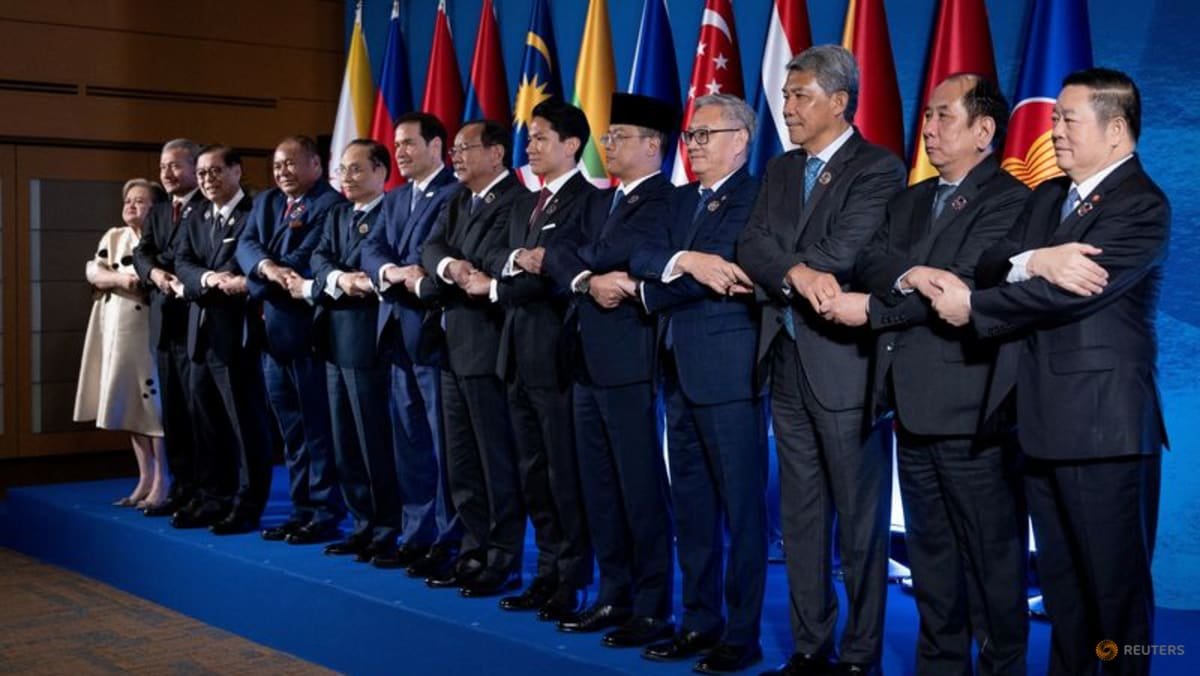
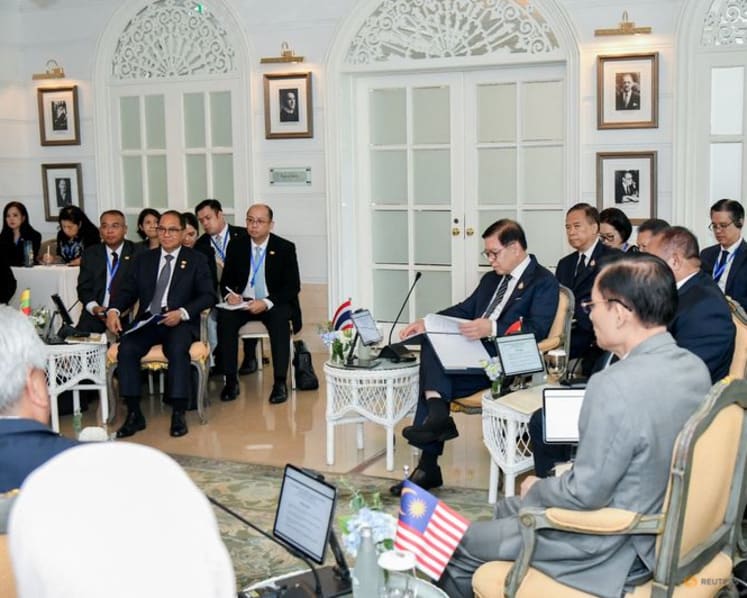
Foreign Ministers at the Association of Southeast Asian Nations (ASEAN) Foreign Ministers’ Meeting in Pasay, Metro Manila, Philippines, July 22, 2026. (Photo: Brendan Smialowski/Pool via Reuters)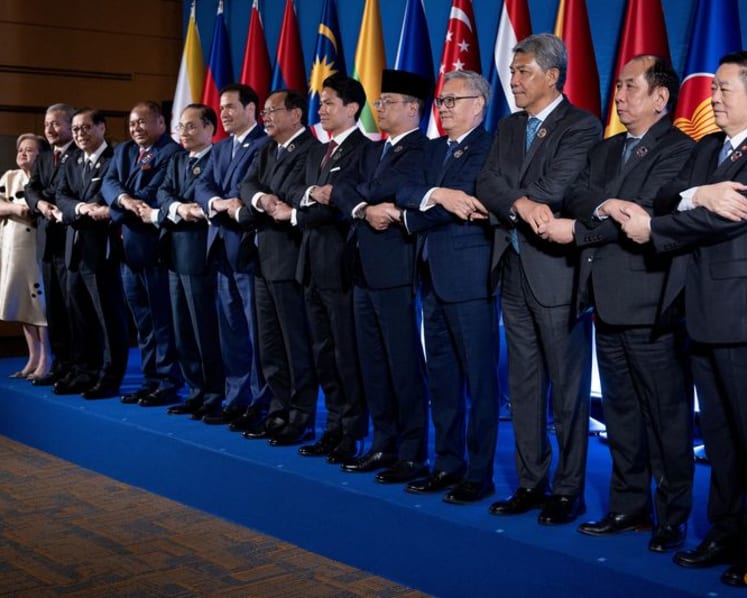
New: You can now listen to articles.

This audio is generated by an AI tool.

Read a summary of this article on FAST.
Get bite-sized news via a new
cards interface. Give it a try.
Click here to return to FAST
Tap here to return to FAST
FAST
MANILA: ASEAN foreign ministers hailed “significant progress” in negotiations on the long-awaited Code of Conduct (COC) for the South China Sea, saying they hoped to conclude talks by the end of this year.
The 59th Association of Southeast Asian Nations (ASEAN) Foreign Ministers’ Meeting wrapped up in Manila on Friday (Jul 24) as renewed tensions flared in the contested waterway, with the Philippines and China trading accusations over separate confrontations near Second Thomas Shoal and Scarborough Shoal.
In a joint communiqué issued on Thursday (Jul 23), ASEAN ministers reaffirmed the importance of maintaining peace, stability and freedom of navigation in the South China Sea.
They said they were “pleased with the sustained positive momentum” in the ongoing negotiations and welcomed the “significant progress achieved so far”.
“We looked forward to continued efforts in endeavouring to conclude the negotiation of an effective and substantive COC that is in accordance with international law, including the 1982 UNCLOS (United Nations Convention on the Law of the Sea), within this year,” the document read.
Philippine Foreign Affairs Secretary Maria Theresa Lazaro, whose country holds the ASEAN chairmanship this year, said the latest incidents will be part of continued discussions on the code.
She added that the pace of negotiations – which has intensified this year – reflected the shared determination of ASEAN member states and China to conclude the agreement.
“This seems to be the focus of many of the countries, and I can see some political will from all the countries involved,” she told reporters on the sidelines of the meeting.
However, analysts cautioned that recent flare ups reveal a gap between diplomatic progress and continued tensions at sea.
“These Code of Conduct negotiations have gone on for decades now and have been quite thorny,” said Mr Andreyka Natalegawa, an associate fellow at Washington-based research institute Center for Strategic and International Studies’ (CSIS) Southeast Asia Program.
“Look at the political realities of what we’re seeing in the waters of the South China Sea – it feels as though a conclusion to the Code of Conduct negotiations seems quite challenging,” he told CNA’s Asia First.

Guess Word
Crack the word, one row at a time

Buzzword
Create words using the given letters

Mini Sudoku
Tiny puzzle, mighty brain teaser

Mini Crossword
Small grid, big challenge

Word Search
Spot as many words as you can
CONCERNS BEYOND SOUTHEAST ASIA
During the meeting, ASEAN foreign ministers also expressed concerns over the situation in the Strait of Hormuz, where months of instability have disrupted global shipping and energy supplies.
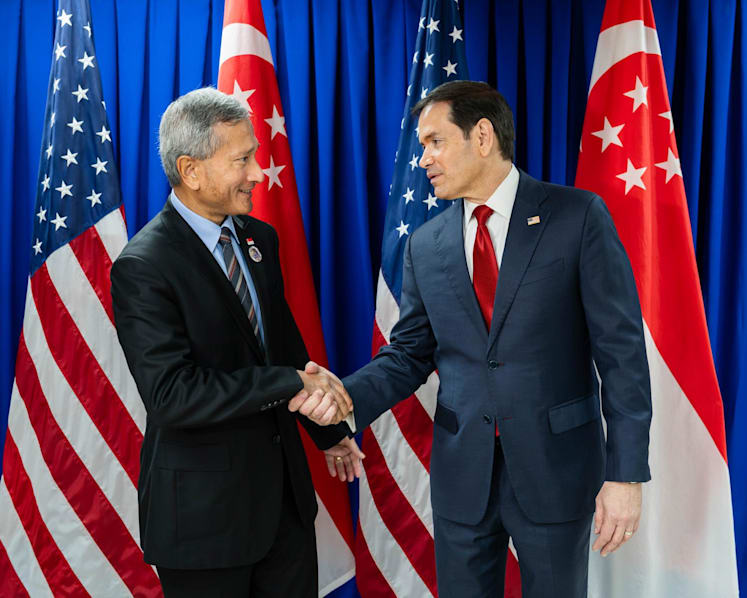
Singapore’s Foreign Affairs Minister Vivian Balakrishnan said recent escalations in the strait, as well as attacks on Saudi tankers in the Red Sea, highlighted the fragility of global supply chains.
“This has (an) impact, certainly on ASEAN, in terms of energy, fertiliser (and) food,” he said, adding there was strong consensus among the bloc’s foreign ministers on the way forward.
“Everyone doubled down on the need to comply with international law, maintain the primacy of international law, and uphold freedom of navigation and overflight,” he said.
MYANMAR REMAINS ON THE AGENDA
The crisis in Myanmar also was discussed during the meeting.
Thailand recently proposed that access to Ms Aung San Suu Kyi – who was state counsellor when she was arrested – be among the indicators used to assess Myanmar’s implementation of ASEAN’s Five-Point Consensus.
Dr Balakrishnan stressed that Ms Aung San Suu Kyi should not be viewed as “a chip to be bargained over”, adding that any changes in ASEAN’s engagement with Myanmar should be based on measurable progress.
“The other parameter … is that just as ASEAN stands willing and able to provide humanitarian assistance, we want to make sure the assistance reaches everyone who needs it, and it’s not filtered on the basis of political affiliation,” he added.
In their joint communique, ASEAN foreign ministers reaffirmed that the Five-Point Consensus remains the bloc’s primary framework for addressing Myanmar’s political crisis.
The peace plan calls for an immediate cessation of violence, constructive dialogue among all parties, the appointment of a special envoy to mediate talks, humanitarian assistance and the envoy’s access to all parties concerned.
Ms Lazaro, who also serves as ASEAN special envoy to Myanmar, said discussions built on informal meetings held in Bangkok on Jul 12, where ASEAN members explored ways to strengthen the bloc’s engagement with Myanmar.
Among the proposals was the appointment of a long-term ASEAN special envoy to replace the current one-year rotating arrangement, providing greater continuity in the bloc’s engagement.
Ms Lazaro is set to visit Myanmar in the last quarter of the year.

Source: CNA/oc(dn)
Sign up for our newsletters

Get the CNA app
Stay updated with notifications for breaking news and our best stories
Get WhatsApp alerts
Join our channel for the top reads for the day on your preferred chat app

Get bite-sized news via a new
cards interface. Give it a try.
Click here to return to FAST
Tap here to return to FAST
FAST