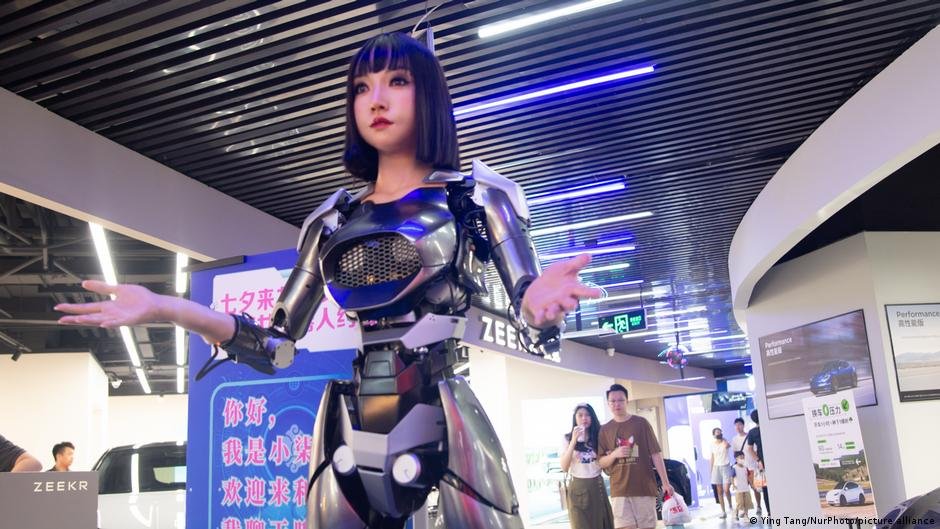
In the latest sign of China’s threat to the United States’s tech dominance, the Trump administration on Tuesday banned new foreign-made humanoid and four-legged robotsfrom entering the country.
The Federal Communications Commission (FCC) cited “unacceptable risks” to national security for the decision.
The FCC noted how the robots “collect data that could be leveraged by malign actors to surveil Americans, enhance the capabilities of foreign intelligence services, or to remotely commandeer the robots.”
The move is widely seen as aimed squarely at China, which accounted for 85% of humanoid robot deployments last year, according to British bank Barclays.
To view this video please enable JavaScript, and consider upgrading to a web browser that supports HTML5 video
How serious is the security threat from Chinese robots?
US officials warn that Chinese humanoid and quadruped (four-legged) robots can collect detailed location and personal data, be controlled remotely and pose risks for critical US infrastructure. Specific concerns center on the robots’ potential dual-use — civilian and military purposes.
Unitree Robotics, a leading Chinese robot maker, appears on the Pentagon’s list of firms with links to the Chinese military. Its robots have been used in army exercises.
Researchers have also shown that Unitree robots have security flaws that let attackers take control with a voice command and then use one robot to control others.
Washington is also concerned that a large cohort of low-cost Chinese robots could feed real-world data back to Chinese artificial intelligence (AI) systems, which are fast catching up with their US rivals.
The threat, however, is largely theoretical as most commercial humanoid robots are in early stages of development.
China has rejected the accusations, insisting the US is using national security as a pretext for protectionism to suppress Chinese technology. Beijing is expected to impose countermeasures, which could include curbs on the raw materials US robotics firms urgently need to scale up production.
The Trump administration has made no secret of its desire to help the domestic US robotics industry, which in turn supports the country’s nearly trillion-dollar AI buildout. According to industry watchers, US President Donald Trump wants to ensure the likes of Figure AI, Tesla Optimus and Agility Robotics are protected from high-volume Chinese producers, whose robots often cost half the price or less of their US rivals.
Washington has put similar curbs on Chinese drones and solar panels and now levies a 100% tariff on Chinese electric vehicles.
Will the ban help US robot makers catch up?
The ban is widely seen as Trump’s attempt to buy time, having been caught off guard by how quickly China scaled robotics production.
According to Omdia, a tech research house, China has six firms in the Top 10 robotics rankings. Those firms shipped nearly 11,600 humanoids last year, versus a few hundred by US firms.
In March, Bank of America forecast around 90,000 shipments by the end of this year.
The US is widely seen as stronger at making a robot’s brain smart through advanced AI, while China leads at mass-producing cheaper robots with bodies that move better thanks to high-performance actuators or robotic muscles.
Rush Doshi, director of the Initiative on China Strategy at the Council on Foreign Relations, described the ban as “one of the most significant actions taken so far in support of the US robotics ecosystem.”
Evan Beard, CEO of Standard Bots, a maker of robot arms, thinks the Trump administration is sending an “unambiguous” message to China.
“Robotics is a technology America must lead and own — and foreign-subsidized robots will not be allowed to unfairly dominate US robotics…” Beard wrote on X.
Critics, however, think the ban could slow US AI innovation as researchers currently benefit from being able to run tests on budget-friendly Chinese robots.
“Restrictions can reduce security exposure, but they do not by themselves create a competitive domestic ecosystem,” Georg Stieler, an advisor to the robotics industry, wrote on X.
CNBC, a US business television channel, cited Marc Einstein, a research director at Counterpoint Research, as saying the ban was “bad news for Chinese humanoid producers planning their IPOs in the coming months.”
Einstein warned that Beijing could now “further restrict rare earth sales to American companies and … Chinese market access for American companies like Tesla and Nvidia.”
To view this video please enable JavaScript, and consider upgrading to a web browser that supports HTML5 video
How big could humanoid robots become?
Barclays estimates the market, currently worth just $2 to 3 billion (€1.7 to 2.6 billion), could reach $200 billion by 2035 in the most optimistic scenario, if the robot’s brains, brawn and batteries can be improved.
Elon Musk is even more bullish, saying Tesla’s Optimus could become “the biggest product ever” with long-term sales potentially reaching $10 trillion.
At scale, he believes the robots, which currently sell for about $100,000, could eventually cost $20,000 to $30,000 each — cheap enough for factories, warehouses and later homes.
Combining Barclays’ forecast with Musk’s target price points to roughly 7 to 10 million humanoid robots being sold each year by 2035.
In the near term, humanoids are expected to take on repetitive and physically demanding jobs in warehouses and factories. Later, they could expand into health, elderly care and household chores.
Edited by: Rob Mudge
About The Author