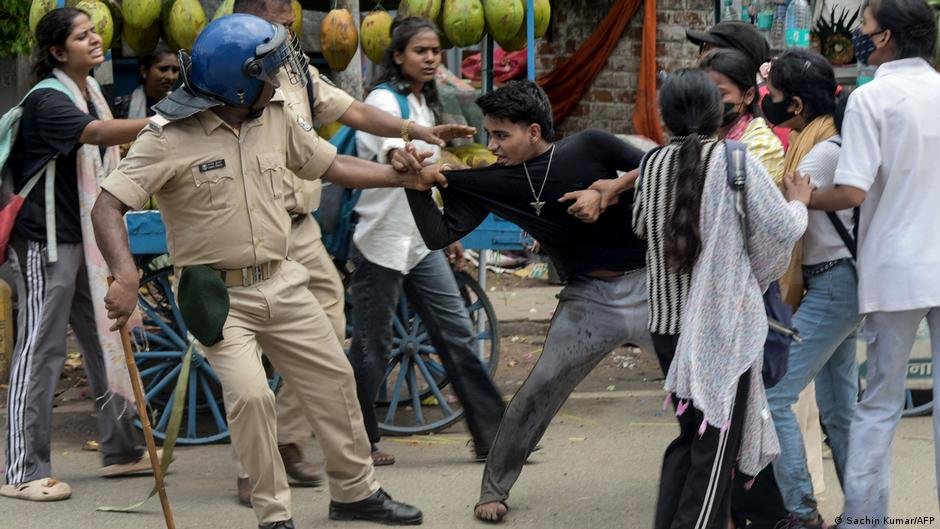
A student-led protest movement in Indiasatirically called the Cockroach Janata Party (CJP) scored a major political win when Education Minister Dharmendra Pradhan stepped down after weeks of protests calling for his removal.
The movement began on social media as an activist campaign sparked by leaks of a question sheet for the NEET exam, a highly competitive entrance test for aspiring medical students, in early May.
Along with the education minister stepping down, the government promised to withdraw police cases against peaceful protesters, compensate families affected by the NEET examination controversy and continue talks on the movement’s five-point charter for reforming India’s examination system.
Now, student leaders, lawyers and activists say the battle has shifted from the streets to police stations, courtrooms and social media.
Indian lawyer and politician Kapil Sibal told DW that the government’s actions after the movement called off further protests have raised fresh questions about whether its public assurances are being honored.
“The way Dharmendra Pradhan was celebrated after his resignation shows the government has learned nothing from the protests or the message the students were trying to convey,” Sibal said.
Authorities seek legal wiggle room with protesters
The agreement that ended the protests appeared straightforward. Governments in Delhi, Bihar, Assam, Maharashtra and West Bengal announced that protest-related police cases would be withdrawn and detained students released.
But some of those orders included an important caveat. The protection does not extend to protesters whom police describe as having “criminal antecedents,” a condition that student leaders say was never discussed during negotiations.
Senior advocate Rebecca Mammen John told DW that government assurances alone do not automatically end criminal proceedings.
“There is a prescribed legal process for withdrawing criminal cases. An oral assurance from the government counts for nothing unless that process is followed,” John said.
“Ultimately, it is the courts that decide whether prosecutions are withdrawn or whether police cases are closed.”
For the CJP, that legal distinction has become a new battleground. Its leaders argue the “criminal antecedents” clause risks leaving room for selective prosecution even after the movement agreed to suspend its protests.
Government officials, meanwhile, insist peaceful protesters have nothing to fear and that investigations will continue only against those accused of violence or other criminal offenses.
India’s Supreme Court, led by Chief Justice of India Surya Kant, said that both police and protesters would be held accountable for violations of the law.
“Whoever has committed excesses and taken [the law into their own hands], and whoever has committed atrocities, they must be brought under the law,” the court said in a hearing on Tuesday regarding the police response to the protests .
A legal battle continues
Sibal told DW that the government’s position before the courts appears inconsistent with the commitments it made while negotiating with the students.
“On the one hand, the government promised that no cases would be foisted on students. On the other, investigations against those said to have criminal records continue,” he said.
“Who allowed criminal elements to enter the protests? Who allowed trucks carrying stones to reach the protest sites? Certainly not the students.
“My fear is that innocent students will end up in jail while the real criminal elements walk free.”
In Kolkata, lawyers Raja Sengupta and Syed Nafirul Islam, who have represented detained protesters pro bono, said the legal fight is far from over.
“Oppression of protesters by governments is not new,” Sengupta told DW. “Our responsibility is to defend people’s democratic rights. The students were protesting for a genuine cause, and they deserve legal protection.”
P S Sanjeev, Kerala state secretary of the Students’ Federation of India, said uncertainty remains.
“We are still trying to establish exactly which police cases have been withdrawn,” Sanjeev told DW. “There is very little clarity, and many families remain anxious.”
Student protesters still under pressure
Student protesters say that police action has changed rather than disappeared. Instead of large-scale arrests during demonstrations, they describe police visits to homes, questioning based on photographs and CCTV footage, continuing investigations and monitoring of social media activity.
A senior Delhi Police official rejected allegations of intimidation, saying officers were only following up on registered cases and investigating alleged offences using CCTV footage, photographs and other digital evidence.
“No one is being targeted for peaceful protest. Action is being taken strictly in accordance with the law against those suspected of criminal acts,” the official told DW on condition of anonymity.
The ruling Bharatiya Janata Party (BJP) did not respond to DW’s requests for comment.
Among those who have approached the courts is Mohammad Junaid Malik, a law student who ran protest-relateda free community kitchen for protesters at Delhi’s Jantar Mantar for 35 days. He has petitioned the Supreme Court, alleging illegal detention, interrogation and harassment of his family after the protests ended.
In Uttar Pradesh state, a young protester told DW anonymously that he was detained after police identified him from a photograph taken during a solidarity demonstration. Police deny any illegal detention and say individuals were questioned before being released.
In Bihar, student organizations say several protesters, including minors, were detained before the state began withdrawing protest-related cases. Police have since begun releasing detainees and removing photographs circulated to identify alleged participants in violence.
“It was an anxious wait for parents” outside the jail, Patna-based student activist Soma Roy told DW. “Many families were not even told where their children had been lodged.”
Student leaders say such incidents have left many protesters uncertain whether the assurances announced by governments are being implemented on the ground.
Several Instagram users said posts and videos relating to the July demonstrations have disappeared, while CJP leaders allege police are identifying protesters through photographs, social media posts and facial recognition technology.
They argue the aim is not simply to investigate alleged offenses but to discourage future mobilization.
“We know how the police operate, and it is up to its old tricks. It is sheer bullying,” Naveen Kumar, an engineering student from Delhi, told DW.
To view this video please enable JavaScript, and consider upgrading to a web browser that supports HTML5 video
Students say police seek to prevent future protests
The result, student groups say, is a climate of fear that lingers. Particularly in Bihar and Uttar Pradesh, several protesters have said they remain under watch even after the demonstrations ended. Students argue the aim is not simply to investigate alleged offenses but to discourage future mobilization.
Neha Bora, president of the All-India Students’ Association (AISA), said the movement is concerned by the government’s emphasis on alleged criminal records.
“That was never part of the assurances given to us,” Bora, who was on a 23-day-long hunger fast, told DW.
“The police have spoken of around 2,800 protesters with criminal cases. To us, that looks like an attempt to justify the crackdown and discredit the movement,” Bora said.
“The aim is to create fear and break the unity that defined the protests,” she said. “But students continue to stand together and demand the release of everyone detained.”
Edited by: Wesley Rahn
About The Author