NASA announces end of long-operating Mars probe’s mission
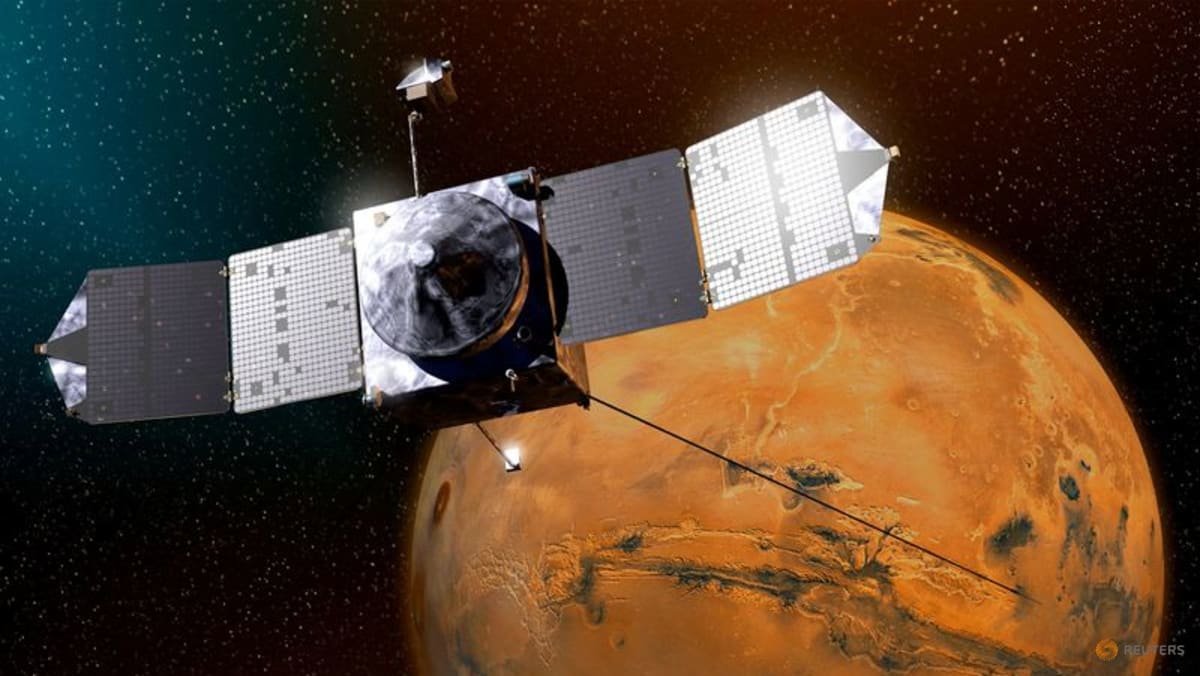
An artist’s concept of NASA’s MAVEN spacecraft orbiting Mars. NASA/Goddard/University of Colorado/Laboratory for Atmospheric and Space Physics/Handout via REUTERS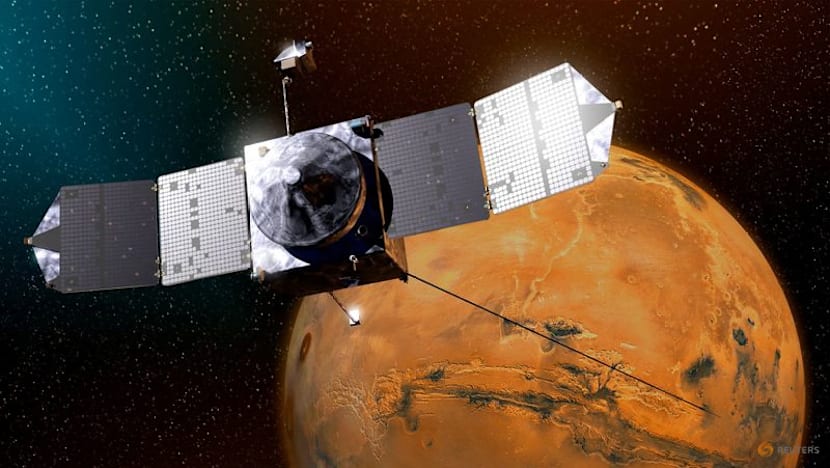
Read a summary of this article on FAST.
Get bite-sized news via a new
cards interface. Give it a try.
Click here to return to FAST
Tap here to return to FAST
FAST
WASHINGTON, May 29 : NASA announced on Tuesday the end of the mission of its MAVEN spacecraft, which spent more than 11 years orbiting Mars to study the atmosphere of Earth’s planetary neighbor, after losing contact with the robotic probe six months ago.
MAVEN, short for Mars Atmosphere and Volatile Evolution, was the U.S. space agency’s first mission devoted to observing the Martian atmosphere and its evolution. Launched in 2013, it began orbiting Mars in 2014 and exceeded its originally planned one-year mission by a decade.
NASA officials told reporters on Wednesday that they last heard from MAVEN on December 6, when it experienced an unexpected loss of signal after passing behind Mars from Earth’s vantage point, and was later determined to be in “an unrecoverable state.”
Mike Moreau, MAVEN project manager at NASA’s Goddard Space Flight Center in Maryland, said a NASA review board is working to determine what caused the failure.

Guess Word
Crack the word, one row at a time

Buzzword
Create words using the given letters

Mini Sudoku
Tiny puzzle, mighty brain teaser

Mini Crossword
Small grid, big challenge

Word Search
Spot as many words as you can
MAVEN was involved in relaying Mars science data from assets such as the robotic surface rovers Curiosity and Perseverance to Earth. Tiffany Morgan, director of the Mars exploration program in NASA’s Planetary Science Division, said there now is “a slight delay on occasion” in getting such science data relayed.
MAVEN explored the Martian atmosphere and studied atmospheric interactions with the sun and the solar wind – the relentless high-speed flow of charged particles from the sun – to better understand the loss of the planet’s atmosphere to space.
Mars more than three billion years ago had a thicker atmosphere and large amounts of liquid water on its surface, with conditions that may have been conducive to microbial life. Studying current atmospheric loss provides insight into how Mars became the inhospitable place it is today.
“We now have a better understanding of atmospheric escape at Mars than at any other planet, including Earth,” Curry said.
MAVEN learned, for instance, that the erosion of the Martian atmosphere increases dramatically during space weather events – when solar storms erupt off the sun’s surface. MAVEN discovered several types of auroras that flare up when energetic particles from these storms plunge into the atmosphere. It also worked with Perseverance to observe an aurora on Mars in visible light for the first time, with the sky glowing softly in green.
MAVEN last year also was able to observe the interstellar comet 3I/ATLAS.
Moreau said the NASA review board is continuing its investigation into what happened to MAVEN, and “we expect to have the results from their work in the coming months.”
Moreau said that while MAVEN normally did not rotate in orbit, it emerged from the pass behind Mars spinning at a rate of 2.7 revolutions per minute. Moreau said the review board concluded that due to this rotation, MAVEN’s batteries were likely drained, causing its communication system to eventually lose power.
Greg Heckler, a deputy program manager for the unit that leads NASA’s space communications operations, said the agency’s Mars relay network has four other spacecraft still operating, but noted that there have been “some small adjustments” made to rover operations as a result of MAVEN’s failure. Morgan said the relay network is resilient enough to make up for the loss of MAVEN.
NASA officials said MAVEN will remain in orbit for 50 to 100 years before falling to the Martian surface, and said it would not endanger any of the agency’s other spacecraft. MAVEN travels in a highly elliptical – oval-shaped – orbit around Mars, getting as close as around 110 to 135 miles (180 to 220 km) and as far away as around 2,500 miles (4,000 km).
Source: Reuters
Sign up for our newsletters

Get the CNA app
Stay updated with notifications for breaking news and our best stories
Get WhatsApp alerts
Join our channel for the top reads for the day on your preferred chat app

Get bite-sized news via a new
cards interface. Give it a try.
Click here to return to FAST
Tap here to return to FAST
FAST
About The Author