Munich‘s Public Prosecutor’s Office believes it has solved one of the worst antisemitic attacks in post-war German history.
Police and prosecutors said on Thursday that new investigations point “clearly” towards the involvement of a man who died in 2020.
Additional information came to light after his death which led to the case being reopened in April 2025.
Now, with investigators satisfied that the culprit is identified — but with no scope to prosecute the deceased and no known indications of accomplices — they are closing the file once again.
What is the case about?
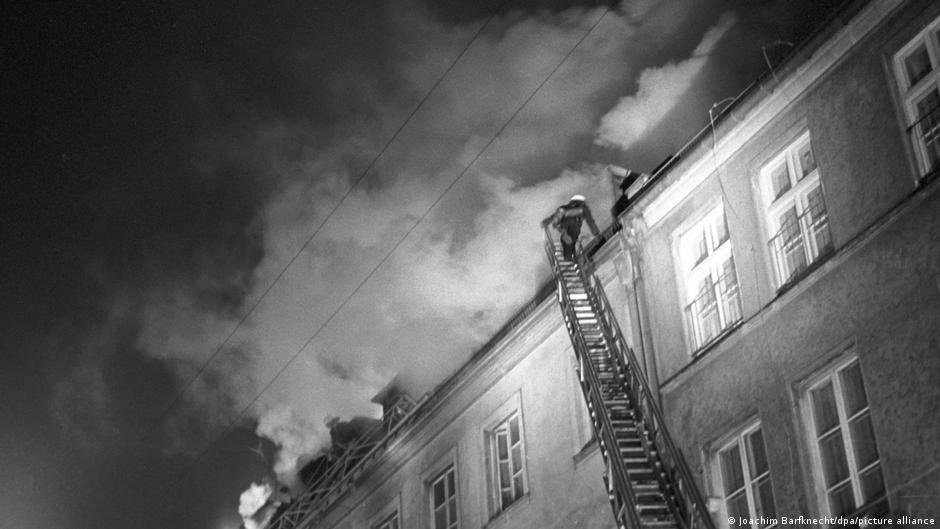
On February 13, 1970, a fire broke out at the Jewish religious community for Munich and Upper Bavaria, in the area incorporating its retirement home, killing seven people.
All of them had survived the Holocaust and two were inmates in Nazi German concentration camps.
Prosecutors said the fire was set using a “gasoline mixture” that was sprinkled and lit in several different places in a stairwell, hoping to ensure that it spread.
Another 15 people were wounded in the fire, four of them seriously. The building in central Munich sustained severe damages, particularly on the upper levels as a result of the stack effect channeling the flames up the stairwell.
What led investigators to reopen the file?
Investigations were originally halted in 2017, almost 50 years after the suspected homicides.
Prosecutors and Munich’s police precinct explained what led them to reopening the case in Thursday’s joint statement.
“A witness provided credible information on the suspect,” they said. “She said that the suspect had been in close contact with one of her close relatives in the 1970s. Shortly after the death of this relative, she revealed her knowledge on the matter.”
Authorities reviewed old files and also interviewed contacts of the suspect in the renewed investigation.
What did investigators say about the suspect?
Prosecutors did not identify the suspect, and stressed that posthumous prosecution was not possible in Germany and that the presumption of innocence still applied in death.
They identified him as a man who died in 2020 and who was 25 years old at the time of the attack. He was regularly in the area of the religious center on Reichenbachstrasse at the time, they said.
On the evening of the fire, investigators said he was alleged to have complained that “the Jews have everything” while standing in sight of the old people’s home and to have expressed a desire to set them alight. Within a quarter of an hour, the building was ablaze, prosecutors said.
“These allegations are based on credible statements from the witness, who in turn was relaying what her deceased relative told her,” the prosecutor’s office said. “Additional relatives confirmed these statements.”
What did prior background investigations reveal?
Prosecutors also said that background investigations further solidified their suspicions.
The suspect was a known member of the far-right community in Munich at the time, with witnesses describing him as an antisemite with a “Hitler obsession.”
In his youth he had listened to Hitler speeches on records. He practiced shooting near Adolf Hitler‘s Berghof holiday home in the Bavarian Alps, the site of multiple antisemitic crimes against humanity in the Nazi era.
He had a history of using explosives and a juvenile conviction for blowing up two telephone booths in the 1960s. A headteacher also recalled a violent incident from his youth when he pulled a Hitler youth dagger which he said was a gift from his father.
Prosecutors said it was not possible to say whether the suspect acted alone or in a group with certainty, but also said the investigations had not found any indications of accomplices.
“All in all, the new investigations conducted after the reopening of the case speak clearly for the suspect’s involvement,” prosecutors concluded, albeit with it no longer being possible to try the case in a court of law.
If you rely on our team for trusted reporting, please take a moment to select us as your Preferred Source on Google, so you’ll always see our verified news first.
Edited by: Zac Crellin