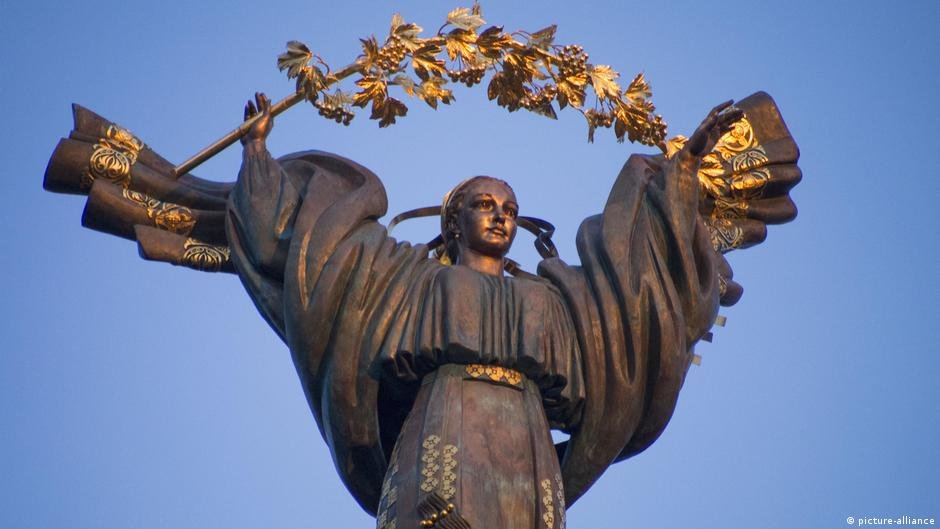
In the 35 years since the collapse of the Soviet Union, Ukraine has charted a path toward Europe, marked by sweeping reforms. Then came the Russian invasion.
Image: picture-alliance
Following the attempted coup in Moscow on August 19, 1991, the parliament of the Soviet republic of Ukraine adopted the Act of Independence on August 24. More than 340 of of the 362 members present voted in favor. In the photo, they are carrying the Ukrainian flag into parliament, known as the Verkhovna Rada.
Image: Privatarchiv Jaroslaw Kendsjor
On December 1, 1991, a nationwide referendum and the presidential election were held. The referendum posed a single question: “Do you approve of Ukraine’s declaration of independence?” A total of 90% voted “Yes.” Leonid Kravchuk won the presidential election with 61% of the vote.
Image: Liu Heung Shing/AP Photo/picture alliance
The early years of independence were marked by hyperinflation, which wiped out the savings of millions of Ukrainians. Overall, prices rose by a factor of approximately 95,000 between January 1991 and September 1996. Due to the economic crisis and unpaid wages, a large portion of the population fell into poverty. The Ukrainian national currency, the hryvnia, was introduced in 1996.
Image: Liu Heung Shing/AP Photo/picture alliance
On November 21, 2004, the Orange Revolution began, triggered by allegations of election fraud in the presidential runoff election. Viktor Yanukovych was declared the winner. The protests ended with an order to hold a new runoff election, from which opposition candidate Viktor Yushchenko emerged victorious. Yanukovych later returned to power, however.
Image: Sergey Dolzhenko/picture-alliance/dpa
On November 21, 2013, mass protests began in Kyiv against the decision by the then-government under President Viktor Yanukovych to suspend the signing of the Association Agreement with the EU. Following deadly clashes between security forces and demonstrators in February 2014, the parliament stripped Yanukovych of his presidential powers. He was forced to flee.
Image: Vasily Maximov and Maksym Marusenko/ AFP
On February 20, 2014, Russian soldiers without insignia crossed the Ukrainian border and occupied strategic sites in Crimea. Based on a “referendum” that was not recognized internationally, the Kremlin announced the annexation of Crimea on March 18, 2014. In April of that year, Russia’s armed aggression began in eastern Ukraine.
Image: Filippo Monteforte/AFP/Getty Images
On February 24, 2022, at 4 a.m. local time, Russia launched its full-scale invasion of all of Ukraine. The offensive, which continues to this day, triggered the largest war on the European continent since the end of World War II.
Image: picture alliance/dpa/Mary Ostrovska/AP
Images from Bucha, near Kyiv, made headlines around the world in the spring of 2022. After Russian troops withdrew, numerous dead civilians were discovered there. The town became a symbol of the alleged war crimes committed by the Russian army in Ukraine. The international investigations are ongoing.
Image: Vadim Ghirda/AP/picture alliance
The siege of Mariupol in 2022 led to a severe humanitarian crisis. Food and water shortages, as well as ongoing shelling, claimed the lives of thousands of residents. The Azovstal steel plant became the last bastion of Ukrainian resistance in the city. Many of the defenders there were later taken prisoner by Russian forces.
Image: Chingis Kondarov/REUTERS
On June 23, 2022, the European Council officially granted Ukraine the status of an EU candidate country. Kyiv had submitted its application just a few days after the start of Russia’s full-scale invasion. On June 15, 2026, the first negotiation cluster in the EU accession process was officially launched. With this, Ukraine entered a new phase on its path toward the European Union.
Image: Christoph Hardt/Geisler-Fotopress/picture alliance 10 images1 | 1010 imageshttps://p.dw.com/p/5JKTf
About The Author