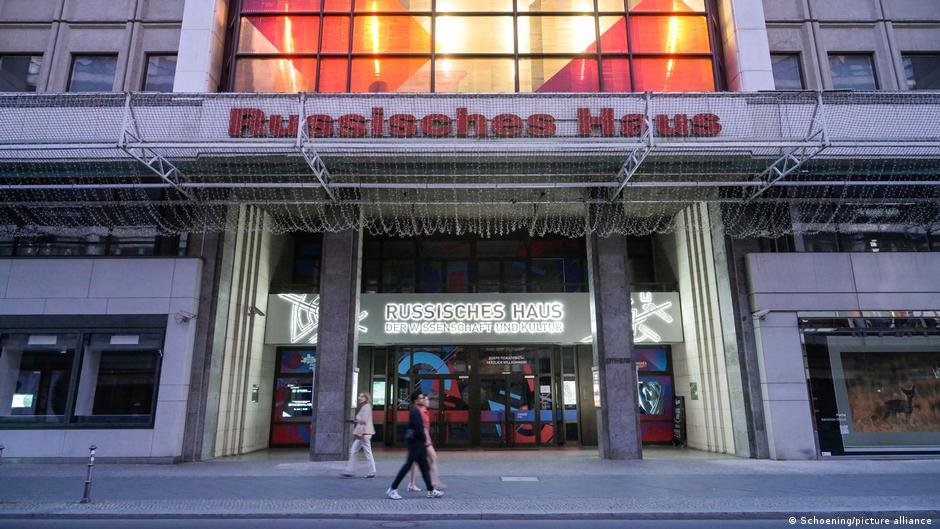
Foreign Minister Johann Wadephul has announced that the contract under which the Russian House is operated will be rescinded. This is one of several measures in retaliation for Russian involvement in the attempted airport drone attack at the Leipzig/Halle Airport on August 4.
The Russian House is centrally located on Friedrichstrasse in the heart of the German capital. As a throwback to a bygone era of friendly German-Russian relations, it has long been the subject of fierce disagreements and has long been a bone of contention in Berlin.
The massive seven-story building covering an area of almost 30,000 square meters opened in 1984. At that time, back in the days of the East German state, its role was to celebrate friendship with the Soviet Union through concerts, film screenings and book readings. It even had its own small bookstore.
To view this video please enable JavaScript, and consider upgrading to a web browser that supports HTML5 video
French authorities have linked the building to possible activities by Russian intelligence services.
“In light of the measures taken against German cultural institutions and organizations, the federal government is comprehensively and continuously reviewing the legal basis of the Russian House under international treaty law,” said German Foreign Ministry spokesperson Martin Giese at a press conference in Berlin at the beginning of August 2026.
Back then, in response to a question from DW about the organization’s future activities, Giese emphasized that the fate of the Russian House is linked to that of the Goethe Institut in Moscow, and that any action taken against one would also have direct consequences for the other.
German tax money for Russian propaganda?
The property on Friedrichstrasse belongs to Germany, yet the building is run by the Russian agency Rossotrudnichestvo, the Federal Agency for the Commonwealth of Independent States, Compatriots Living Abroad and International Humanitarian Cooperation.
Rossotrudnichestvo, whose primary purpose is to promote the Russian language abroad, currently has dozens of similar institutions worldwide. The German Foreign Office has repeatedly stated that the employees of the institute have diplomatic status in Germany.
Since 2022, following Russia’s invasion of Ukraine, the agency has been on the EU sanctions list. At the time, the EU justified this by stating that the agency’s goal was to consolidate “a wider public perception of the occupied Ukrainian territories as Russian.”
Moscow still maintains that the Russian House is a place to celebrate the friendship between the two countries: “The Russian House is Russia’s cultural embassy in the heart of Berlin,” according to the Russian Embassy’s website.
The events that take place there attract 200,000 visitors a year, according to Russian House organizers. Critics label them as propaganda.
Berlin media outlets have repeatedly reported on events at the in-house cinema where, for example, films were shown in which Ukrainian citizens were portrayed as Nazis.
Germany fears closure of Goethe-Institut in Moscow
The Russian House is owned by the Russian Federation, but the Federal Republic of Germany pays the property tax for the building on the basis of its legal obligation under the bilateral German-Russian agreement on property issues relating to cultural institutes.
Moscow and Berlin are also bound by the Intergovernmental Agreement on Cultural Cooperation, which was signed in December 1992 and entered into force in May 1993. It has a term of five years and is automatically extended for the same period unless one of the parties notifies the other at least six months before the expiration of the respective term.
Both agreements — regarding the property of the Russian House and the Goethe-Institut, as well as the cultural cooperation between Russia and Germany — remain in force even in the fifth year of Russia’s war against Ukraine.
It is an open secret that the German government has been shying away from conflict over the Russian House because it fears the Russian government could respond by closing the Goethe-Institut in Moscow.
The institute was already forced to significantly scale back its operations in Russia in May 2023, when restrictions were imposed on the number of German officials in Russia.
A few weeks earlier, the Goethe-Institut’s bank accounts in Russia were frozen in retaliation after the Berlin Public Prosecutor’s Office opened a preliminary investigation against the Russian House for violating sanctions and ordered the freeze of its accounts.
So far, the Goethe-Institut continues to offer digital language courses in Russia. The libraries at its branches in Moscow and St. Petersburg continue to receive the latest German literature despite logistical difficulties, as representatives of the institute assured DW earlier this year.
Direct Russian-German contacts have become virtually impossible
In recent years, several German foundations in Russia have been classified as “undesirable organizations.”
This includes the foundations run by Germany’s established political parties.
Anyone who cooperates with “undesirable organizations” faces criminal prosecution in Russia. This makes all direct contact provided for in the cultural agreement virtually impossible.
This article was originally written in German and first published in August 2025. It was updated and republished in September 2026 to reflect news developments.
About The Author