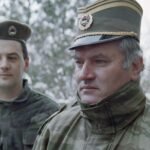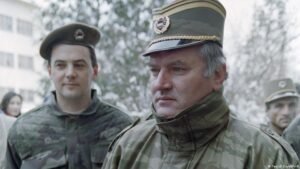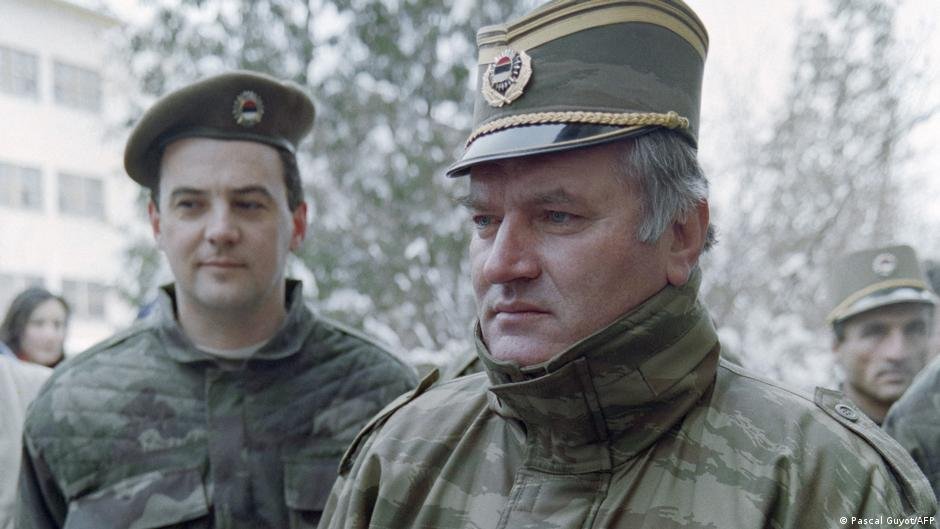
The death of Ratko Mladic should have closed one of the darkest chapters in European history.
Instead, it has reopened old wounds, proving that both the Dayton Accords that ended the 1992-95 Bosnian war and the three decades of international engagement that followed never came close to addressing the causes that led to the conflict.
When Mladic, the former commander of the Bosnian Serb army, died on August 27, 2026 in a prison hospital in The Hague, his conviction for genocide, crimes against humanity and war crimes — including the 1995 Srebrenica massacre and the siege of Sarajevo — had been final for nearly a decade.
To view this video please enable JavaScript, and consider upgrading to a web browser that supports HTML5 video
What was never settled, however — and what, it seems, was never even seriously attempted — is the question of how a society lives with a man who remains a convicted criminal in the eyes of an international court but is viewed by some as a hero and symbol of the Serbian people.
For this reason, the reactions that followed Mladic’s death came as no surprise.
Mladic openly mourned in Republika Srpska
In Serbia and the Serb-dominated Republika Srpska, one of the two semi-autonomous entities created within Bosnia-Herzegovina by the 1995 Dayton Peace Agreement, Mladic’s death was mourned as the loss of a national hero, not the end of an era of crimes — a narrative that stands in direct contradiction to the facts established by international courts.
Senior officials in Republika Srpska, which covers around 49% of the territory of the former Yugoslav republic of Bosnia-Herzegovina, called on citizens to gather in squares and light candles “for the salvation of the general’s soul.”
Milorad Dodik, still the most powerful political figure in Republika Srpska despite stepping down as its president last year after a six-year ban on holding public office imposed by Bosnia’s constitutional court, called Mladic’s death a “murder,” suggesting it was “an organized approach that was meant to lead to a fatal outcome.”
In Banja Luka, the de facto capital of Republika Srpska, Mayor Drasko Stanivukovic expressed his condolences to Mladic’s family and confirmed that Mladic is not perceived as a man convicted of genocide but as a symbol of “a time and a struggle.”
Institutional support in Belgrade
In the Serbian capital, Belgrade, this stance received institutional backing.
Serbia’s justice minister announced a funeral with the highest state and military honors.
President Aleksandar Vucic accused the tribunal in The Hague of “uncivilized behavior” for not allowing Mladic to spend his final days outside his prison cell.
Former Interior Minister Aleksandar Vulin spoke of Mladic in the same breath as other Serbian national heroes, invoking a narrative linking World War I to the 1990s, saying, “From Gavrilo Princip to Ratko Mladic, the best Serbs are killed tied up.”
A very different response elsewhere in Bosnia
In the Federation of Bosnia-Herzegovina, the other main entity in Bosnia, where Bosniaks and Croats form the majority, news of Mladic’s death was met with unanimous condemnation of the deceased, given that Mladic was finally convicted of genocide in Srebrenica, a town in eastern Bosnia where around 8,000 men and boys were killed in July 1995.
Bosnia’s foreign minister, Elmedin Konakovic, framed the official Serbian response as Serbia’s conscious choice. “No one is forcing Serbia to treat Mladic as a hero, nor to attribute his crimes to it. Serbia is choosing this itself,” he said.
Representatives of victims and survivors pointed out that any public glorification is a direct insult to the families of those killed.
The European Commission, responding to questions about the announced state funeral, said that “glorifying convicted war criminals is contrary to the most basic European values” and that such practices have no place in either member states or candidate countries.
The European Movement in Serbia warned that a state funeral would amount to “institutional glorification” and a “serious moral, legal and political attack on Serbia.” It urged the Serbian government to abandon the plan.
How can this happen?
But how is it possible that a man who has been finally convicted of genocide in Srebrenica is still honored as a military commander?
The answer is not simply that he is viewed by some as a national hero. It is structural, and it begins with the Dayton peace agreement itself.
The 1995 Dayton Accords ended the war in Bosnia-Herzegovina by turning existing front lines and territorial control into the constitutional architecture of a new state.
One of the fundamental elements of the agreement was Republika Srpska, which is recognized by all signatories and embedded in the constitutional structure of Bosnia-Herzegovina.
That division was not an administrative technicality; it reflected the political reality on the ground at the time negotiations were held, including territories under the control of forces commanded by Mladic.
The compromise was necessary to stop the bloodshed. The problem is that since 1995, it has never been accompanied by a mechanism for dealing with the past that would match the political compromise.
Dayton created a complex constitutional architecture — a state divided into two entities and the Brcko District with a total 14 governments and parliaments at state, entity and cantonal level — for a country of just 3 million people.
It is a system built to prevent war, not a system built to produce common citizenship, and was described by the Council of Europe’s Venice Commission as long ago as 2005 as “neither rational nor efficient.”
In such a system, where ethnic identity is built into the very logic of power, denial or relativization of crimes is not a marginal phenomenon, it is a political resource.
In other words, each side sees itself as a victim, which makes joint recognition of committed evil as a precondition for reconciliation impossible.
Price of missed responsibility
Bosnia-Herzegovina has state-level legislation that criminalizes the public denial, gross minimization or justification of genocide and the glorification of persons convicted of such acts.
To view this video please enable JavaScript, and consider upgrading to a web browser that supports HTML5 video
In reality, however, enforcement of this legislation remains uneven.
Serbia has no such law, and its public authorities, instead of distancing themselves from Mladic’s legacy, openly embrace it.
This is not just a symbolic difference, it is the difference between treating the wartime legacy as something shameful to be overcome or as a resource to be politically exploited.
Dayton Accords helped maintain status quo
The international community, which stopped the war in 1995 through force and diplomacy, has subsequently retreated into the role of administrator of the status quo.
The Office of the High Representative, the international envoy empowered to impose laws and remove obstructive politicians under the Dayton Accords, did indeed impose laws and remove obstructive politicians for decades. But in doing so it only stabilized the system without dismantling its causes.
The result is twofold: a deeply divided society that has not moved forward in the 30 years since the end of the war, and the fact that an ideology that gave rise to that war is still very much alive.
Edited by: Aingeal Flanagan
About The Author