



Singaporeans lured by alleged pyramid scheme linked to investment opportunities in China
Amid a clampdown by Chinese authorities on pyramid schemes, CNA has learnt of at least a dozen Singaporeans who were approached by fellow Singaporeans over a so-called business and investment scheme in China’s southern city of Nanning.
It is unclear how many Singaporeans have been approached or are involved in the alleged pyramid scheme in China, but many of those interviewed by CNA, most of whom requested their full identity not be revealed, said they knew others who were part of it. (Image: iStock)
New: You can now listen to articles.

This audio is generated by an AI tool.


Read a summary of this article on FAST.
Get bite-sized news via a new
cards interface. Give it a try.
Click here to return to FAST
Tap here to return to FAST
FAST
SINGAPORE: When Michelle (not her real name) accepted an invitation earlier this year to learn about a business opportunity linked to the Chinese city of Nanning, she believed this was a chance to join what appeared to be an exclusive investment venture.
However, she has since started to have doubts about the scheme and is trying to recover more than S$75,000 (US$59,200) that was invested.
Michelle was introduced to the programme earlier this year. She was facing challenges in her job and had become curious when a long-time friend, Evelyn (also not her real name), told her she was “doing business” while travelling frequently.
Evelyn invited her to find out more and to join her on one of her trips.

Guess Word
Crack the word, one row at a time

Buzzword
Create words using the given letters

Mini Sudoku
Tiny puzzle, mighty brain teaser

Mini Crossword
Small grid, big challenge

Word Search
Spot as many words as you can
In a few weeks, Michelle was on a flight from Singapore to Nanning, capital of Guangxi in China’s south.
Over five days, she attended meetings and presentations by fellow Singaporeans, before being formally invited to join what organisers described as a business opportunity linked to Nanning’s development.
To participate, she bought “shares”. This allowed her to earn commissions by recruiting two others into the programme.
Michelle and another member she recruited eventually transferred S$75,000 to Evelyn’s Singapore bank account.
But she said she started to feel concerned when she was not offered a receipt of this transaction.
Neither was she given a copy of an earlier expression of interest agreement that she had signed in Nanning.
Commissions which Michelle said she was promised after recruiting another person, have also yet to materialise.
Today, she is trying to recover what was invested. All attempts to get answers from Evelyn have failed, with questions either side-stepped or ignored.
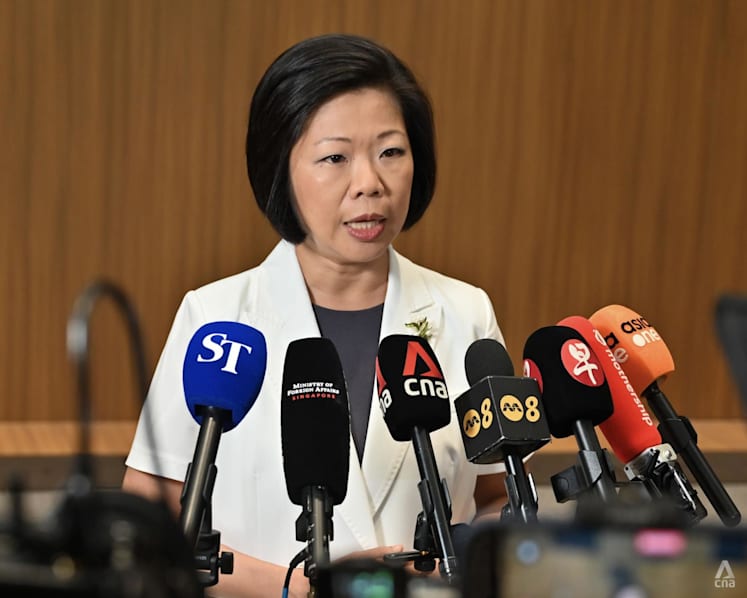
On Friday (Sep 4), Singapore’s Ministry of Foreign Affairs said that 52 Singaporeans have been arrested in China for suspected involvement in an alleged pyramid scheme.
CNA understands that the scheme is linked to the 1040 sunshine project – a long-running pyramid scheme which Chinese authorities have clamped down on previously.
The modus operandi is similar to what was experienced by Michelle, as well as at least a dozen Singaporeans that CNA has interviewed, although not all ended up investing.
It is unclear how many Singaporeans have been approached or remain involved. But many of those interviewed said they knew others who were part of the scheme. Those interviewed ranged from professionals in finance and business to retirees, and three of them have filed police reports.
THE SINGAPORE MEETINGS
Through CNA’s interviews, it appears that the recruitment process has remained largely unchanged for more than a decade.
Most of the experiences start with casual conversations with new contacts or mutual friends about broad investment opportunities in China or Nanning.
These usually take place at professional or networking events, and even social gatherings organised by existing members of the programme.
Interviewees told CNA that many who attended appeared successful or had interesting anecdotes about their lives.
CNA went undercover recently at one such session in central Singapore.
The two-hour gathering was attended by a group of around 10 people.
Conversations started innocuously, mostly centred on participants’ backgrounds, retirement plans and hobbies. Some were meeting each other for the first time.
When a guest brought up interest in investing in China, an individual identified to CNA as being part of the programme began talking up the potential of Guangxi, especially Nanning.
The pitch was premised on several factors including: the high involvement of Singaporeans and Singapore companies in developing the city, the local government’s enthusiasm for foreign funds, Nanning’s rapid growth, and vast future potential.
Such a narrative featured prominently in every interview that CNA conducted for this story.
CNA also witnessed current members exchanging contacts with guests and suggesting follow-up meetings at a “more appropriate setting”, to find out more.
A potential trip to China in the future was also floated by the organiser, although he said this would likely not happen in the next few months due to the bad weather conditions in Nanning.
Several interviewees later told CNA that it was at the smaller follow-up meetings that they were introduced to business and investment opportunities specific to Nanning, even if these pitches did not go into the details of how the scheme worked.
In January, Rob (not his real name), was asked out by his friend and a mutual acquaintance. He was between jobs at the time.
Rob said the scheme was described to him as similar to how Singapore attracts global investors, except members run it “a little bit less obviously.”
Another interviewee, Alfred (not his real name), was told that it was an exclusive, invitation-only opportunity for overseas ethnically Chinese people, and that it was linked to Nanning’s development.
“I was told Nanning was being positioned for major growth, with references to ASEAN integration, a Nanning–Singapore corridor, and the Belt and Road Initiative,” said Alfred.
TRIP TO NANNING
Those who show interest in investing are invited on an organised trip to Nanning.
Mr Adrian Tan, 47, was among those who have gone there.
The marketing professional, who agreed to be identified so as to raise awareness about the pyramid scheme, said he was going through a difficult period in his career.
He travelled in 2018 after being told Nanning represented an opportunity similar to investing in Shenzhen before its rapid economic growth.
“I thought maybe this may be a turning point. Hence, that was also my push factor to consider going down.”
Some interviewees spoke about being put up in hotels, while others stayed at the apartments of other Singaporeans involved in the scheme.
CNA also reviewed screenshots of text messages detailing itineraries sent to prospective participants.
These included city tours, visits to local malls and supposed development centres in Nanning.
Also included were meals and meetings spread across the four- to five-day trip.
Kim (not her real name), who travelled to Nanning earlier this year, said she initially believed she was simply going on a holiday with a friend.
“All you have to do is just pay for your own airfare and everything will be settled. Accommodation, food, all will be settled,” she recalled being told before the trip.
But many interviewees said much of their time was spent meeting other Singaporeans already involved in the scheme, over meals at restaurants, cafes and at private homes.
“I was so shocked to see so many Singaporeans,” Kim said, recalling one presentation she attended.
For Benjamin (not his real name), who travelled to Nanning in 2019 on the premise of exploring opportunities to expand his business, that was the first sign that something was amiss.
“If you are asking me to expand my business in China, the first thing is you are supposed to introduce me to local businessmen… not other Singaporeans,” said Benjamin.
THE PITCH
Most interviewees said their trips culminated in at least two briefing sessions conducted by fellow Singaporeans, usually in private homes or offices.
There, presenters shared personal testimonials before explaining how participants could join and earn money from the programme.
CNA heard similar explanations in hours of secretly recorded audio obtained from interviewees who attended such sessions.
In one recording from February 2025, participants were told their role was to identify and invite prospective members in Singapore.
Participants were also repeatedly told that the opportunity could transform not only their own lives, but those of the people they recruited.
According to Mr Tan, the marketing professional, organisers described the scheme as having a membership model.
Participants are told of different membership tiers, each requiring a different upfront payment.
They could join by paying either about S$30,000 or S$50,000, with each tier allowing them to recruit a different number of “downlines”.
“Commission comes from the membership fee of your downline,” Mr Tan told CNA. “You’re just passing the money from the bottom all the way to the top.”
Although interviewees gave differing accounts of how organisers said the money would be used, all were told returns depended on recruiting additional participants into the scheme.
Several interviewees also said they had to open a local bank account, for commissions to be credited into.

CONCERNS RAISED
Despite being initially impressed by what he saw in Nanning, Mr Tan said he became increasingly uncomfortable as the presentations continued.
“There was no product,” he said. “It’s just purely membership.”
Benjamin said it was only when organisers drew diagrams explaining how the money flowed that he concluded the opportunity was fundamentally different from what he had expected.
“The moment they drew it out, you realise that it’s not an investment … You have to work for the money, to bring people in and get people to bring money in,” said Benjamin.
He and his travel companion decided to leave the organised programme after the third day, booking another hotel for the remainder of the stay.
“We literally ran away in China,” he added.
Kim said the organisers told the participants that they were to transfer their money entirely to “whoever recruits you”.
When she asked what would happen if the recruiter disappeared with the money, she said the organisers replied that “they will never run away, because they have more to gain than to run away”.
Alfred said he was shown his contact’s China bank account, which showed deposits of 50,000 to 250,000 RMB (S$9,500 to S$47,000) every few months, as proof of returns from this investment.
During one presentation, Kim recalled organisers encouraging participants to search online for information themselves.
Organisers also claimed that legal action was taken against individuals who had criticised the scheme online.
One interviewee said he asked a member of the scheme about online articles alleging it was a pyramid scheme. The person claimed that the reports were merely rumours, and advised him not to place too much weight on them.
DEAL OR NO DEAL
Several interviewees who had been to Nanning described the trip culminating in a final “commitment” session.
At a private residence, Mr Tan said he and another attendee were presented with a short agreement and were encouraged to sign up by paying a 300RMB fee.
Such an arrangement was corroborated in secret audio recordings by another interviewee.
Mr Tan and the other attendee signed the agreement and provided their passport details.
“Ultimately, we discussed, and I think since we didn’t have to pay upfront, we just said yes and then got out (of the room),” recalled Mr Tan, adding that they did not follow through with payment nor put money into the scheme.
But it was a different story for Rachel, who visited Nanning in 2016.
Despite some reservations, she said she ultimately felt she could trust her host and other investors she had met.
“They are all older than me. I thought they were more savvy than me. If they recognised this as a good business opportunity, maybe I should consider,” said Rachel.
She and Michelle also described being advised on how to raise the funds required to join the scheme.
“(She) taught me to pawn things from my own assets… Also, (she said) you can cash out your (insurance) policy. You can pawn your Rolex. You can sell (other things),” recalled Rachel.
“You can borrow a few S$1,000 from your family members. You can slowly return them.”
Rachel said she eventually chose to sell off her insurance policies and raised S$45,000. She then transferred S$45,000 to her host’s Singapore bank account.
REALISATION AND REGRETS
After investing, those who signed on to the scheme were offered training sessions and workshops. No photos and videos were allowed at these sessions in Singapore.
Rachel said they included lessons on rules of engagement and how to approach prospective investors, including family members whom they were told to approach first.
She eventually asked her cousin if he was interested.
“He was asking, how much is the amount you need to put in, and how much is the interest?” said Rachel. “He said it cannot be so good.”
Her cousin showed her the online news articles about such a scheme but she was initially in denial. Nevertheless, she looked into it more and realised that the details outlined in the articles were similar to what she had experienced.
She then began thinking of ways to exit the scheme.
“I would not want anybody to take over my place just because I want to get my money back. So I said no. This option is out,” said Rachel.
She told her recruiter that her family needed the funds back urgently. This, however, was initially met with refusal and frustration.
Rachel said she persisted by calling her recruiter every day for a month, before she finally relented.
Her recruiter told her the S$45,000 she had transferred over would be returned to her via the account which she had opened in Nanning.
For many weeks, Rachel would withdraw the maximum allowed each day from her Nanning account and has so far retrieved about S$20,000.
“I consider myself lucky to get (some) money back,” said Rachel. “I feel so naive.”
Others like Michelle were less fortunate and are trying in vain to recover the money they have put in.
POLICE REPORTS AND SPEAKING OUT
Despite not putting money into the programme, Mr Tan made a police report following the trip.
He was among three interviewees to do so.
He decided to recount his 2018 experience in a LinkedIn post in July, after a friend told him more Singaporeans were being invited to Nanning in recent times.
The post prompted numerous people to contact him.
“A lot of people reached out to me … Some of them had worse experiences than me,” he said.
Rachel said she has tried to warn others whom she got to know on the Nanning trip or those who may have been interested in investing.
“I called all my girlfriends … if anyone tells you to go to Nanning, please be mindful,” said Rachel.
“The experience itself is one whole big lesson.”
Financial experts stressed the need for individuals to be discerning about investment opportunities.
Professor Lawrence Loh, who is Director of Governance and Sustainability at the National University of Singapore Business School, said individuals should approach investment opportunities with caution, particularly when they are asked to commit significant sums of money.
“Whenever something comes… always try to validate the information, even through multiple channels,” he said.
Source: CNA/gr
Sign up for our newsletters

Get the CNA app
Stay updated with notifications for breaking news and our best stories
Get WhatsApp alerts
Join our channel for the top reads for the day on your preferred chat app

Get bite-sized news via a new
cards interface. Give it a try.
Click here to return to FAST
Tap here to return to FAST
FAST







