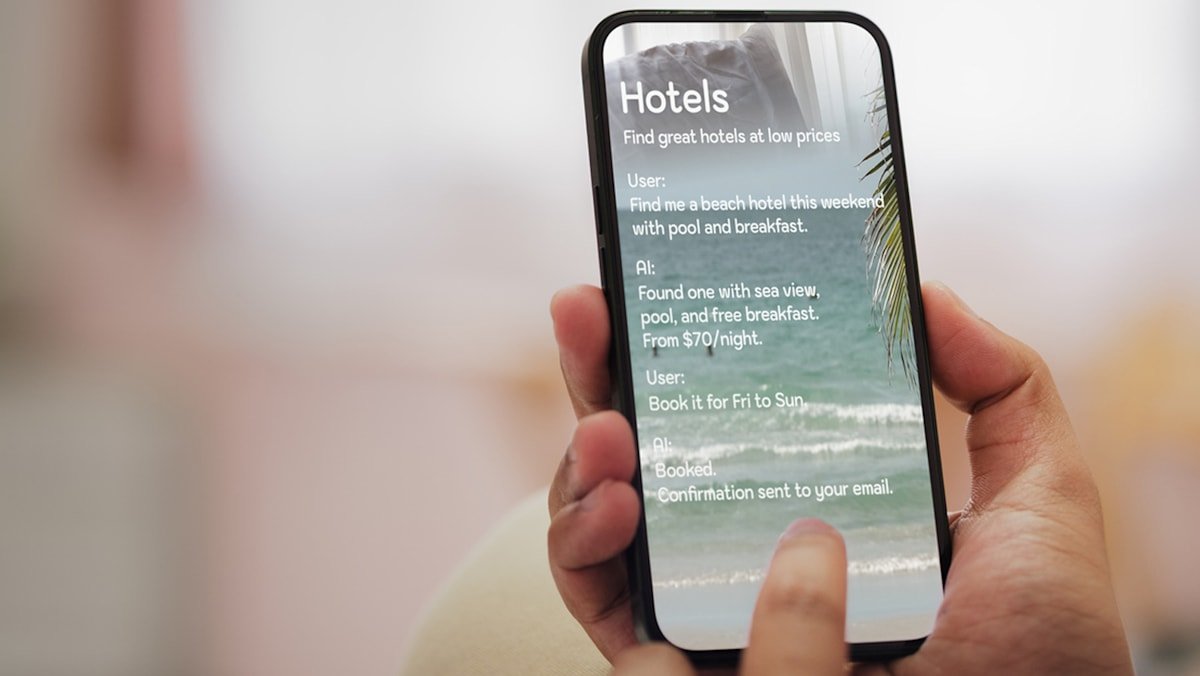
AI can plan your holiday. But would you trust it to book the trip?
Travellers are increasingly using AI to find hotels, build itineraries and narrow their choices. When money, bookings and disruptions are involved, however, human judgement still matters.
From finding a hotel to completing a booking, AI is beginning to take on more of the travel-planning process. (Photo: iStock)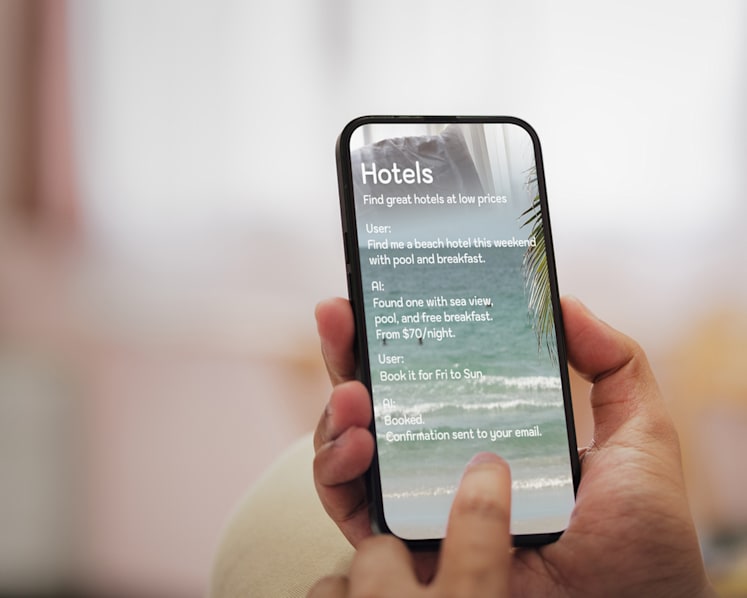
New: You can now listen to articles.

This audio is generated by an AI tool.

By
Read a summary of this article on FAST.
Get bite-sized news via a new
cards interface. Give it a try.
Click here to return to FAST
Tap here to return to FAST
FAST
Artificial intelligence is changing how we choose where to go, where to stay, and what to do when we arrive. As machines take on more of the journey, the value of human judgement may only become greater.
Communications manager Jeanne Lim first turned to AI with questions about health, fitness and careers. Travel planning felt like a natural next step. “I only started using AI tools to plan itineraries in the past three months,” she admitted. What appeals to her is the ability to ask questions in natural language and fold several constraints into a single prompt: budget, location, dates and whether she’s travelling alone, with elderly relatives or with children. “The suggestions are usually a useful starting point.”
That last phrase may matter more than it sounds.
Imagine asking an assistant to plan a honeymoon in Kyoto. Somewhere quiet, with a garden, close enough to walk to good cafes yet far from the busiest streets. You’d like to see the temples, though you’d rather linger than rush from one landmark to the next: a morning in a neighbourhood bookshop, an afternoon wandering narrow lanes, one memorable dinner within easy reach of the hotel. You no longer have to turn those wishes into a string of searches. You can simply describe the trip.

That small change is reshaping how travel is discovered. AI is beginning to sit somewhere between the guidebook and the search engine, helping travellers make sense of an overwhelming amount of information and turn aspirations into itineraries. Flights, hotels, visas, weather, transport, attractions, disruptions and payments still sit across a complicated web of systems. What’s changing is how travellers navigate them.
For travellers like Lim, that promises less friction. For the industry, it brings greater responsibility. Every recommendation is also a promise.
FROM SEARCH TO CONVERSATION
For decades, digital travel rewarded travellers who knew how to search: the right keywords, the right filters, enough patience to compare dozens of options. Conversational AI works differently. A family can describe the kind of holiday it wants. A solo traveller can ask for neighbourhood cafes rather than the city’s most “Instagrammed” attractions. A couple can explain that privacy matters more than an ambitious sightseeing schedule.
Junqiu Jiang, assistant professor of Marketing at ESSEC Business School, sees the shift as reducing the cognitive load of travel planning. The traveller stays in control, spending less time moving between fragmented sources of information, with AI serving as an aid to judgement.

Travellers across Asia Pacific are already testing that idea. Booking.com’s research shows rapid adoption of AI-assisted planning in the region, though it also points to an important nuance: when it comes time to book, travellers still tend to return to brands they trust.
Klook sees a similar pattern. According to Sarah Wan, Klook’s general manager for Singapore, Malaysia, Indonesia and Thailand, travellers in India, Vietnam, Indonesia and Thailand are among the region’s more active users of AI for trip planning, while those in Japan, Australia and Hong Kong remain more cautious. In Singapore, when Klook asked which sources travellers trusted most when deciding what to book, family and friends came first, followed by verified reviews and travel forums. AI ranked below influencer recommendations.
Lim’s own behaviour reflects that gap. She uses AI to narrow the search, then checks prices, reads customer reviews, looks at social media photos and checks the property’s location on a map before booking. An AI answer can be persuasive and still require verification. That’s the first lesson of the AI travel era: discovery may be moving to machines, but trust is moving much more slowly.

THE THREE-HOTEL PROBLEM
Suppose a couple asks an AI assistant for three boutique hotels in Kyoto with garden views on a quiet street. Three properties make the list. The rest disappear.
For the traveller, this is wonderfully convenient, sparing them from opening 40 browser tabs. For the hotel that doesn’t make the shortlist, the consequences are greater. This is the new visibility battle. Travel companies have spent decades learning how to appear in search results and on booking platforms. Now they face a different question: can an AI system find them, understand them and recommend them?
Travellers increasingly ask questions rather than enter keywords, receiving a handful of suggestions through conversation. The competition is shifting from being visible in search to being remembered by the system doing the recommending. Accenture’s research points to The Ascott Limited as an example of a company building the infrastructure, connecting inventory, personalisation, and booking capability needed to reach travellers in the environments where AI increasingly shapes their decisions.
That matters because the information an AI system uses may not come directly from the hotel at all. McKinsey research finds that 47 per cent of travel and hospitality consumers now use AI-powered search somewhere in their purchase journey, while only 5 to 10 per cent of what an AI system says about a given brand is drawn from that brand’s own website. For hotels, this is creating a new discipline often described as “generative engine optimisation”, the practice of structuring information so AI systems can understand a property accurately enough to recommend it.
Traveloka sees opportunity in this shift too. As AI systems become more attuned to regional travel behaviour, recommendations can become more contextual, surfacing motivations that might previously have remained buried in search histories.
Visibility, though, creates a second problem: what happens when the machine is wrong?
WHEN THE MACHINE MAKES THE RECOMMENDATION
A recommendation for a quiet boutique hotel assumes the room is actually available. A suggestion to visit Angkor Wat early in the morning assumes opening arrangements haven’t changed and transport will work. The traveller experiences the answer as a single piece of advice, while behind it sits an enormous operational system.
For years, travel companies digitised individual parts of the journey. Hotels modernised reservation systems, airlines introduced mobile boarding passes and attractions adopted electronic tickets. Each solved a particular problem, even as the traveller experienced the journey as one continuous thing.
AI is beginning to connect those pieces more closely. Emily Weiss, senior managing director and global travel lead at Accenture, describes leading travel organisations as moving beyond isolated AI experiments towards models in which intelligence becomes part of everyday decision-making, helping them anticipate demand, coordinate resources and respond to disruption.

Minor Hotels offers a practical example. It is building a single data and AI platform with Google Cloud, Salesforce and Deloitte to bring guest data, marketing and service operations together. The ambition, from a guest’s perspective, is simple: whichever part of the organisation she encounters, the hotel should already understand the context, so she never has to explain herself twice.
THE TRUST GAP
The enthusiasm for AI is real, and so is the hesitation. Booking.com’s Global AI Sentiment Report found that 95 per cent of Asia Pacific consumers expressed excitement about AI, while only 8 per cent said they fully trusted it. Its Travel Happiness Index found that 88 per cent felt more at ease booking through a platform they already trusted. Travellers are happy for AI to help them explore, far less willing to let it make consequential decisions for them.
Klook’s Travel Pulse survey illustrates the distinction in Singapore, where travellers use AI for inspiration but record one of the region’s lowest AI-to-booking conversion rates.
Lim puts the concern more plainly. She’s encountered inaccurate or outdated AI-generated information, including restaurants that have temporarily closed and travel advisories that have changed. That makes her reluctant to rely on AI alone. “I don’t fully trust AI responses because they are not always accurate or up to date,” she says.

The same caution extends to agentic commerce. Phil Pomford, general manager for Enterprise APAC at Global Payments, says research in Singapore found that 44 per cent of consumers would let an AI agent browse and purchase travel on their behalf within the following 12 months, with roughly a third willing to entrust an agent with several hundred Singapore dollars for a flight booking. Businesses, meanwhile, are less prepared than consumers might assume. Globally, only 11 per cent of restaurant, hospitality and leisure businesses describe themselves as very familiar with agentic commerce, compared with 25 per cent of retailers.
There’s a real difference between asking a machine, “Where should I go?” and telling it, “Book it.” The first is inspiration. The second is a financial decision. Javier Laforgue, EVP and managing director for Asia Pacific at Amadeus, argues that conversational and increasingly agentic AI will only be as dependable as the infrastructure beneath it. The question is no longer whether the machine can produce an answer, but whether the traveller can safely act on it.
Lim isn’t ready to make that leap. “AI agents have been documented acting unpredictably, and I’m not willing to risk my hard-earned money,” she said.

WHEN THINGS GO WRONG
A flight is cancelled after a family has already checked out of its hotel. A traveller falls ill halfway through a trip. Another misses a connecting train because of a delay no system anticipated. These are the moments when technology is tested most severely – and when hospitality becomes visible.
Booking.com’s approach offers one model. Its AI-powered chatbot handles the large majority of routine customer enquiries, while emergencies and complex situations are escalated to human agents. The principle is straightforward: automation handles volume, people handle ambiguity.
Singapore Institute of Technology’s associate professor Lee Kuan-Huei adds another dimension, noting that trustworthy AI depends not only on technical capability but also on governance, operational processes and user confidence. For travellers, that’s tangible. It’s what happens when an AI assistant gives you the wrong answer about a pet policy and someone fixes it, or when a suspicious property listing is removed before you book.

Lee cites industry research showing that only 2 per cent of travellers would give an AI tool full autonomy to make and modify bookings without human oversight. Meanwhile, 81 per cent prefer to double-check AI-provided information, while more than half are uneasy about granting AI access to documents such as visas and passports. That caution may simply be a rational response to the stakes.
THE HOTEL THAT KNOWS WHEN TO CALL
Hospitality companies are beginning to design AI around that distinction. Millennium Hotels and Resorts has rolled out an in-room voice assistant across Singapore, Thailand and Malaysia, reaching more than 2,700 rooms within nine months. Guests can make requests directly, while a multilingual chatbot handles bookings, dining and promotions. The goal is to free hotel employees for the moments when their presence matters most.
Celine Quek, senior lecturer at Republic Polytechnic, points to the gap between what guests want and what hotels have historically been able to deliver. A 2024 Agilysys study found that 68 per cent of guests said they would pay more for personalised service, while 56 per cent of executives responsible for delivering it said they lacked the technology to provide that personalisation at scale.

Rosewood Hotel Group’s chief information officer, Taywin Khampasri, describes the boundary clearly. AI can increasingly take on repetitive back-end tasks, freeing associates to focus on context, anticipation and the interactions that make hospitality feel personal. Nicole Robinson, chief marketing officer at andBeyond, makes a similar point from the luxury travel perspective: as planning becomes faster and more scalable, genuinely personalised hospitality may become rarer – and therefore more meaningful.
Authentic hospitality has always sold more than a bed, a view or a faster check-in. It sells the feeling that someone has anticipated what you need. AI is exceptionally good at identifying patterns and connecting preferences with contextual information at a scale no human employee can match. But knowing that a guest prefers a quiet room is different from noticing she’s had a difficult morning and would rather not be interrupted. Personalisation can be automated. Hospitality still requires interpretation.
MHR’s results offer a glimpse of how the economics might work. Between January and June 2026, its chatbot supported more than 19,000 conversations and contributed to a group-wide return of US$14 (S$17.75) for every dollar invested. Automation can help finance the human side of hospitality rather than replace it. If AI handles the questions that don’t require judgement, employees have more time for those that do.
THE ROLE THAT STILL REMAINS HUMAN
Ben George, senior vice president and commercial director, Asia Pacific, at Hilton describes AI as a way to enhance both guest and team-member experiences while preserving human connection. Marriott’s John Toomey similarly envisions a future that’s human-led and technology-powered, with AI streamlining routine work and enabling more personalised guest communications.
That distinction matters because travel rarely unfolds exactly as planned. The most memorable hotel employee may be the one who recognised that a moment called for something other than the fastest response.

The travel industry has spent decades making it easier to book a trip. AI is now making it easier to imagine one. A traveller can describe an experience rather than construct a search. A hotel can understand a guest before she reaches the front desk. A destination can surface through conversation rather than be discovered through dozens of links.
Convenience, though, creates a new expectation. If AI recommends the hotel, the hotel must deliver. If it makes the booking, someone must be accountable when circumstances change.
The strongest travel companies will be those that understand where automation adds freedom and where it risks removing confidence, building reliable data underneath the experience and putting clear human intervention around the moments where the stakes are highest.
For travellers, that may be the most reassuring part of the AI revolution. The perfect travel companion is the one that knows when to stop talking, when something has gone wrong and when the journey needs to be handed back to a person.
Source: CNA/bt
Get bite-sized news via a new
cards interface. Give it a try.
Click here to return to FAST
Tap here to return to FAST
FAST