Can AI help Hong Kong’s struggling comic book industry turn the page?
As local artists grapple with sluggish comic book sales, some are turning to artificial intelligence to cut production time and take their creations beyond the printed page.
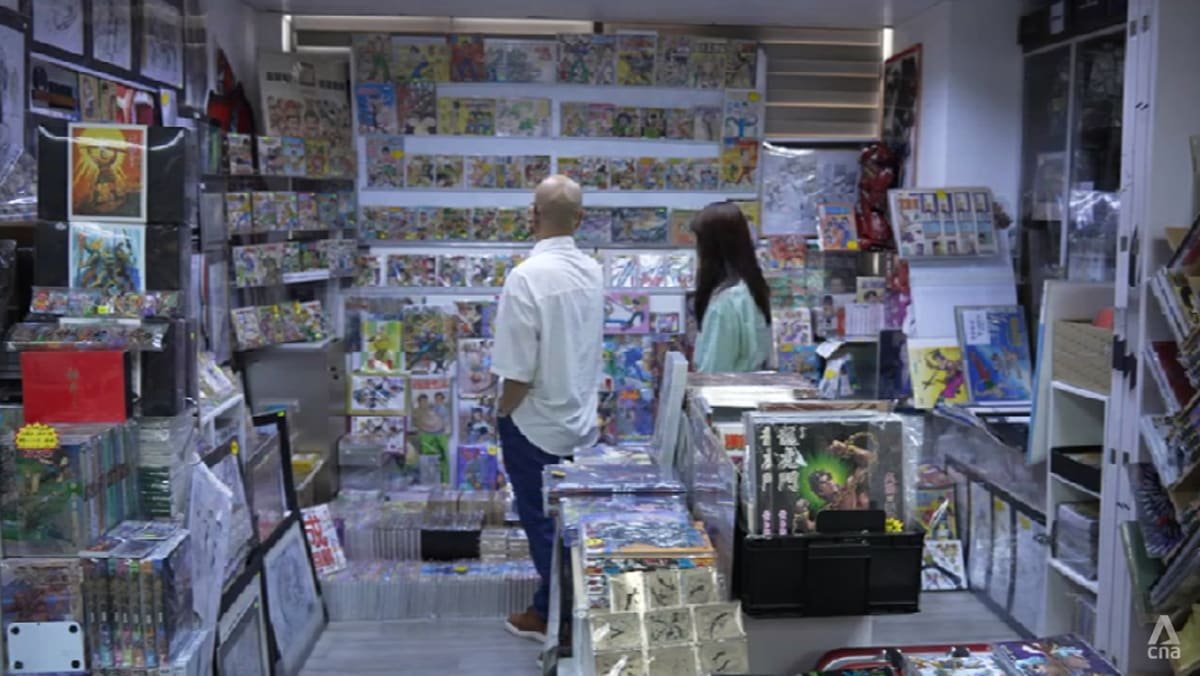
The Epic One bookstore, believed to be the only shop in Hong Kong exclusively selling local comics. (Image: CNA)
New: You can now listen to articles.

This audio is generated by an AI tool.

Read a summary of this article on FAST.
Get bite-sized news via a new
cards interface. Give it a try.
Click here to return to FAST
Tap here to return to FAST
FAST
HONG KONG: In its heyday, Hong Kong was a comics powerhouse.
Local titles commanded a huge following, their characters became household names, and some even made the leap from the printed page to the big screen.
During the industry’s boom years in the 1980s, about 50 million copies were sold annually.
Martial arts comic Fung Wan, first published in 1989, was adapted into the 1998 blockbuster The Storm Riders, starring Ekin Cheng and Aaron Kwok.

Guess Word
Crack the word, one row at a time

Buzzword
Create words using the given letters

Mini Sudoku
Tiny puzzle, mighty brain teaser

Mini Crossword
Small grid, big challenge

Word Search
Spot as many words as you can
Another local comic, Teddy Boy, spawned the hugely popular Young and Dangerous films about the triad underworld.
But the golden age did not last. Hong Kong comics have been widely regarded as being in decline since the mid-1990s.
Today, specialist stores are harder to find, print runs are far smaller, and many of the city’s artists can no longer rely on drawing comics as their sole source of income.
Few have witnessed that transformation as closely as Dicky Lam, owner of the Epic One bookstore in Kowloon.
It is believed to be the only shop in Hong Kong devoted exclusively to local comics.
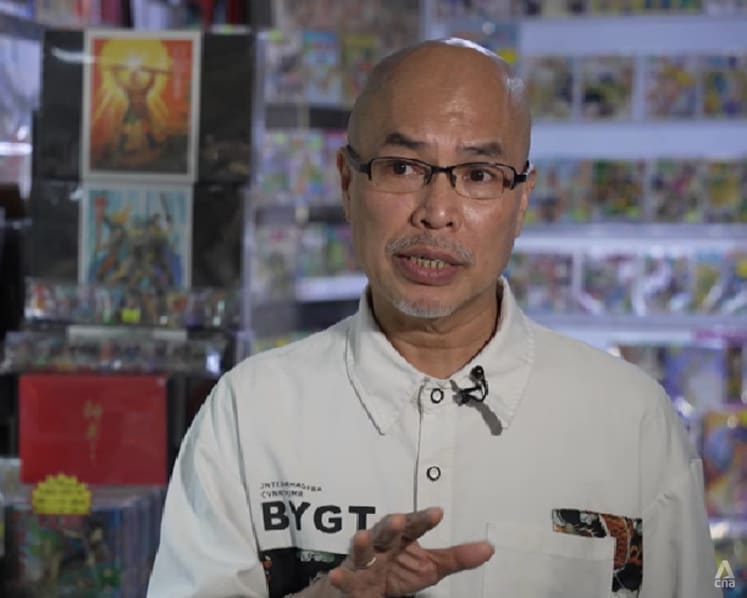
“In the past, comic book sales were easily in the tens of thousands, (even) a few hundred thousand,” he said.
“Now, if we can sell … a few thousand books, it’s already a very good figure. So, you can see that the Hong Kong comic market has shrunk by 90 per cent.”
LABOUR INTENSIVE
The smaller audience has changed the economics of making comics.
Producing one remains labour-intensive, requiring artists and their teams to develop characters, backgrounds and storylines before moving through sketching, colouring and other stages of production.
With fewer copies being sold, recovering those costs has become increasingly difficult.
Yet, the industry’s commercial decline has not stopped a new generation of artists from producing new work – or winning recognition overseas.
Artist Jerry Cho received a bronze award at this year’s Japan International Manga Award for his comic The Life After Life. The awards are organised by Japan’s Foreign Ministry to recognise manga artists overseas.
But international recognition does not necessarily translate into large sales at home – just 3,000 copies have been sold so far.
The comic took six months to produce, involving Cho, two full-time staff and another five outsourced contributors.
It is an equation Cho is now trying to improve with artificial intelligence.
USING AI BEFORE PUTTING PEN TO PAPER
Cho uses AI early in the production process – as a research and visualisation tool that allows him to experiment with ideas before his team commits time to drawing them.
One example is character design.
Cho can feed an image of one of his characters into an AI tool and experiment with different clothes, allowing him to judge whether an outfit works before his team begins illustrating the finished scene.
“In the past, I would do this (experimentation) too, but I would draw them all out,” he said.
“After sketching, I may not be able to sense that it feels off, and after my colleagues complete the scene and add in the colours, then we realise it’s wrong.”
By then, changing his mind could mean having to redo the scene, wasting hours of work.
“Now with AI to do testing, it reduces the time wasted,” he said.
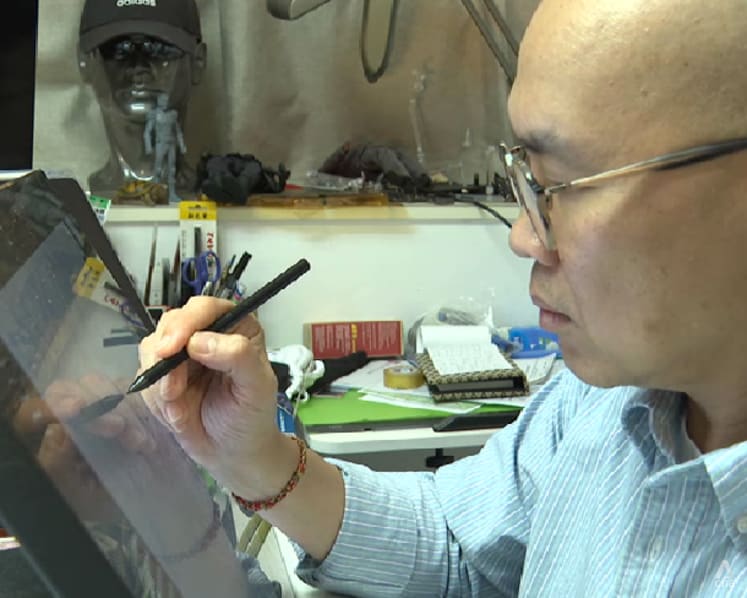
Cho estimates AI now saves his team about 10 per cent of production time.
But he draws a line at using AI-generated images in the finished comic – at least for now.
To demonstrate why, Cho provided an AI tool with one of his drawings and instructed it to change only his character’s clothes.
“The result is … (while) the AI-generated images look like the character, the drawing style shows it’s not the same person,” he said.
Asked whether that was because AI could not replicate each person’s individualistic drawing style, Cho replied: “Yes, because art is unique.”
FINDING NEW WAYS TO SELL COMICS
Still, faster production does not solve the industry’s bigger problem: finding enough people to buy its work.
The Hong Kong Comics and Animation Federation estimates that about half of the city’s comic artists work freelance or part-time.
Authorities and industry groups have been trying to nurture a new generation of creators and help their work find audiences beyond Hong Kong.
In 2021, the federation launched the Hong Kong Comics Support Programme, which is government-backed.
By the end of 2025, it had supported the publication of 63 original Hong Kong comics. Some of those works have received international awards, while more than 50 licensing agreements and adaptation deals have been secured.
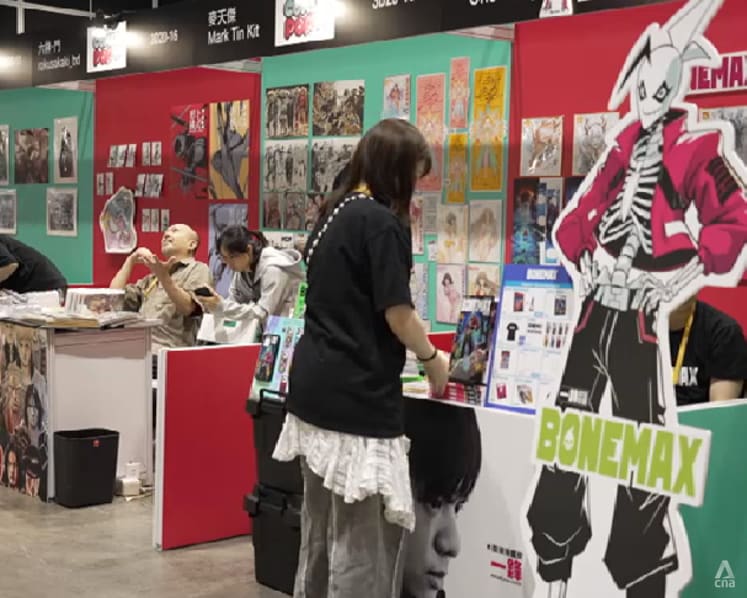
The programme has also taken Hong Kong works to events overseas, including France’s Angouleme International Comics Festival and Malaysia’s Comic Fiesta, as part of efforts to expose them to new readers and business opportunities.
However, there is no data available on how many copies the titles have sold.
COULD AI BE THE ANSWER?
Industry players believe AI could make it easier for artists to turn their work into animation and other formats.
Traditionally, turning a comic into moving images is costly and requires specialised skills – from animation and modelling to editing and post-production.
Generative AI could lower some of those barriers.
“Comic artists can create their comics first, then turn them into an AI-generated animation, or even an AI computer graphics drama,” said Alan Wan, vice-president of the Hong Kong Comics and Animation Federation.
He added that this is why comic artists need to keep abreast of developments in AI and learn how to use the technology.
“Once they do, they’ll reach another level – they won’t just be comic artists, they could become directors.”
But greater use of AI brings another uncertainty: Who owns what it creates?
Questions surrounding copyright, authorship and the material used to train generative AI systems have become increasingly important as the technology enters creative industries.
“The legal system is not very comprehensive. It’s not very ready for AI work,” said Fan Tingting, associate director of the University of Hong Kong Business School’s Asia Case Research Centre.
“We’re not sure about the boundaries at this moment. But protecting humans’ work, protecting the creativity of human beings, that is very important.”

Source: CNA/dn(mp)
Sign up for our newsletters

Get the CNA app
Stay updated with notifications for breaking news and our best stories
Get WhatsApp alerts
Join our channel for the top reads for the day on your preferred chat app

Get bite-sized news via a new
cards interface. Give it a try.
Click here to return to FAST
Tap here to return to FAST
FAST