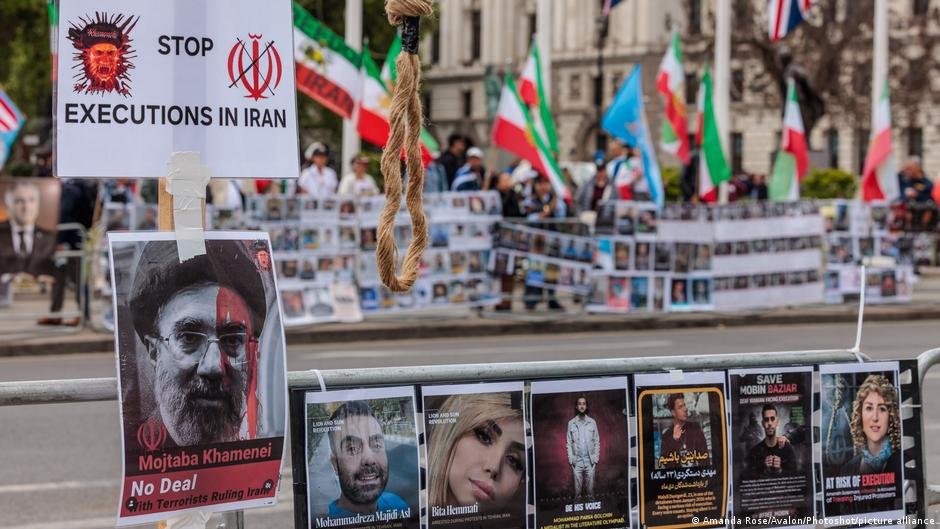
“Several young men born in the second half of the 2000s are sitting beside me. They are under 20. They keep moving their necks up and down and from side to side. I ask them what they are doing. They say: ‘We are preparing our necks for the hangman’s noose’.”
This account by Soheil Arabi, a photoblogger who has been jailed several times since 2013 and who was recently released from one of Iran’s largest prisons, Ghezel Hesar, after two months, offers a disturbing glimpse into human rights violations in Iran during the current conflict.
Since Israel and the US attacked Iran on February 28, 2026, the world has been mostly focused on the war, Iran‘s nuclear program, the blockage of the Strait of Hormuz and the future balance of power in the Middle East.
But inside the country, rights groups fear an increasingly deadly wave of repression, thanks to the ongoing war.
Iran already accounted for 80% of a global surge in executions during 2025, according to rights group Amnesty International. During 2025, “Iran executed at least 2,159 people, more than double its 2024 figure,” the group said.
For nearly half a century, the Iranian government has used the death penalty as a tool to suppress any political opposition. In recent years, Iran has been among the world’s leading executioners.
According to reports from Iranian opposition groups, at least 40 people have been executed in political and security-related cases since the Iran war began, while at least 78 others remain on death row. According to Iran Human Rights, an Oslo-based group that has documented detentions, in the six weeks up to the end of April, Iran recorded an average of one political execution every two days.
Potential crimes against humanity
The stories aboutexecutions make for grim reading. Gholamreza Khani Shakarab, 34, a former martial arts champion, was accused of working for Israel – he regularly travelled for sports contests – and he was hanged without ever getting to see his family again. Dual Swedish-Iranian national Kourosh Keyvani was arrested in 2025, during the first round of fighting between Israel and Iran, then hanged in March this year.
A 68-year-old woman Zahra Shahbaz Tabari was sentenced to death on charges of “armed rebellion.” Her first trial only lasted 10 minutes and she had no independent lawyer present. Although her verdict was overturned, she was found guilty again after a retrial in late May.
“Documented patterns such as killings, torture, enforced disappearances, mass arrests and political executions could amount to crimes against humanity if it is established that they were carried out in an organized manner and as part of a state policy,” Amnesty International’s Iran researcher Raha Bahreini told DW.
She warned that the intensity of the recent crackdown has reached unprecedented levels even compared with Iran’s previous record and that the risk of further grave human rights violations remains high.
Amnesty International has also documented practices that amount to torture, including mock executions, simulated hangings, placing a gun in a prisoner’s mouth, severe beatings, suspension by the limbs, prolonged solitary confinement and deprivation of food and medical treatment.
According to Amnesty International, more than 6,000 people have been arrested since the start of the war.
Those detained include protesters, journalists, lawyers, human rights defenders, artists, civil society activists, students, teachers, members of ethnic and religious minorities, families seeking justice for victims and dual nationals.
“Espionage” has been one of the principal charges in the recent wave of prosecutions. Observers argue that, as Iran grapples with the political and social consequences of the war, authorities are using the death penalty to raise the cost of dissent and reinforce deterrence.
Several senior figures including Iran’s judiciary chief, Gholamhossein Mohseni-Ejei, have previously called for cases involving alleged links to Israel to be expedited.
To view this video please enable JavaScript, and consider upgrading to a web browser that supports HTML5 video
Teenagers on death row
Among those executed or sentenced to death in recent political and security-related cases, were at least five people between the ages of 18 and 21. In late April, the name of Matin Mohammadi, a 17-year-old arrested on charges of setting fire to a mosque in Pakdasht, south-east of Tehran, in January, appeared on the lists of those awaiting execution.
“With restrictions on reporting and reduced oversight of prisons, concerns about the situation of prisoners, particularly teenagers, are extremely serious,” says Mahmood Amiry-Moghaddam, founder of the organization, Iran Human Rights. “The Iranian authorities want, through executions and repression, to intimidate a generation that has taken to the streets in recent years to such an extent that it will never return to protest.”
Can executions be stopped?
According to Amnesty’s Bahreini, there are three legal avenues to hold Iranian officials to account: “Referral of the situation in Iran to the International Criminal Court by the UN Security Council, prosecution of perpetrators under the principle of universal jurisdiction, and the creation of a dedicated international justice mechanism for Iran.”
Bahreini says that international governments must now do their best to raise the costs of such human rights violations and argues that the continued silence of many states has contributed to ongoing impunity.
Amiry-Moghaddam says that “placing executions and human rights violations at the center of any negotiations and engagement with the Islamic Republic is one of the few ways to restrain Iran’s execution machine.”
He believes the current war has provided Iran with a “political opportunity,” one that has facilitated a sharp increase in executions because it has lowered the political cost of repression. If the international community remains passive, Iran may witness near-daily executions in coming months, he concludes.
To view this video please enable JavaScript, and consider upgrading to a web browser that supports HTML5 video