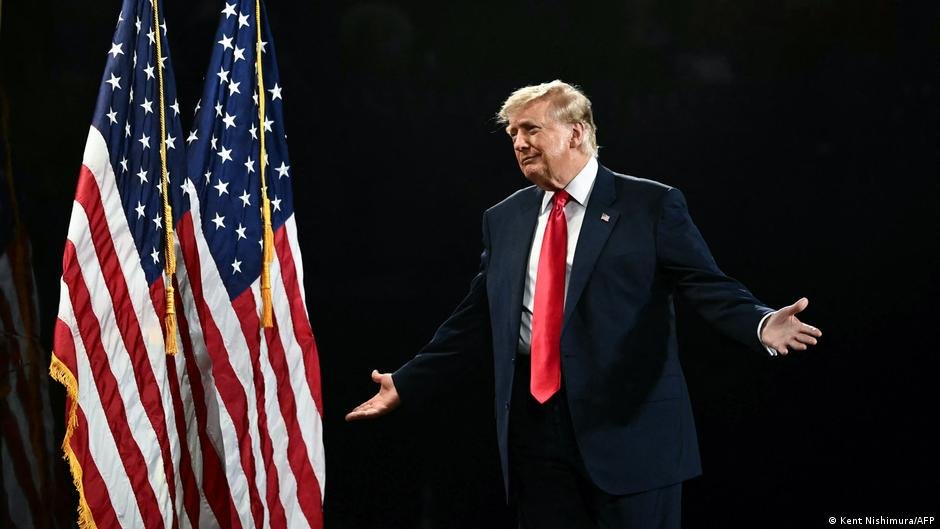
It’s neither a joke nor fake news but a real report from earlier this week: Donald Trump has backed down. On Monday, the US president announced that a series of advertisements aired in September promoting him and his administration would no longer be funded with taxpayer money.
“The radical Left is upset with the fact that I am taking ads, which I consider to be a positive promotion for our great USA, and paying for them with USA money,” Trump wrote on his platform Truth Social.
He went on to claim that funding partisan ads with public money was a “rather standard thing to do,” before adding that future ads would be paid with money raised from donations.
The ads themselves have caused some controversy in the United States. They ran in September between popular shows such as Saturday Night Live and football games, marked with the line: “paid for by the US government” — that is, paid with tax dollars.
The commercials showed scenes such as when US troops captured Venezuelan President Nicolas Maduro earlier this year but they mostly consisted of images and videos of Trump himself, along with combative messages that he would “expel the warmongers” or “throw off the sick political class,” and ensure that the US did not become a communist state.
To view this video please enable JavaScript, and consider upgrading to a web browser that supports HTML5 video
Public funds for personal praise
Political opponents and a series of NGOs responded to the campaign with sharp criticism. Not only does US law prohibit the use of taypayer funds for political advertisements, but the ads also appeared shortly before the midterms — elections held near the midpoint of a president’s four-year term.
On Tuesday, the US broadcasting network CBS reported that, according to contracting records, the US Department of Homeland Security had paid an agency $20 million (€17.9 million) for a “national media campaign.”
The “rather standard” practice that Trump referred to actually applies to public service announcements, but this is not what the campaign ads are, argued the US non-profit consumer advocacy group Public Citizen.
“Federal law explicitly prohibits using appropriated public funds for government propaganda, self-aggrandizement, or partisan political advertising,” the organization wrote in a public complaint to the Federal Communications Commission (FCC) .”Yet, that is exactly the nature of Trump’s recent campaign ads.”
Independent experts have also voiced concerns. Patrick Malone, a professor in the department of Public Administration and Policy at American University in Washington DC, said the timing of the videos was problematic.
“You’re not supposed to use taxpayer dollars to pay for anything that’s campaign-related,” he told DW. “Technically, [Trump] is not campaigning. He’s not saying ‘Vote for me!’ The thing that’s created the challenge here is the timing. Weeks before the midterms, this is a real big issue.”
To view this video please enable JavaScript, and consider upgrading to a web browser that supports HTML5 video
Will the Republicans keep their majority after midterms?
Voters do not choose presidents in the midterm elections but members of Congres, which comprises the Senate and the House of Representatives and is the legislative branch of the federal government. On November 3, those eligible to vote will cast their ballots for all the seats in the House of Representatives, and roughly a third of the seats in the Senate. Some states will also be choosing governors.
Republicans have not been faring well in recent polls, which may be why Trump has been trying to promote his party’s achievements. The Republicans currently hold a majority in both houses, with 53 of 100 seats in the Senate, and 219 of 435 seats in the House of Representatives. This has enabled Trump to pass a large number of his proposals fairly easily.
But a Reuters/Ipsos poll released on Monday indicates that this could soon change. “Voters age 50 or older preferred Trump’s party over the Democratic Party by just 2 percentage points — 44% to 42% — compared to an 8-point Republican advantage in December,” it found. This age bracket “is particularly important for midterm elections, when older Americans historically have made up large shares of the electorate.”
Meanwhile, among voters under the age of 50, “Democrats led by 18 points,” the survey showed.
The poll also found that opinions on Trump himself were low, with “32% of Americans giving a thumbs up to Trump’s presidency.” This level of approval, the study highlighted, was unchanged from an earlier poll “that saw the leader’s rating at the lowest of his political career.”
Republicans shy away from Trump’s support
This could also be one of the reasons why Republican candidates do not seem so keen on making public appearances with the president, usually a highlight of a campaign trail.
Many US citizens associate Trump with high living costs, or the war with Iran, which has dragged on for over half a year now.
One Republican operative told the news website Politico on condition of anonymity that if the the president were to visit a battleground state — where Democratic and Republican support is fairly equal among voters — to campaign for his party, they suspected their “candidates would come down with COVID” to avoid having to attend.
In September, a number of Republicans skipped Trump’s big party convention — typically reserved for presidential, not midterm elections — even though the event could have offered them a platform for their campaign.
Susan Collins from Maine and Dan Sullivan from Alaska, are just two examples of Republican senators whose seats are on the line and who did not attend. Neither did candidates for the House of Representatives from the swing states Arizona, Iowa and Michigan.
To view this video please enable JavaScript, and consider upgrading to a web browser that supports HTML5 video
Trump promises $5,000 payout if Republicans win
Those who skipped the event missed the president repeating an unusual campaign message: To encourage more people to vote, Trump urged supporters to “pretend” he was on the ballot.
And if that wasn’t enough, he also promised each US citizen eligible to vote a $5,000 payout if Republicans maintained their majority in both houses of Congress.
Keeping that pledge could cost the federal government over $1.2 trillion, but observers doubt it would ever come to that.
“He has no money to do that with. It would have to be authorized and appropriated by Congress,” Mallone explained. “I think the likelihood is very slim,” he added. “It’s one of those things like ‘Mexico is going to pay for the wall.’”
Whether Trump’s commercials or promised payouts will be enough to rally majority Republican support remains to be seen.
This article was originally published in German.