Across the border, India’s ‘cockroach’ movement draws young Pakistani interest
India’s “cockroach” protest movement is resonating with some youths in Pakistan, who see parallels in their own struggles over education, jobs and opportunities.
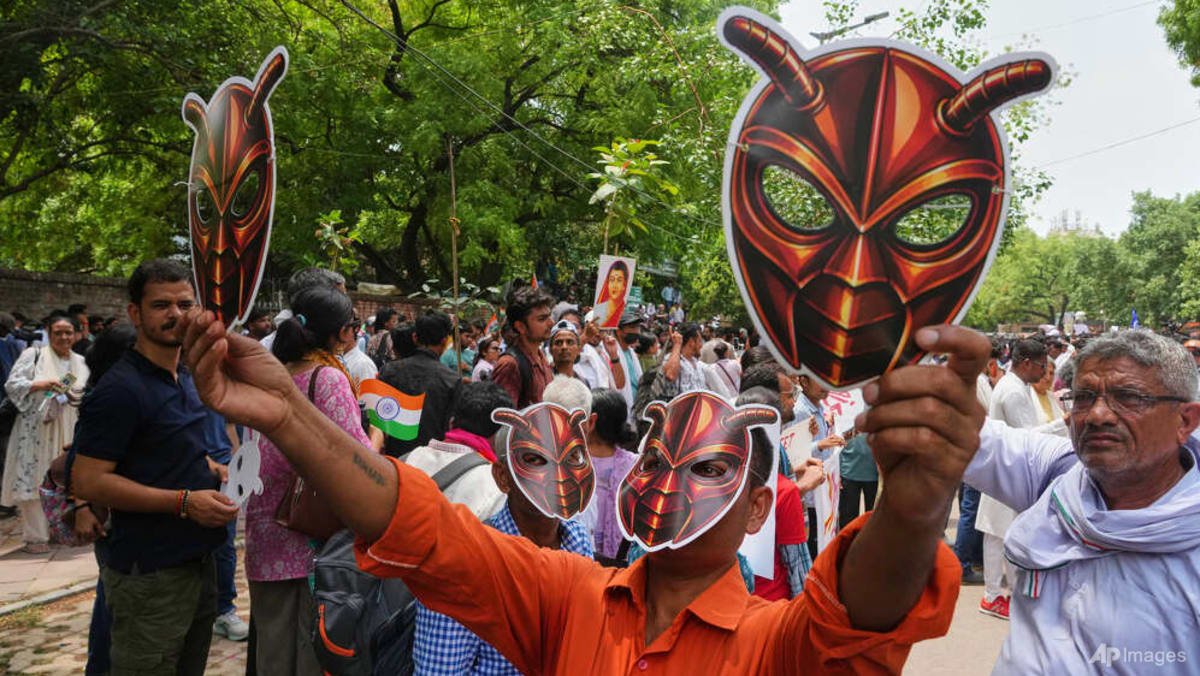
Supporters of the Cockroach Janta Party wear and display masks during a protest demonstration in New Delhi, India, on Jun 6, 2026. (Photo: AP/Manish Swarup)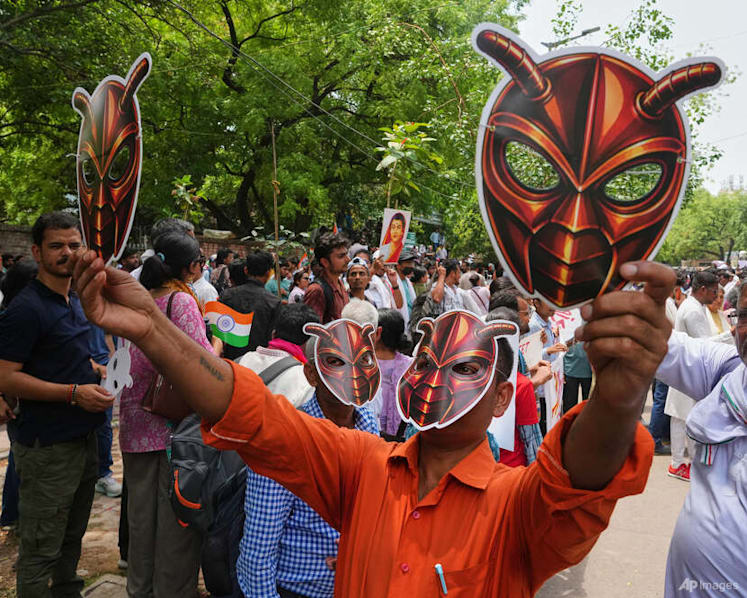
New: You can now listen to articles.

This audio is generated by an AI tool.
Read a summary of this article on FAST.
Get bite-sized news via a new
cards interface. Give it a try.
Click here to return to FAST
Tap here to return to FAST
FAST
ISLAMABAD: India’s viral ‘cockroach’ protest movement is finding an audience across the border in Pakistan, where some young people say the frustrations driving it – from education to economic opportunities – are hitting close to home.
The Gen Z-led Cockroach Janta Party (CJP), which began as online satire before evolving into mass protests, has returned to India’s streets for over a week, with thousands demonstrating in New Delhi against changes to voter rolls.
The movement first gained prominence through protests over alleged exam irregularities and calls for education reform, which forced the resignation of India’s education minister in July.
That campaign has struck a chord with some young Pakistanis. Copycat social media pages have popped up, including one called the Cockroach Awami Party that describes itself as a “rising voice against corruption and injustice”.

Guess Word
Crack the word, one row at a time

Buzzword
Create words using the given letters

Mini Sudoku
Tiny puzzle, mighty brain teaser

Mini Crossword
Small grid, big challenge

Word Search
Spot as many words as you can
Among those following the Indian movement is law student Khushbakht Rashid, who sees parallels with the challenges facing students in Pakistan.
The 21-year-old has spent the past few months following the movement online, sharing its posts and making her own video in solidarity.
“I made some content online so that I can tell (others), as a student, what I want from this education system,” the public university student told CNA.
“We are forced to study based only on facts and expected to memorise. But why? Who is going to teach us critical thinking?”

Another university student, Kainat Shabbir, said she similarly identified with the movement’s demands on education.
The 23-year-old aspiring doctor spent years preparing for Pakistan’s Medical and Dental College Admission Test (MDCAT), taking the examination twice.
But after dealing with the pressure of the process, intense competition and restrictions on where she could apply, she eventually reconsidered her plans and switched to studying law.
“What I experienced was quite similar to what is happening in India because I myself (sat for) the MDCAT twice,” she said. “I wasn’t able to understand what I should do after taking a gap year and investing so much (time) in it.”
In 2025, more than 140,000 students registered for the MDCAT, competing for about 22,000 places in medical and dental colleges nationwide, underscoring the intense competition facing young Pakistanis seeking a place in higher education.
PRESSURES BEYOND THE CLASSROOM
The pressures facing Pakistan’s youth extend well after graduation.
Official data puts unemployment among those aged 15 to 29 at 11.8 per cent, while the country faces the broader challenge of creating enough jobs for a rapidly growing working-age population.
World Bank president Ajay Banga has said Pakistan needs to create as many as 30 million jobs over the next decade – roughly 2.5 million to 3 million new jobs each year – as more young people enter the workforce.
He has warned that the country must turn its large youth population into an economic dividend or risk greater instability and outward migration.
Pakistan’s own political leaders have acknowledged the risks posed by mounting frustration among younger people.
In July, Interior Minister Mohsin Naqvi warned policymakers against underestimating young Pakistanis frustrated by limited economic opportunities and dissatisfied with the existing system.
In an apparent reference to youth-led protests across the border in India, he said: “We are unable to give our youth what they want. You can call them youth or cockroaches or whatever. But if these cockroaches get together, then they can overturn everything.”
His warning comes as Pakistan grapples with persistent economic pressures, a difficult job market, political divisions and security challenges – adding to uncertainty over the prospects facing its younger generation.
RESONATING ACROSS THE BORDER
Analysts say those conditions help explain why a youth movement in India can find an audience among some Pakistanis, despite decades of political hostility and strained relations between the neighbours.
“They need jobs, they need opportunities. The government is responsible for those opportunities to be created,” said Khurram Abbas, India Study Centre director at the Institute of Strategic Studies Islamabad.
“In that capacity, there is significant resentment in the young population of Pakistan. But they are not as socially connected with each other as the Indian youth.”
For now, there is little indication that the engagement among Pakistani students will translate into organised protests of the kind seen across the border.
But the interest generated by the CJP shows how grievances over education, employment and opportunities can resonate across even one of South Asia’s most politically fraught borders.
Source: CNA/dn(sn)
Sign up for our newsletters

Get the CNA app
Stay updated with notifications for breaking news and our best stories
Get WhatsApp alerts
Join our channel for the top reads for the day on your preferred chat app

Get bite-sized news via a new
cards interface. Give it a try.
Click here to return to FAST
Tap here to return to FAST
FAST