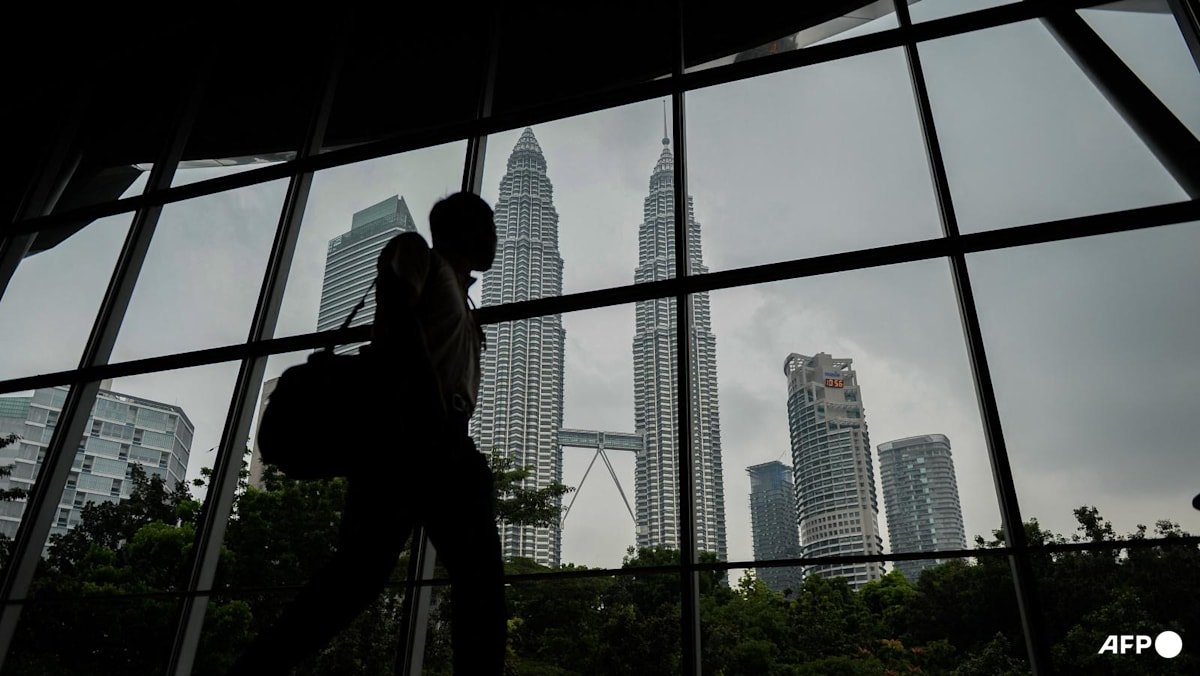
Malaysia’s wage growth lags behind GDP as ‘top firms are not scaling’ – what gives?
A World Bank report in May found that Malaysia’s wage growth since 2010 has lagged behind its gross domestic product (GDP) growth in part because top firms in the country are not scaling up.
A man walks past the Malaysia’s iconic Petronas Twin Towers from the Kuala Lumpur Convention Centre. (Photo: AFP/Mohd Rasfan)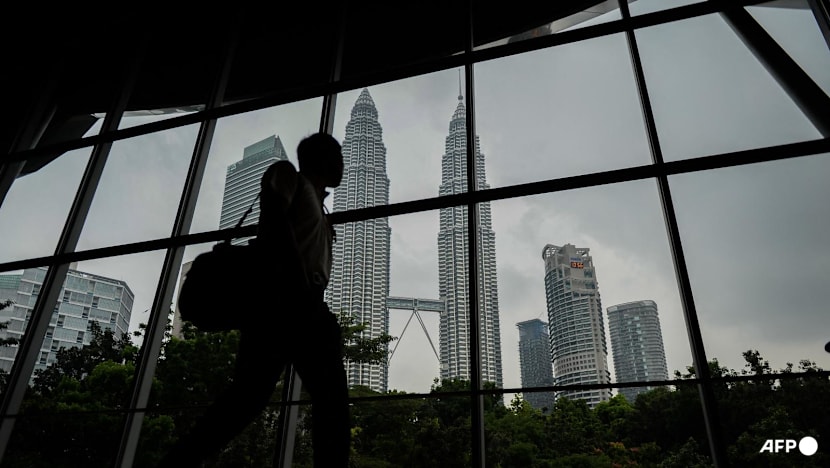
New: You can now listen to articles.

This audio is generated by an AI tool.

Read a summary of this article on FAST.
Get bite-sized news via a new
cards interface. Give it a try.
Click here to return to FAST
Tap here to return to FAST
FAST
KUALA LUMPUR: They form the top 10 per cent of businesses in Malaysia productivity-wise.
They are considered to be highly efficient and more importantly, pay their employees nearly three times the national median wage.
They span across industries and all types of formal businesses operating in the country, ranging from small enterprises to large corporations.
But a recent World Bank report revealed that Malaysia’s “frontier firms” are, however, failing to scale or absorb the broader workforce – a stagnation cited as one factor in the country’s sluggish wage growth.
This then raises the question as to why Malaysia’s most capable engines of growth are failing to actively scale up.
The core issue, economist Sedek Jantan of IPP Financial Advisers told CNA, is that the broader business ecosystem is not allocating capital, talent, and market opportunities to these firms efficiently enough.
“In more competitive and dynamic economies, productive firms naturally absorb larger market shares, attract stronger financing flows and scale more rapidly.
“In Malaysia, this process remains constrained by structural frictions such as regulatory complexity, uneven competition dynamics, financing limitations and slower business reallocation mechanisms,” he said.

Guess Word
Crack the word, one row at a time

Buzzword
Create words using the given letters

Mini Sudoku
Tiny puzzle, mighty brain teaser

Mini Crossword
Small grid, big challenge

Word Search
Spot as many words as you can


Sedek noted that competitive advantage today depends increasingly on “innovation intensity, technological ownership, research and development capabilities (as well as) intellectual property creation” – areas where many Malaysian firms continue to lag global leaders.
“The issue is not that Malaysia lacks productive firms. The larger issue is whether Malaysia can successfully transition from an efficiency-driven economy into a productivity and innovation-driven economy,” he said.
WHY IT MATTERS
The World Bank report titled “Raising the Ceiling, Raising the Floor” that was released in May said that although positive, wage growth in Malaysia since 2010 has lagged behind the growth of its gross domestic product (GDP).
This then has led to a failure to deliver on the country’s high-income aspirations.
The report said that in real terms, median monthly wage rose from RM1,300 (US$320) to RM1,864 between 2010 and 2024, while the average monthly wage grew from RM1,792 to RM2,570, representing a 43 percent rise for both.
This was, however, considerably lower than the 82 per cent increase in GDP over the same period.
According to the World Bank, Malaysia’s real GDP was RM821.43 billion in 2010 compared to RM1.49 trillion in 2024, when calculated using constant 2010 prices.
GDP at constant prices serves as an inflation-adjusted measure that uses a fixed base year to strip away price fluctuations, allowing economists to isolate and track the true growth of a nation’s actual output in goods and services.
“One reason for slow wage growth is that top firms – which pay higher wages and offer high productivity employment – are not scaling. The market share of these firms, as well as absorption of the labour force, has deteriorated over the last decade,” the report said, referring to these frontier firms.
The World Bank report also found that in contrast to what is occurring in advanced economies, the productivity of frontier firms in Malaysia has increased by less than the rest of the firms in the country over the last two decades.
Mariana Vijil, a senior economist from the World Bank Group, told CNA that its ranking is based on the level of productivity at a given point in time, and not to the rate at which productivity is growing over time.
She said that while Malaysia’s frontier firms remain at the top of their respective sectors, their productivity growth has been sluggish.
“These firms have grown their productivity more slowly than the rest of the firms in their sector, meaning the gap is narrowing through a catch-up process from below. In advanced economies, the opposite holds: Frontier firms’ productivity continues to grow faster than the rest, sustaining their competitive edge,” she said.


The World Bank also said that Malaysia’s central challenge is no longer job creation itself; with labour force participation at historic highs and unemployment low, and with the economy already demonstrating a robust capacity to generate employment.
“The more pressing challenge, rather, is the creation and scaling of high-quality, and well-matched roles which result in significant wage growth.
“This means jobs in higher value-added activities generated by productive firms that are able to pay higher wages, which allow workers to better utilise and upgrade their skills, and which support durable gains in purchasing power,” read the report.
It also found that the share of Malaysian firms that export their products is low and on a declining trend. Goods export growth in 2025 is largely electronics-led, the report found, with growth of other goods exports declining compared with recent years.
It said that only 15 per cent of firms export at least 10 per cent of its sales, and even firms exporting as little as one per cent of sales remain relatively rare.
“This is a missed opportunity given that exporting can expand demand and raise productivity through competition and learning-by-doing, supporting the creation of better-paying jobs,” read the report.
Elaborating on this stagnation, Vijil said that frontier firms in Malaysia have not been able to grow as strongly as intended, with both their domestic market shares and their absorption of the labour force deteriorating over the last decade.
She said that in the manufacturing sector for instance, frontier firms’ employment share fell from 36 per cent in 2010 to 33 per cent in 2023, with their market share dropping from 80 to 71 per cent in the same period.
“Barriers exist at every stage of the life cycle of a business. The result is that even Malaysia’s most capable firms find it difficult to expand as fast, and as far as their productivity would otherwise allow,” she said, adding that this resulted in weak innovation outcomes and limited export participation beyond flagship sectors like the electronics and electrical (E&E) sector.
The World Bank did not name any of these frontier firms explicitly, but economist Sedek said these firms are generally concentrated in higher value-added industries such as semiconductors, E&E, advanced manufacturing, information and communication technology and knowledge-intensive services.
Sedek said that for an upper-middle-income economy such as Malaysia, the scaling of frontier firms was critically important.
“Long-term economic upgrading increasingly depends on the creation of high-skilled, high-productivity and high-income employment opportunities,” he said.

WHAT ARE THE BARRIERS TO SCALING?
Economists and the World Bank note that allocative inefficiency, driven by interconnected structural constraints and frictions within the business environment, remains a central bottleneck to Malaysia’s growth.
Vijil of the World Bank said that any of Malaysia’s frontier small-and medium-sized enterprises (SMEs) which have plans of expanding will have to navigate restrictive, overlapping and cumbersome regulatory and a government-to-business (G2B) services efficiency environment.
For instance, she noted that building and operating a new production facility requires navigating a maze of construction permits and operating licences, a complex process that varies depending on the nature, location, and sector of the business.
“Inconsistent application of regulations and a lack of coordination across various public sector entities add delays, costs and uncertainty, resulting in approvals that can take 24 to 36 months.
“If your new production line depends on imported inputs, obtaining a single import licence takes two months on average, more than four times as long as in aspirational peers. Also, 20 per cent of Malaysian businesses reported that their prices are regulated, twice the rate of aspirational peers, distorting investment incentives,” she said.
Vijil added that capital misallocation remains a challenge, with frontier SMEs and young, highly productive startups continuing to face gaps in access to finance.
She also highlighted skills shortages, noting that firms often struggle to find workers with the capabilities they need most.
“Over one in five exporting firms (and similar patterns in innovating firms) identify an inadequately educated workforce as their biggest operational constraint,” said Vijil.
The World Bank report also said there were signs of brain drain of Malaysian inventors, with Malaysian inventive capacity increasingly being captured by foreign firms.
The report found that the number of Malaysian-invented patents owned by foreign applicants worldwide has increased sharply, while those owned by Malaysian applicants have remained largely stagnant and jointly-owned ones have declined.
It said that as a consequence, the share of Malaysian invented patents owned by Malaysian entities has decreased from around 62 to 63 per cent in the early 1990s to lower than 20 per cent by 2020.
“Overall, the limited performance of Malaysia in technology generation and commercialiation over the last decade suggests that the binding constraint is the business environment influencing firms’ dynamics, rather than limited inventors’ capabilities,” read the report.
Ultimately, these compounding local constraints do more than just stall internal growth, they actively drive firms out of the country.
Economist Geoffrey Williams, director of Williams Business Consultancy, cited the example of technology and ride-hailing firm Grab that left Malaysia for Singapore because of funding hurdles, regulatory capture, and freer overseas markets.
“It had funding issues in Malaysia and went overseas for finance but there was also a fear of expropriation or regulatory capture. Overseas markets are freer,” he told CNA.
Grab was initially established and launched in Malaysia in 2012, but moved its headquarters to Singapore two years later.
The firm has since morphed into one of Southeast Asia’s most valuable tech startups, operating in more than 200 cities across eight countries.
Williams also believed that some of Malaysia’s most productive frontier firms are failing to scale up because they are satisfied with their capture of the domestic market share.
“They have a clear competitive advantage domestically but not internationally and so they stick to local markets which may be protected for them,” he said.
But besides structural barriers such as cumbersome regulations, slow insolvency processes, or capital misallocation, Williams said that there are underlying behavioural factors such as protected status in local markets and the fear of expropriation.
“If companies are too successful they become targets for hostile takeovers. If they access funds from government linked investment companies, they become government controlled,” he said.

WHAT NEEDS TO BE DONE
Economists told CNA that Malaysia’s next economic chapter requires a fundamental shift in how its leading enterprises and SMEs approach growth.
They said that by moving up the value chain, these firms will finally be able to afford higher wages for Malaysian workers.
Sedek said that Malaysia’s frontier firms need to shift from a scale-and-efficiency mindset to a scale-and-innovation mindset.
“The next phase of growth is not about producing more of the same but about moving into higher-value activities through innovation, technology adoption and intellectual property creation,” he said.
This aligns closely with the government’s stated ambition to transition from a “Made in Malaysia” assembly model to an intellectual property-driven “Made by Malaysia” economy.
To achieve this, Sedek adds that firms must internationalie more aggressively – expanding beyond domestic borders, deepening their presence in global value chains, and capturing a larger share of value creation.
Williams echoed these views, pointing out that local limits necessitate cross-border growth. For larger firms, scaling up inevitably means expanding overseas because the Malaysian domestic market is simply too small, capped at just 27 million adult consumers, he said.
“Regional expansion makes sense within the Association of Southeast Asian Nations (ASEAN), but global offerings are now viable through online sharing economy platforms, which eliminate the need for heavy brick-and-mortar investments overseas,” said Williams.
He noted that the Malaysia Digital Economy Corporation (MDEC) for one has a specialised sharing economy team to facilitate this transition.
MDEC, a government agency under the purview of the Ministry of Digital, was established in 1996 to lead Malaysia’s digital economy.
He said that these digital platforms, often embedded in e-commerce apps, also offer unprecedented scaling opportunities for SMEs, allowing them to instantly bypass geographic constraints and capture international market share.
In its report, the World Bank said there was a need for a comprehensive productivity-focused reform agenda that simultaneously strengthened the business environment, supported innovation, improved workforce capabilities, and better aligned skills development with employer needs.
It also said that there was a need for Malaysia to strengthen good regulatory practices, competition policy, and public service delivery to improve the business environment.
Sedek said that the broader message from the World Bank is that Malaysia is approaching a critical stage in its economic transition.
He said that government policy will be a critical enabler for Malaysia to transition from an upper-middle-income economy towards a high-income economy.
“If Malaysia gets this right, the payoff could be substantial. More productive firms typically create more high-skilled jobs, pay higher wages and invest more in workforce development. Over time, that translates into stronger productivity growth, rising household incomes and a more resilient economy.
“Ultimately, the real prize is not larger companies. The real prize is higher-value jobs, stronger wage growth and a more innovation-driven economy. That is how countries successfully make the transition from upper-middle-income to high-income status,” said Sedek.


Source: CNA/rv(as)
Sign up for our newsletters

Get the CNA app
Stay updated with notifications for breaking news and our best stories
Get WhatsApp alerts
Join our channel for the top reads for the day on your preferred chat app

Get bite-sized news via a new
cards interface. Give it a try.
Click here to return to FAST
Tap here to return to FAST
FAST