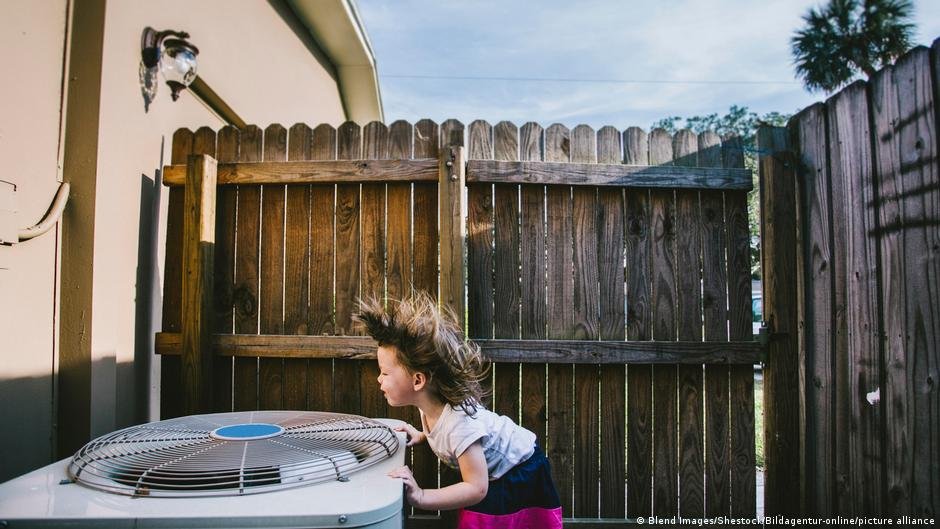
In countries like the United States, Australia and Japan, the hot, sticky summer months are made bearable by the blast of chilled air provided by a humming air conditioner.
But across large parts of Europe, the solution is often decidedly low-tech: shut the shades, fire up the fan and keep plenty of ice water within reach.
Around 90% of people living in the US have air conditioning at home, according to the US Department of Energy. In Europe, which has a similar climate, that figure is only about 20%, though it does vary across the continent. In a sunny southern country like Spain, around half of households have cooling, while in Germany it’s around just 6%.
There’s a good reason for that. Until recently, air conditioning wasn’t seen as a necessity in many European countries, especially in the north.
Summers have always been hot — what’s changed?
Hotter weather was always a part of summer in Europe, but now extreme heat waves — persistent high temperatures that endanger infrastructure, ecosystems and human health — are quickly becoming the norm.
The UN’s Intergovernmental Panel on Climate Change has shown that extreme heat events are rising faster than climate models predicted, especially in western Europe.
A recent analysis from ClimaMeter, a European research partnership analyzing extreme weather events, revealed temperatures in June 2026 were around 2 to 4 degrees Celsius (3.6 to 7.2 Fahrenheit) warmer than they would have been under similar conditions during the late 20th century.
These dangerous conditions are “driving surges in electricity demand for cooling,” said Tommaso Alberti, an Italian researcher affiliated with ClimaMeter, in a statement.
Demand for air conditioners and cooling units in Germany rose by 75% between 2019 and 2024 — the warmest year on record. Eurovent, the industry association for heating, ventilation, cooling and refrigeration, has also noticed a “steady” growth rate in recent years.
Despite this trend, resistance to air conditioning persists in Europe, said Stijn Renneboog, Eurovent’s deputy secretary general.
“In tips on how to stay cool circulating on social media, I still see advice to avoid the use of air conditioning,” he told DW in an email.
“Cooling is still too often written off as a luxury,” he said, adding that hot conditions pose a serious public health risk. “There are tens of thousands of heat-related deaths in Europe every year.”
European homes not built for heat, or AC
Most Europeans feel their homes do not help them stay them cool during the summer. Many houses and apartments in Germany and other parts of northern Europe were designed to keep heat in during colder months, but not for maximum cooling when it gets hot.
One recent study found that nearly half of respondents across the EU turned to improved shading and insulation to ward off heat. But many are also now considering air conditioners.
To view this video please enable JavaScript, and consider upgrading to a web browser that supports HTML5 video
“The days of low AC penetration in Europe are coming to an end,” said Helge Brinkmann, an associate director at the Boston Consulting Group specializing in green energy and the environment, in a September 2025 industry analysis.
Installing air conditioning in older European housing can be a challenge. “While cooling technology is easily built into new residential and commercial properties, it’s less straightforward to retrofit existing infrastructure,” said the analysis. Major renovations can allow for the installation of new systems, but historic cities across Europe often have “additional regulatory and aesthetic hurdles to overcome.”
In addition, many tenants are prevented from installing cooling units in their rental homes by restrictive rules, or are unwilling to make major investments in someone else’s property. That leaves people in countries where around half the population rents — like Germany, Denmark and Austria — settling for less efficient cooling options.
Cooling ‘a serious social and public health issue’
Cost is another factor holding many Europeans back from installing air conditioning. Rising energy prices are making it expensive to beat the heat, and 38% of people in an EU-wide survey said they could not afford to keep their home cool.
A 2020 study by researchers in Italy, looking at how global warming is fueling the rise in air conditioning in temperate countries like France, Spain, Sweden and the Netherlands, pointed out that lower income groups would be disproportionately affected as cooling becomes increasingly essential.
Renneboog said that while winter heating is considered a basic need, it’s a different story for cooling. “Maybe it would be appropriate to have similar recognition that the inability to keep buildings safely cool in summer is also becoming a serious social and public health issue,” he said.
Air conditioners can make global heating worse
Environmental concerns have also slowed the uptake of air conditioners in Europe.
The total amount of energy needed to cool homes and other spaces in the EU has crept steadily upward over the last decade, especially since 2020. The latest data from European statistics office Eurostat shows that while the energy used for heating buildings decreased slightly in 2024, cooling used 15.3% more energy compared with a year earlier.
Globally, cooling accounts for around 10% of annual electricity demand. But with much of that power still generated by polluting, planet-warming fossil fuels, it only makes the problem worse. And various studies have found that AC use can increase outside temperature by several degrees, creating a vicious circle.
Renneboog said Europe’s move to cleaner power sources is helping to curb the emissions problem, and added that energy demand patterns are changing.
“Europe is seeing a seasonal shift: cooling degree days are increasing, while heating degree days are decreasing. In other words, yes, we’ll spend more energy on cooling, but we’re likely to spend less on heating,” he said.
Are there alternatives to air conditioners?
Greener alternatives to standard air conditioners also exist.
“New buildings can be designed to limit their cooling needs, they can favor alternatives to air conditioning systems,” said Jean-Sebastien Broc of the Institute for European Energy and Climate Policy amid a heat wave in July 2025.
These alternatives include building designs that improve cross ventilation and use materials that minimize heat retention, and improved solar shading such as shutters, awnings and roof overhangs. Heat pumps, while generally more expensive, are an efficient way to both heat and cool a home and can help lower carbon emissions.
Greenery and water features also help cool cities and reduce the urban heat island effect, and many cities have focused on shared solutions, like misting systems and public cooling centers. In places like Paris, Stockholm and Copenhagen, district cooling centralizes air conditioning by using chilled water and underground pipes to cool multiple buildings instead of just one.
Smart technologies that include sensors and AI tech can even make new air conditioners up to 40% more efficient, lowering the temperature — and emissions.
Edited by: Tamsin Walker
About The Author