All eyes are on Saxony-Anhalt this week, ahead of a state election on Sunday that could trigger a political earthquake across Germany.
Though the state is small, with a population of just 2 million — and with economic strength and life expectancy the lowest of any of Germany’s 16 federal states — a victory for the Alternative for Germany (AfD) could usher in the first far-right government in the history of post-World-War-II Germany.
The AfD’s lead candidate is Ulrich Siegmund, and polls show him well in the lead. The only open question seems to be whether the AfD will be able to secure an absolute majority of the seats in Saxony-Anhalt’s parliament, which would allow it to govern alone. This would appear to be Siegmund’s only path to the state premiership, as the other parties have said they will not enter a coalition with the AfD.
To view this video please enable JavaScript, and consider upgrading to a web browser that supports HTML5 video
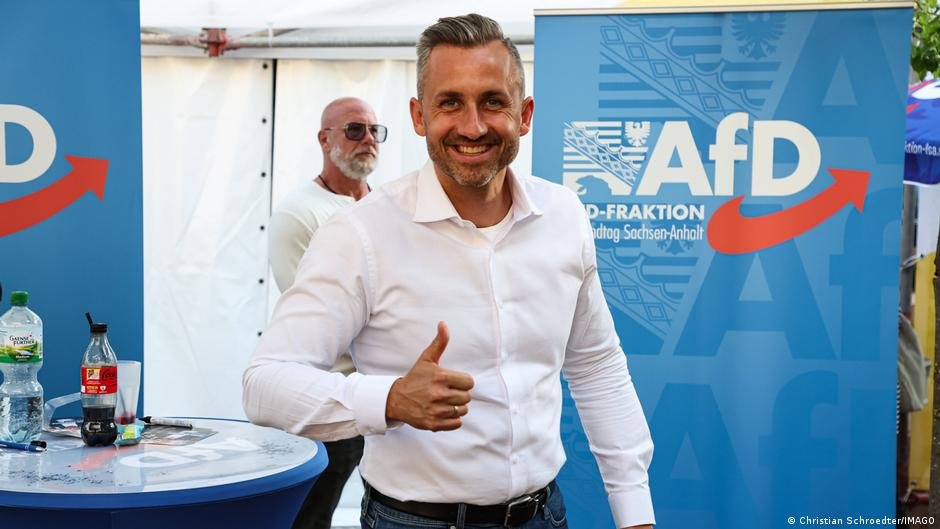
Things are going well for the 35-year-old Siegmund. As he tours his state on the campaign trail, he draws crowds — even in small towns. He’s often surrounded by a swarm of international journalists: from Canadian and Danish television, Swiss broadcasting, the BBC and the British magazine The Economist, alongside dozens of reporters from across Germany. Everyone wants to know: Who is Ulrich Siegmund?
The candidate was born in the small town of Havelberg, Saxony-Anhalt, in 1990. He joined the center-right Christian Democratic Union (CDU) at age 19, only to leave the party five years later and join the AfD. A former perfume salesman, he cuts a dynamic and athletic figure: slim, handsome and fresh-faced.
Above all, he is cheerful — playing the role of a charismatic charmer in his public appearances. When he steps into town squares to a cheering crowd, he beams back, shaking hands and cracking jokes. Nothing about him seems forced; he visibly enjoys the campaign grind.
“I don’t know when there was last such a high approval rating, even among young people,” Siegmund told DW. “It’s simply enormous.” He speaks quickly, articulately and with practiced ease.
To view this video please enable JavaScript, and consider upgrading to a web browser that supports HTML5 video
AfD campaign pushes policies with ‘high-gloss marketing’
Even critical observers in Saxony-Anhalt can’t help but admit that the AfD has all the momentum in this election.
“The AfD’s campaign events run like clockwork, both logistically and in terms of political strategy,” observed David Begrich of Miteinander, an organization based in the state capital of Magdeburg that fights right-wing extremism. “It is high-gloss marketing of their own policies.”
But what exactly do the AfD’s policies aim to achieve? To judge by Siegmund’s campaign speeches, the goal is a return to a bygone era — a time before Germany viewed itself as a country of immigration, when electricity came from nuclear power plants rather than wind turbines, and when LGBTQ+ rights were not yet recognized. Siegmund wants to pursue, as he says in his campaign speeches, politics “from the people, for the people!”
Apparently, that doesn’t include all the people living in the state. The AfD’s “100-day immediate action plan” contains some radical policies, including a key promise to “deport from minute one” foreign nationals who have no legal right to stay, but whose presence is tolerated for humanitarian reasons, many of whom have found work and established their lives in Germany.
To view this video please enable JavaScript, and consider upgrading to a web browser that supports HTML5 video
The action plan also calls for funding cuts to pro-democracy NGOs, forcing refugees to work and prioritizing a love for the German homeland over social diversity. There are significant legal doubts, however, about whether a state government actually has the authority to implement all these pledges.
Controversial figures behind the scenes
There are also doubts over the “clean” image that Siegmund has cultivated. He has not been able to escape the allegations of cronyism that have dogged the AfD, after it was reported that several of the party’s state and federal lawmakers secured well-paid jobs for their friends and relatives in the offices of other AfD officials.
Siegmund himself found a position for his own father. While not illegal, the move was poorly received, even within his own party.
Then there are the people behind Siegmund, those who support him as leader of the AfD’s parliamentary group in Saxony-Anhalt. According to the daily newspaper Die Welt, the group employs four former members of a now-banned neo-Nazi organization, the Heimattreue Deutsche Jugend (German Youth Loyal to the Homeland). Before it was outlawed, the group openly admired Adolf Hitler‘s Nazism and adhered to his racial ideology, one that led to the murder of 6 million Jews and hundreds of thousands of Sinti and Roma in the Holocaust.
To view this video please enable JavaScript, and consider upgrading to a web browser that supports HTML5 video
Siegmund himself appears to have no qualms about associating with supporters who have tattoos or clothes with neo-Nazi symbols. DW observed him appearing arm-in-arm with men wearing neo-Nazi attire and sporting tattoos such as the Black Sun, a recognized symbol among neo-Nazis.
AfD wants to ‘turn Saxony-Anhalt into a testing ground’
But what would all this mean if the AfD actually did take power after the September 6 election?
“There are clear indications that if the AfD were to enter government, it would turn Saxony-Anhalt into a testing ground for the whole country,” said Begrich. “Just how far can one go in overriding the written — and perhaps even more importantly, the unwritten — rules of democratic culture in a federal state?”
For that reason, many churches, trade unions, civil society organizations and political parties have warned against an AfD victory. Begrich shares their concerns.
“Naturally, things will become difficult, above all, for those in society who either belong to minorities or do not fit into the AfD’s ideological worldview,” he said. “The social climate would inevitably shift to an authoritarian regimentation — and that poses a problem for people who need liberal openness in society as they need air to breathe.”
Like many critics, Begrich believes that winning Saxony-Anhalt is only the first step for a party that wants to take over the entire country.
This article was originally published in German.
About The Author