analysis
Ahead of Malaysia’s next general election, BN reminds PN it won’t play second fiddle
Barisan Nasional is not committing to any electoral pact yet as it negotiates seat allocations with Perikatan Nasional, say analysts.
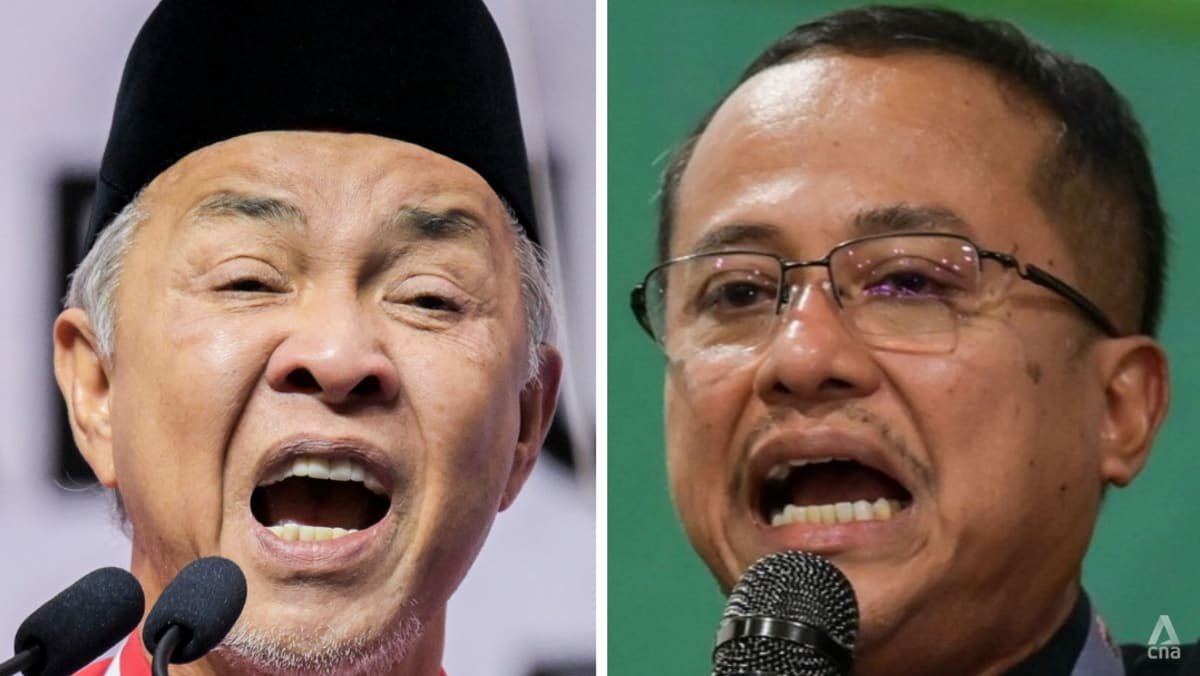
A composite image of Barisan Nasional chairman Ahmad Zahid Hamidi (left) and Perikatan Nasional chairman Ahmad Samsuri Mokhtar. (Photos: CNA/Fadza Ishak)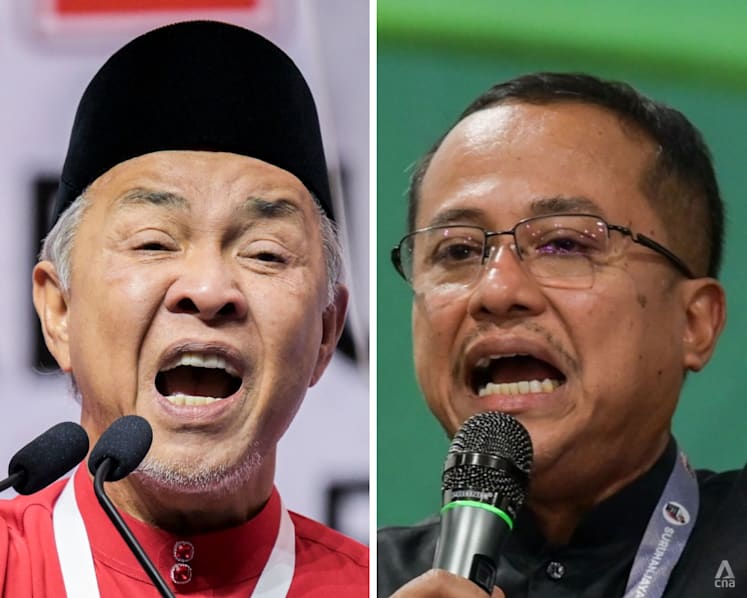
New: You can now listen to articles.

This audio is generated by an AI tool.

Read a summary of this article on FAST.
Get bite-sized news via a new
cards interface. Give it a try.
Click here to return to FAST
Tap here to return to FAST
FAST
KUALA LUMPUR: After convincing wins alongside the opposition Perikatan Nasional (PN) coalition in the Melaka and Negeri Sembilan state elections, Barisan Nasional (BN) chairman Ahmad Zahid Hamidi’s comments on the pact’s future heading into the next general election might have raised a few eyebrows.
While BN and PN avoided direct clashes in the two recent state polls under a “political understanding”, BN had “never planned to take this (cooperation) any further”, Zahid said on Sunday (Nov 15).
“However, if the time comes and circumstances require it, we will sit down together to discuss the matter,” he said as quoted by local media.
Zahid’s comments come at a critical juncture. He has appeared to arrest BN’s decline since its dismal performance at the previous general election in 2022, just as there will likely not be further opportunities to test electoral partnerships.

Guess Word
Crack the word, one row at a time

Buzzword
Create words using the given letters

Mini Sudoku
Tiny puzzle, mighty brain teaser

Mini Crossword
Small grid, big challenge

Word Search
Spot as many words as you can
After Sarawak heads to the polls on Dec 12, no other state must hold an election until the 16th general election (GE16), due by February 2028. The states of Perak, Pahang and Perlis could, however, choose to call early polls before GE16.
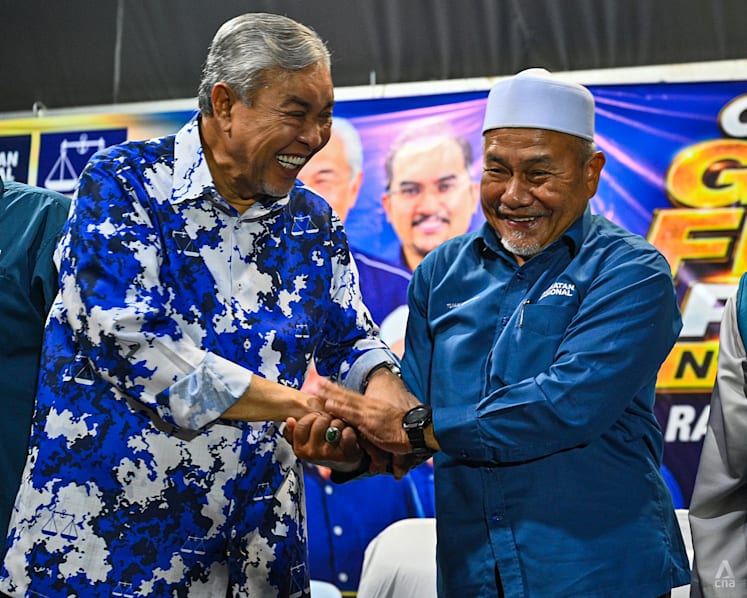
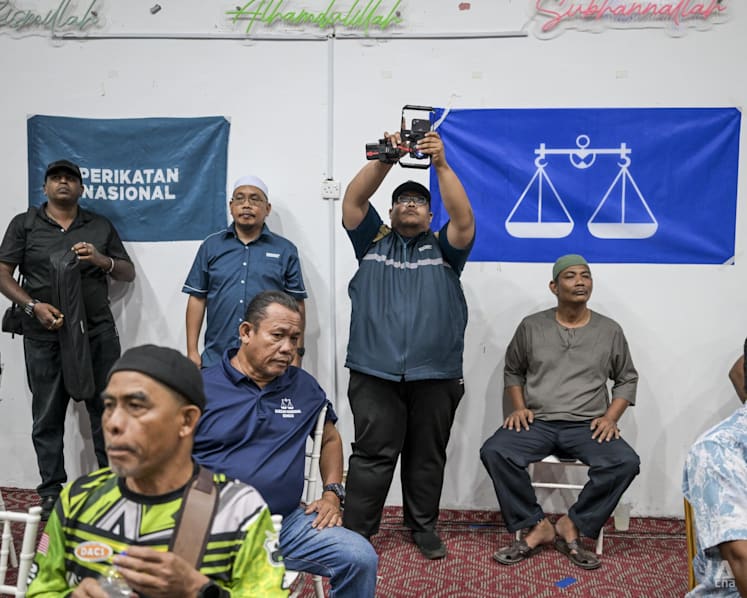
Analysts say BN is keeping all options on the table when it comes to partnerships for GE16, including sticking to its current arrangement within the unity government with Prime Minister Anwar Ibrahim’s weakened Pakatan Harapan (PH) coalition if the latter lets BN contest more seats.
PH ceded control of Negeri Sembilan and lost ground in Johor and Melaka to BN-PN at the respective state elections.
BN chief Zahid is deputy prime minister in Anwar’s Cabinet.
But the analysts believe BN is still likely to work with PN at GE16, with BN buying time to discuss seat allocations in traditionally conservative states like Perlis, Kedah, Terengganu and Kelantan where PN is more dominant.
Ahmad Fauzi Abdul Hamid, a political science professor at Universiti Sains Malaysia (USM), said Zahid is “doing what he can to secure the most powerful position” for BN in whichever alliance it goes with for GE16.
“Zahid won’t be content playing second fiddle to PN or PH; he has clearly used the results of the Johor, Negeri Sembilan and Melaka elections to make his position clear,” he told CNA.
“Whoever is fated to collaborate with BN in GE16 will have to accept a BN prime minister – this will be the condition.”
Shifting tides of Malaysian politics
At Malaysia’s last general election in 2022, the once-dominant Barisan Nasional (BN) coalition emerged looking like a truly spent force.
Led by the United Malays National Organisation (UMNO), BN won only 30 of the 179 seats it contested, faring even worse than its performance in the 2018 general election, when the long-ruling coalition was defeated for the first time on the back of a national corruption scandal.
But royal intervention after the hung parliament in 2022 meant BN somehow clung onto power, as it joined forces with Prime Minister Anwar Ibrahim’s Pakatan Harapan (PH) coalition and Borneo-based parties to form a federal unity government.
Still, PH-BN lost further ground in subsequent state elections in 2023 as Malay voters – BN’s traditional vote bank – flocked to the opposition PN, and observers questioned if BN had lost its political relevance.
Even at the Sabah state election in December 2025, where racial politics are less pronounced, PH components Parti Keadilan Rakyat (PKR) – led by Anwar – and the Chinese-majority Democratic Action Party (DAP) performed poorly. The latter failed to win a single seat of the eight it contested there, despite being the incumbent in six of them.
The results showed that DAP could be losing support among its traditional minority base, as these voters expressed frustration with Anwar’s perceived slow pace of promised reforms, analysts said then.
Fast forward to 2026, and the tide has turned. While PH’s fortunes have continued on a downward trend, BN has appeared to reverse its decline.
Zahid has orchestrated a seemingly dual track where BN maintains support for PH at the federal government level, but teams up with PN to immense success at a trio of state elections in 2026.
In an unofficial pact, the BN-PN partnership swept to victory at the Johor state election in July, and followed up by contesting the Negeri Sembilan and Melaka polls in a more official alliance, achieving equally convincing wins.
The partners achieved a two-third supermajority in all three state legislative assemblies – a feat that allows them to amend the state constitution.
Sentiments from leaders in both camps have indicated that they will continue this partnership at the next general election due by February 2028, in a bid to wrest control of Putrajaya.
Collapse
Expand
ALL NOT LOST FOR UNITY GOVERNMENT PACT?
Zahid’s comments show that BN could still be willing to work with PH for GE16, something that might be used as a bargaining chip during seat negotiations with PN, said Nusantara Academy for Strategic Research senior fellow Azmi Hassan.
Going by the results of the previous general election in 2022, PN has more members of parliament than BN not only in Perlis, Kedah, Terengganu and Kelantan, but also in states with a significant PH presence like Penang, Perak and Selangor.
“If the incumbency formula is used, as in the Melaka state election, BN will be on the losing end,” Azmi told CNA, referring to a criteria parties use when dividing which seats to contest.
“It is also a message to Datuk Seri Anwar: All is not lost, because the cooperation between BN and PH still can materialise … If BN is on the losing side, BN will choose a partner that allows it to get the best outcome.”
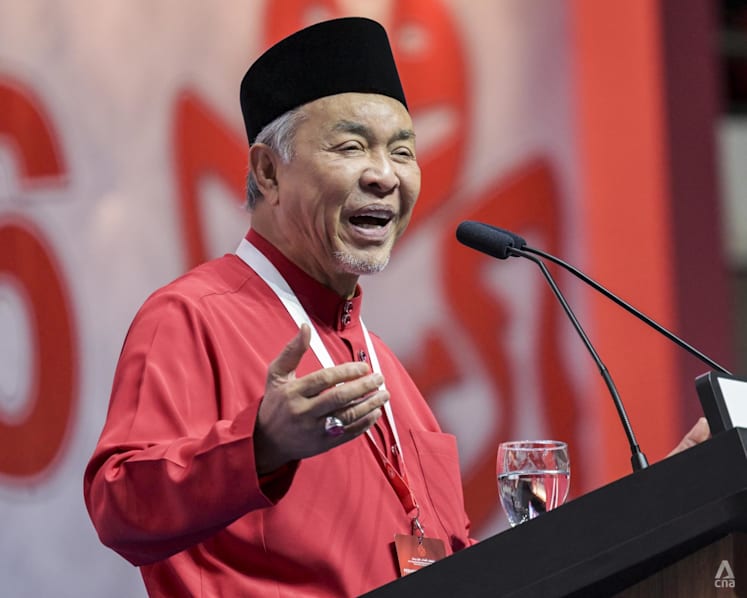
Zahid might also stop short of finalising a deal with PN as a “better offer might come from Anwar and PH in an attempt to salvage his beleaguered government”, USM’s Fauzi said.
If this is the case, Zahid and BN would probably be content to work with PH and forgo seats in Kedah, Kelantan and Terengganu as “collateral damage”, as long as BN can secure the “most advantageous” position in any upcoming alliance, he said.
“In politics, sometimes there’s utility in being vague. By not committing himself and BN-UMNO to any future alliances, he’s keeping options open,” Fauzi added, referring to the BN lynchpin party United Malays National Organisation.
BN LIKELY TO CONTINUE WITH PN
While another political analyst agreed that Zahid was keeping options open, she feels it would be “folly” for BN not to work with PN, as this would again split the crucial Malay vote at the expense of BN.
“BN wants to contest more seats especially in Kedah and Terengganu. They’re hoping to have some leverage in negotiating with PAS,” International Islamic University Malaysia’s (IIUM) Syaza Shukri told CNA, referring to the Parti Islam Se-Malaysia component that leads PN.
“But BN knows they can’t go alone in the other states. I think it is more to buy time as they really settle seat negotiations and more importantly craft the narrative to sell to the people.”
At the 2022 general election, BN, PN and PH contested separately. By the end of campaigning, “it was evident” that PN led BN in the contest for Malay votes, an ISEAS-Yusof Ishak Institute study published in 2023 said.
Because the Malay votes were split, the post-election manoeuvrings “led to a somewhat paradoxical situation” where PH gained the right to lead the government, the study noted.
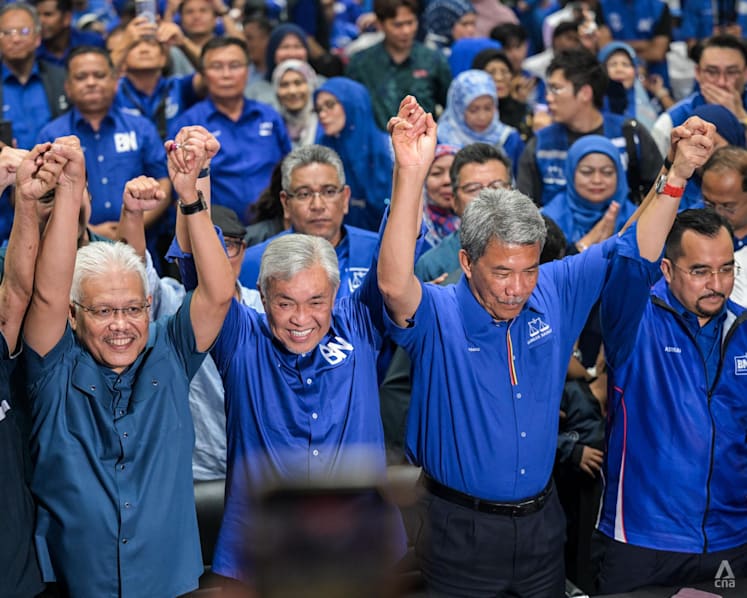
Adib Zalkapli of strategic consultancy Viewfinder Global Affairs said Zahid’s statement does not rule out future cooperation with PN.
“There are steps to be taken before firming up the cooperation, and one of the important parts of the process is seat allocation negotiations especially in the east coast states (of Terengganu and Kelantan) where PAS dominates the political landscape,” he told CNA.
Another factor that could complicate seat negotiations, he said, is the presence of PN component Parti Wawasan Negara (Wawasan), a splinter party of former PN component Parti Pribumi Bersatu Malaysia (Bersatu) largely made up of former UMNO members.
While PAS and UMNO have carved out their own areas of influence, Adib feels Wawasan is “directly competing” with UMNO.
“PAS is a pragmatic party so they have to strike a balance in the cooperation with UMNO and Wawasan,” he said.
“Despite these issues, their objective is clear – winning Putrajaya – so I believe they will set aside their differences in time before the next general election.”
Ultimately, Adib believes PAS “on paper” is content to play second fiddle to UMNO in the broader alliance.
“They know they don’t have an acceptable prime minister candidate, so the next best thing is to have a PM they can control,” he added.
WILL PAS NEGOTIATE?
Despite that, there are already signs that PAS could stand its ground with UMNO.
PN chairman Ahmad Samsuri Mokhtar, himself touted as a future prime minister candidate, said on Monday that his party PAS is open to discussing seat allocations with BN if Terengganu holds a state election.
But this only applies to the five seats in the Terengganu state legislative assembly held by PAS’ erstwhile partner Bersatu, he said according to local media. The remaining 27 seats all belong to PAS.
“Everyone knows the Terengganu assembly has 32 seats and only five seats are not from PAS. I don’t think there’s any other space,” the Terengganu chief minister reportedly said.
”So, it will be up to discussions between PN and BN how to allocate these five seats.”
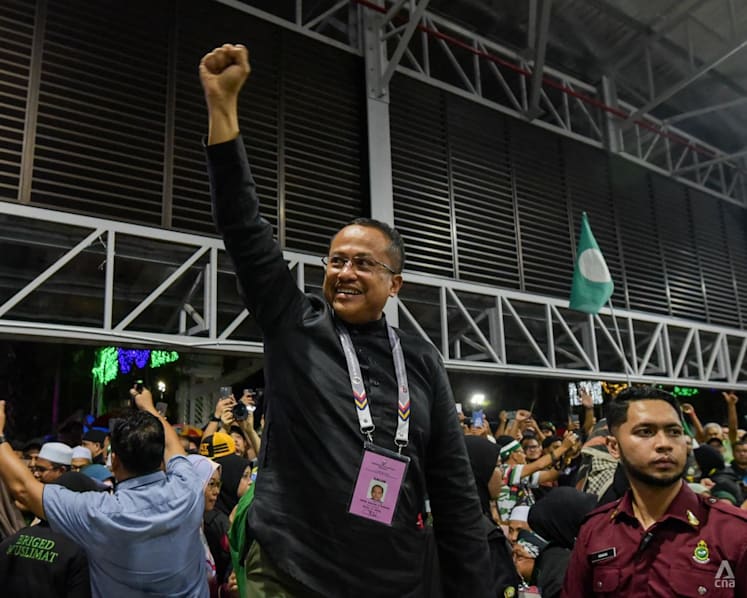
When asked to comment on Zahid’s statement about cooperation with PN, PN information chief Annuar Musa, who is from PAS, told CNA: “No need to respond. Not through media.”
IIUM’s Syaza said PAS is well aware that it does not need to depend on BN in states like Perak and Selangor.
“Maybe we might see some protests (to UMNO’s demands), especially by PAS youth as well, but overall I think PAS understands what is going on,” she said.
“And with Wawasan mediating, I think PAS is prepared to negotiate as well.”
Fauzi from USM suggested that UMNO and PAS need each other equally, highlighting that BN controls the southern states of Johor, Melaka and Negeri Sembilan, while PN dominates the northern states of Kedah, Terengganu and Kelantan.
Fauzi expects BN and PN to cooperate at GE16, and are only delaying announcing an official pact as BN would face “unbearable” pressure to leave Anwar’s government otherwise.
“BN and PN know that if both forces collaborate for GE16, they’ll probably be unbeatable in these states,” he added.
“So, their need for each other is now mutual. Contesting separately will benefit PH rather than either of them by splitting the Malay and anti-PH votes.”
Source: CNA/hz(as)
Sign up for our newsletters

Get the CNA app
Stay updated with notifications for breaking news and our best stories
Get WhatsApp alerts
Join our channel for the top reads for the day on your preferred chat app

Get bite-sized news via a new
cards interface. Give it a try.
Click here to return to FAST
Tap here to return to FAST
FAST