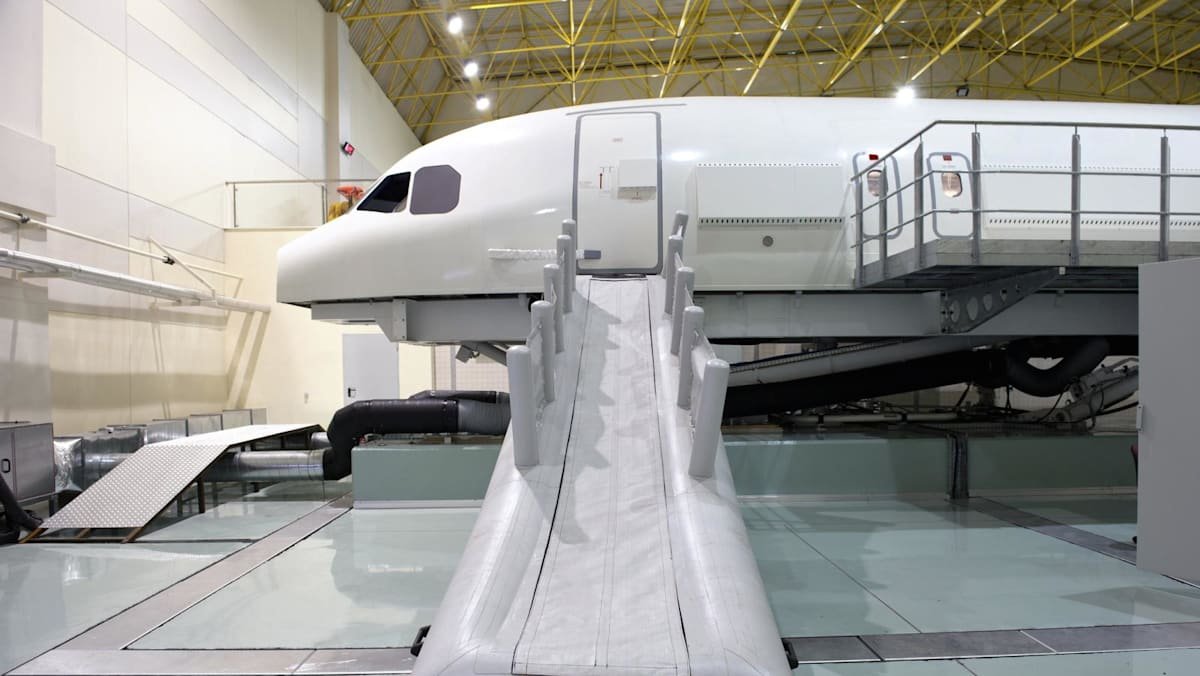
Air passengers urged to leave bags behind during evacuations in new IATA campaign
A survey commissioned by IATA of recent air travellers in Singapore, the United States, the United Kingdom and the United Arab Emirates found “critical gaps” in safety knowledge.
An aircraft emergency slide. (Photo: iStock)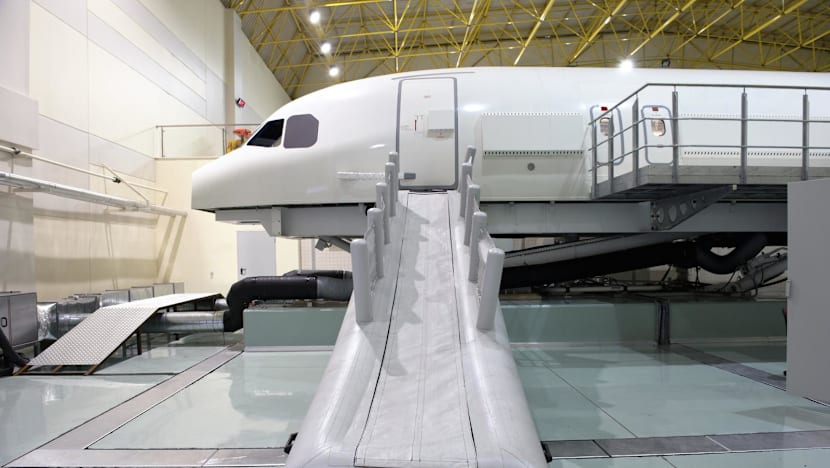
New: You can now listen to articles.

This audio is generated by an AI tool.

Read a summary of this article on FAST.
Get bite-sized news via a new
cards interface. Give it a try.
Click here to return to FAST
Tap here to return to FAST
FAST
SINGAPORE: The International Air Transport Association (IATA) on Monday (Jun 8) launched a global passenger safety campaign urging travellers to leave cabin baggage behind during aircraft evacuations.
Called Save a Life, Not a Bag, the campaign is being supported by aviation safety regulators, including the European Union Aviation Safety Agency (EASA) and the Federal Aviation Administration.
IATA said the campaign addresses the growing number of cases where travellers have stopped to collect their baggage or take photos during evacuations despite cabin crew instructions.
The evidence of such behaviour can be seen in numerous videos shared online, the organisation added in a media statement.

Guess Word
Crack the word, one row at a time

Buzzword
Create words using the given letters

Mini Sudoku
Tiny puzzle, mighty brain teaser

Mini Crossword
Small grid, big challenge

Word Search
Spot as many words as you can
IATA director general Willie Walsh said that taking bags during an evacuation is not “a minor issue”.
“Every second matters. Even taking one bag can affect the safe evacuation of everyone onboard,” Mr Walsh said.
“Save a Life, Not a Bag is a message that passengers need to understand and act upon,” he added.
To support the campaign, IATA commissioned a survey of recent air travellers in Singapore, the United States, the United Kingdom and the United Arab Emirates.
The survey found that while 80 per cent of respondents believed they knew what to do during an emergency evacuation, only 61 per cent correctly identified that they should leave all personal belongings behind.
One third of those surveyed said they had seen reports of passengers taking baggage with them during evacuations. Among this group, 22 per cent said they would be likely to do the same.
The findings also showed that many passengers overestimate how long an evacuation should take. Only 18 per cent were aware that aircraft evacuation procedures are designed around a 90-second safety benchmark, while 38 per cent believed an evacuation could take three minutes or longer.
Despite being instructed not to, one in 10 respondents admitted they might still take baggage with them during an evacuation, or follow other passengers who do so, even when instructed not to.
The survey also found that 60 per cent of respondents said they would be less likely to take baggage during an evacuation if essential items were already secured on their person.


WHAT PASSENGERS SHOULD DO
IATA recommends passengers pay attention to crew instructions and leave all baggage behind, as stopping to retrieve personal belongings can delay the evacuation and put others at risk.
The association also advises passengers not to film or photograph emergencies, as doing so can create congestion and distract people from evacuating the aircraft quickly.
Passengers are encouraged to keep aisles and emergency exits clear and to avoid taking any bags onto evacuation slides, which can damage the equipment and injure others.
IATA recommends passengers keep essential items such as medication, passports and keys with them whenever possible.
EASA executive director Florian Guillermet said: “Rapid evacuation in an emergency situation saves lives. Aircraft are certified to stringent evacuation standards and crews are trained extensively for emergency situations, to make sure every single passenger has the best possible chance of survival in an acute situation.
“For this to work in a real emergency, all passengers must play their part too. And it is very simple: follow crew instructions, leave all baggage behind and move quickly to the nearest usable exit,” he said.
Source: CNA/dc
Sign up for our newsletters

Get the CNA app
Stay updated with notifications for breaking news and our best stories
Get WhatsApp alerts
Join our channel for the top reads for the day on your preferred chat app

Get bite-sized news via a new
cards interface. Give it a try.
Click here to return to FAST
Tap here to return to FAST
FAST