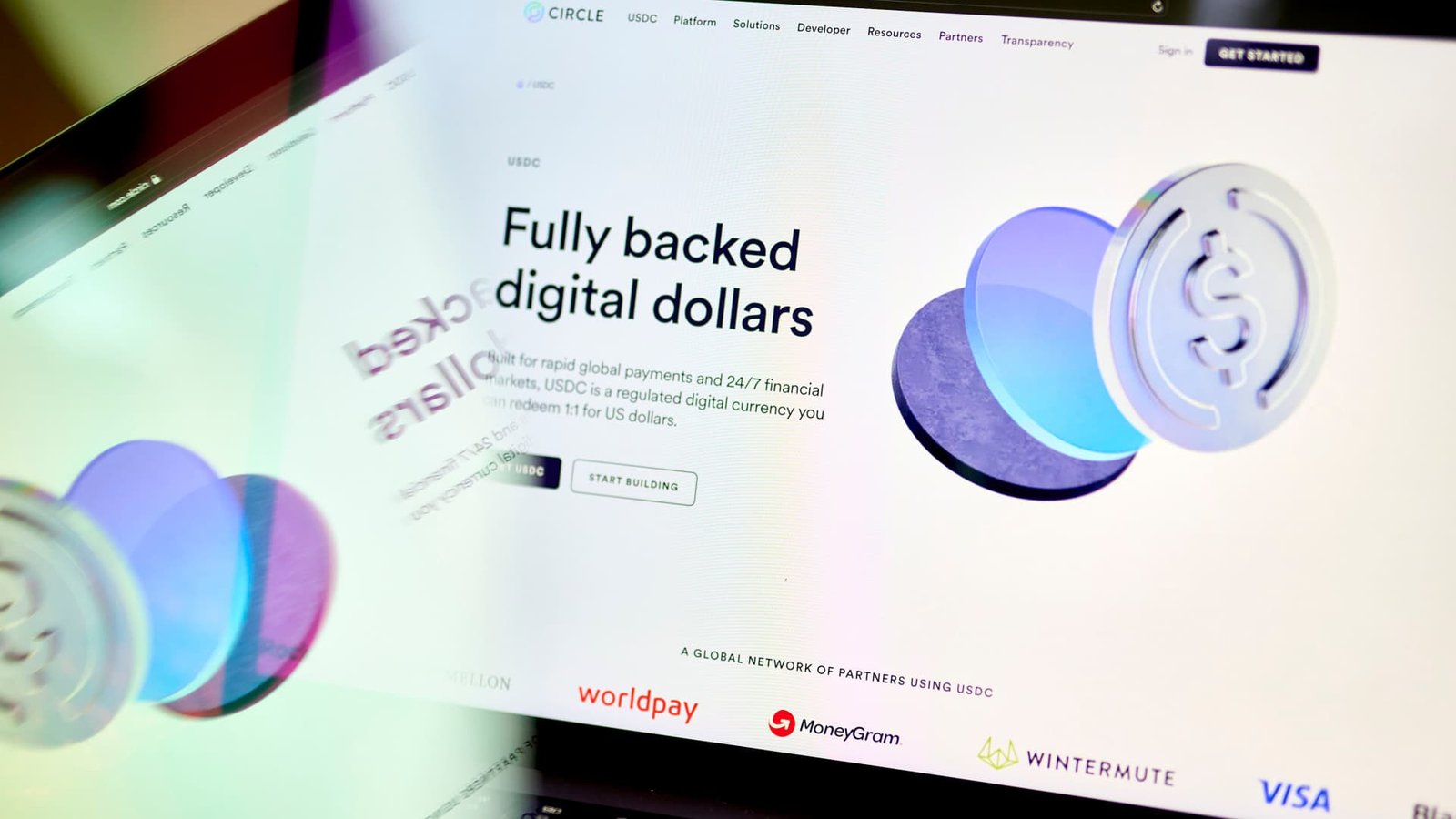
If you’ve never traded cryptocurrency, you may not be familiar with stablecoins. But experts say it might not be long before they hit the mainstream.
Stablecoins are a type of cryptocurrency pegged to another asset, typically the U.S. dollar, which means their value tends to fluctuate less than other digital tokens. For now, the stablecoins in circulation — valued at roughly $300 billion, according to Morningstar — are mostly in the hands of traders who need a stable place to park their cash when they buy and sell crypto. But the market is expected to grow to $1.45 trillion by 2035, as financial institutions warm to use of stablecoins for payments or as a means to move money between the likes of banks and credit card companies.
Exhibit A: In June, Visa, Mastercard and BlackRock were among a consortium of more than 140 firms backing a new dollar-pegged stablecoin called Open USD. Crypto industry experts say that the move amounts to the old guard embracing blockchain technology, a decentralized, digital ledger that could become a major vehicle for transferring money — from person to person, between consumers and merchants and even among financial institutions.
“Blockchain technology has the potential to fundamentally change transactions and the way money moves,” says Brian Kaas, president of stablecoin firm TruStage Digital Assets. “Your stablecoins and blockchain technology really are built for the digital world that we now live in.”
How stablecoins act like ‘chips in the crypto casino’
If you know one thing about cryptocurrencies, it’s likely that their prices tend to fluctuate — wildly. In January of this year, the price of bitcoin topped $96,000 only to drop by about 33% by early August. Such volatility can make crypto difficult to use as currency.
Stablecoins, rather, are designed to overcome one of the “fundamental weaknesses of cryptocurrency, which is that it’s far too volatile to be used as a medium of exchange,” says Lee Reiners, a lecturing fellow at the Duke Financial Economics Center.
Issuers of stablecoins hold a basket of high-quality assets, such as Treasury bonds, in reserve, which helps keep the price of the coins pegged to the U.S. dollar. For every $100 in stablecoins a firm issues, there’s $100 worth of low-risk assets sitting in reserve.
This allows a stablecoin to act like virtual cash, which comes in handy when trading or transacting in crypto assets. If you sell $100 worth of bitcoin, you can instantly receive $100 worth of stablecoins without, for instance, waiting for a wire to clear to receive real U.S. dollars.
“Essentially stablecoins are like the casino chips at the crypto casino,” Reiners says.
Stablecoins are issued by private companies which retain much of the interest they earn on their reserves. Issuers are prohibited from paying any of that interest directly to coin holders, but some have commercial agreements with third parties, such as online brokers, which pay investors “rewards” for holding stablecoins on their platforms.
Those rewards can look a lot like the interest you might earn on a deposit account, but you should beware of the risks before parking a significant amount of cash in stablecoins, says Amanda Fischer, COO and policy director at Better Markets, a financial consumer advocacy nonprofit.
For one thing, the protections are different. While the Federal Deposit Insurance Corporation is helping set up the rules around stablecoin issuance, stablecoins themselves don’t come with the same FDIC insurance you would see on, for instance, a savings account.
“You think that when you give a dollar to a financial services firm and they hold that dollar on your behalf, that that money ought to be insured by the government up to $250,000 per account,” Fischer says. “That is not the case with stablecoins.”
Plus, if you want to redeem your stablecoin for a dollar, you’ll likely have to go through a brokerage rather than exchanging directly with the issuer she says. That means the value of your dollar is only as stable as the private firm holding it: “Your ability to redeem your money is contingent on these third-party service providers being reliable.”
For now, savers on the hunt for yield on their idle cash would be safer to park it in the likes of high-yield savings accounts, certificates of deposit or money market accounts, Fischer says — even if a stablecoin holding purportedly comes with a higher yield.
“I would offer that the premium that they can pay on other investment products is due to the lack of insurance and the less rigorous regulatory environment,” she says. Even so, stablecoin’s benefits are starting to emerge, as usage widens.
The future of stablecoins: ‘faster, cheaper, 24/7’
The turning point for stablecoins came last year, when Congress passed the GENIUS Act, which created a regulatory framework for the digital assets, including which companies can issue them and what assets can be held in reserve.
The legislation cleared the way for financial institutions to get on board, and it won’t take long for them to realize that stablecoins can bring some important upgrades to the way money moves, says Stephane Ouellette, founder and CEO of digital asset firm FRNT Financial. “The whole thesis and concept behind this is that blockchain-based payment rails are faster, cheaper and work 24/7,” he says — no waiting on wires to clear or for banks to open on Monday to get your money.
Just how we get there is an open question. Some have suggested U.S. consumers could use stablecoins to pay for everyday items as well as big ticket purchases. If you wanted to sell a car, for instance, using stablecoin could allow for an instant transaction, says Kaas.
“Effectively in real time, you could transact that payment. There would be certainty that the funds are there, that they’re good for that,” he says. “And that’s a transaction, again, that could occur at 7 p.m. on a Sunday.”
Kaas can also see a world where major retailers offer stablecoins of their own and pitch them as a win-win: the retailer issues its own stablecoin and gets to save on the transaction fees of dealing in cash, and consumers get a discount for using the coins, paid out of the interest the retail earns on their reserve assets.
But don’t expect consumers to start managing their own digital stablecoin wallets overnight, says Reiners. For now, credit cards offer ease, rewards and consumer protections that stablecoins can’t match, he says.
“By and large, consumer payment behavior in the US is very sticky. People just don’t change,” Reiners says. “We’re kind of addicted to our credit cards. We want the miles. We want the rewards.”
More likely, experts say, is that consumers will continue to use traditional banks and credit cards, but that back-end transactions will happen via stablecoins on the blockchain.
“The payment rails that we use today predate the internet. So these, some of these rails are 30, 40 years old,” says Kaas. That makes them poorly equipped to handle accelerating transactions in an economy becoming increasingly influenced by AI, he says.
Indeed, Jeremy Allaire, CEO of stablecoin issuer Circle, recently published some 18,500 words on the subject, arguing that a future economy run by AI agents will have to move money at “machine speed” on the blockchain using digital money.
The winners and losers of that sort of shift remain to be seen. But for regular folks, the change may not even raise an eyebrow, at least at first, says Kaas.
“For your average consumer, they probably will be introduced to stablecoin without necessarily knowing anything about cryptocurrency or understanding it.”
Want to get ahead at work? Then you need to learn how to make effective small talk. In CNBC’s new online course, How To Talk To People At Work, expert instructors share practical strategies to help you use everyday conversations to gain visibility, build meaningful relationships and accelerate your career growth. Sign up today!
 VIDEO09:36I quit my $250K/year tech job–now I make $33K/year selling matchaMillennial Money
About The Author