


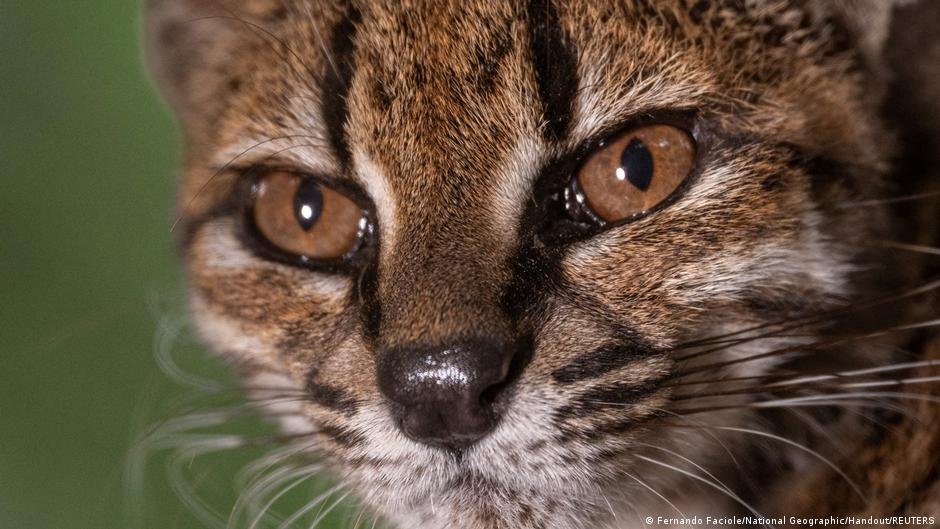
Scientists in Bolivia have identified a small wild cat with a leopard-like coat as a previously unknown species.
Local communities call the feline “tilcayo,” a nickname that inspired the cat’s new scientific designation: Leopardus tilcayo.
Biologist and National Geographic explorer Paola Nogales-Ascarrunz described the discovery as a “remarkable event, because a new wild cat species hasn’t been described in 100 years.”
The last feline species to be discovered was the Uruguayan pampas cat in 1923.
What do we know about Leopardus tilcayo?
The cat was found in Bolivia’s Yungas forest, a remote region on the eastern slope of the Andes mountains.
The animal measures around 18 inches (46 centimeters) long and weighs around 3 pounds (1.4 kilograms), making it smaller than the average domestic cat.
“Its fur is light brown … with irregularly shaped rosettes across its body,” Nogales-Ascarrunz said.
According to National Geographic, Nogales-Ascarrunz first came upon the animal in 2016 after receiving a call from a local wildlife sanctuary.
The organization said at the time that it had been handed “a weird cat.”
“I took a hundred pictures of it,” Nogales-Ascarrunz told National Geographic. “I was so fascinated.”
It was a few years later that she realized the cat she had photographed was unlike any previously seen.
Species finds its place in cat family tree
Research on the new species was published this week in the journal Current Biology.
Using genetic analysis in collaboration with geneticist Eduardo Eizirik, co-lead authors Nogales-Ascarrunz and the University of Antwerp’s Jonas Lescroart were able to place the feline in its specific category in the cat family tree.
Nogales-Ascarrunz said that a pair of tilcayos have undergone whole-genome sequencing and are the only such creatures found so far.
“So far, it’s only been detected in Bolivia” and not “anywhere else on the planet,” Nogales-Ascarrunz said.
“Showing the general public that even in a flagship group such as cats … there are still new species to be discovered may transmit an important message,” said Eizirik, who is an evolutionary biologist at the Pontifical Catholic University of Rio Grande do Sul in Brazil.
“There are many undiscovered species out there in the world, and they are at risk of disappearing before we even discover them.”
Edited by: Natalie Muller
Don’t let the algorithm hide the news. If you rely on our team for trusted reporting, please take a moment to select us as your Preferred Source on Google by clicking here and hitting the “star” or “preferred” button, so you’ll always see our verified news first.







