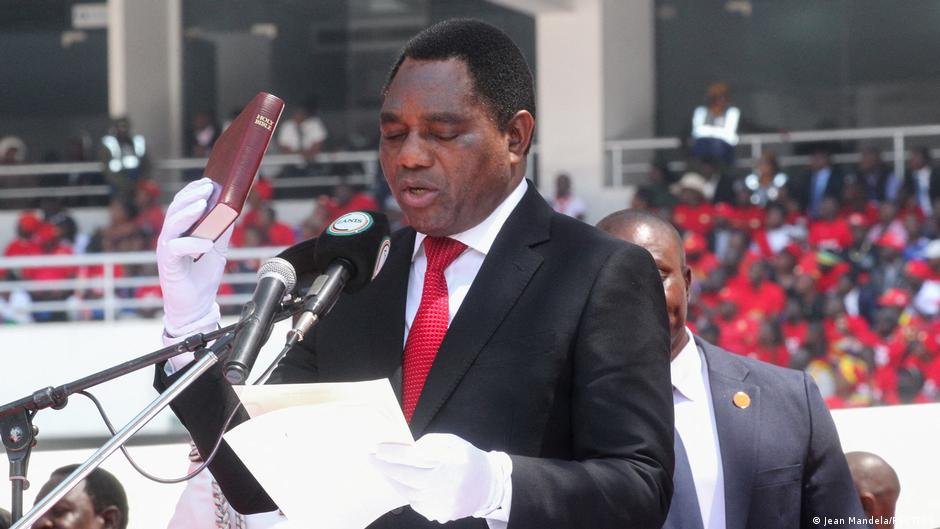
Zambian President Hakainde Hichilema was sworn in for a second five-year term on Tuesday.
For decades, Zambia has worn its peaceful transfers of power almost like a badge of honor in a region where elections have too often ended in disputed results, violence or leaders refusing to leave. Hichilema’s own victory in 2021 appeared to strengthen that reputation.
Five years later, the picture is more complicated.
Hichilema begins his second term after a disputed election, with his main challenger facing treason charges, opposition supporters questioning the credibility of the vote and controversy surrounding the closure of courts during the crucial window for election petitions.
Hichilema has promised reconciliation. But for a president who once sat on the other side of power as an opposition leader and treason suspect himself, the test now is whether those words will be matched by the political space he gives his opponents.
Ngobola Cengelo Muyembe, a political, business and social analyst, told DW that reconciliation must begin by recognizing that a significant part of the electorate backed someone else.
“You have to remember that in every 10 people that voted, four people voted for the other side,” Muyembe said, noting that during the president’s inaugural address, he spoke about reconciliation and uniting people. “But that message can only resonate if what is on the ground reflects what is being spoken about.”
Can Hichilema reunite a divided country?
Raymond, a self-employed Zambian who asked that his full name not be used, told DW that Hichilema should look beyond who supported him at the ballot box and govern across Zambia’s political and ethnic divisions.
“The president, congratulations! Don’t think about people who voted for you, didn’t vote for you. One Zambia, one nation, one city,” Raymond said. “Real change in mines and agriculture. The mines want us Zambians to be benefiting. Even your Tonga, your Bemba, you are all Zambians.”
Artist Mazuba Nzabuka told DW he also wants Hichilema to govern those who supported him and those who did not, while giving young people a greater voice.
“Going forward, he is going to do the promises left behind. He is a president for all people,” said Nzabuka. “Those who did not vote for him, those who voted for him. We are the same people. The five years going forward, our voices can be heard. Look after the youths.”
But reconciliation will have to contend with the political fallout from the election.
Zambia returned to multiparty democracy in 1991 and has since witnessed several changes of governing parties through elections. Hichilema himself benefited from that tradition when he defeated incumbent President Edgar Lungu in 2021.
The latest election prompted debate about whether that image remains intact.
Democracy faces a new test
The independence of Zambia’s institutions may feature prominently during Hichilema’s second term.
Critics said their concerns intensified after courts were closed on the final day available for presidential election petitions. Interruptions during the announcement of election results prompted some opposition supporters to question the process.
To view this video please enable JavaScript, and consider upgrading to a web browser that supports HTML5 video
Analyst Muyembe said that protecting political speech and allowing opponents to openly challenge the government will be crucial to rebuilding confidence.
“If you really respect the people that voted against you, allow them to speak, engage them in a debate, not where you just have to bring in only the people that agree with you and the ones that are talking to themselves on TV, and encourage this national dialogue,” Muyembe said.
“Allow the opposition who lost to complain about it the way they want, and then from there you can chart a way forward. But to stifle debate and fudge facts, this is not really helping our democracy.”
The arrest of Hichilema’s main challenger, Brian Mundubile, and his running mate on treason charges linked to allegations of plotting an armed uprising has become another point of political controversy.
Authorities maintain that the case concerns national security, while opposition supporters have questioned the timing of the arrests.
The situation has drawn attention because Hichilema himself once faced a treason charge while in opposition.
The question of whether the institutions that once wielded enormous power over him can operate independently when dealing with his own political opponents is likely to remain part of the debate surrounding his second term.
From economic stability to household relief
Political freedoms are not the only test. Hichilema enters his second term pointing to progress in stabilizing Zambia’s economy, including lower inflation and the restructuring of the country’s external debt.
But many Zambians are waiting for those gains to reach their homes.
Mutinta Mushabati, who attended Hichilema’s inauguration at Heroes Stadium in the capital Lusaka, told DW that she was encouraged by what she heard from the president.
“That he is going to increase everything, new allowances for school-going children, social cash transfer, CDF,” she said, refering to Zambia’s expanded Constituency Development Fund, which allocates public money directly to each of the country’s constituencies to finance community-driven local development projects and infrastructure.
“I’m very excited right now. I don’t even know what I can say. I’m very happy.”
Muyembe told DW that the gap between positive national economic indicators and the experience of ordinary households represents a key challenge for Hichilema’s second term.
He compared the economy to a reservoir that may be full while the pipes carrying water to individual homes remain blocked.
“Imagine that you got a giant command reservoir that distributes water to houses in the village,” the analyst said.
“When the reservoir is full, you have stabilized your macroeconomic arrangement. But if the pipes that take water to the small little villages, the small little houses in these villages, are clogged and blocked, then you haven’t really solved the issue because the people need to have the water in their individual houses.”
Making Zambia’s minerals work for Zambians
Copper and mining remain central to Zambia’s economy and could provide one route for translating economic growth into household gains.
Muyembe told DW that Hichilema’s government should focus not simply on attracting billions of dollars in investment, but also on ensuring Zambian businesses participate in the supply chains created by that investment.
“If a mine is going to spend $2 billion or $3 billion [€1.7 billion to €2.6 billion] to expand that mine, that $3 billion has to go to the people, the people that are small businesses.”
Greater local participation, Muyembe argues, could help create businesses and employment while allowing Zambia to retain more of the wealth generated from its natural resources.
The challenge is particularly important for young Zambians, whose expectations extend beyond political stability to jobs and opportunities.
Five years to shape a legacy
Despite his criticism of the political environment surrounding the election, Muyembe told DW that Hichilema still has an opportunity to determine how his second presidency will ultimately be remembered.
He pointed to former Zambian President Levy Mwanawasa, whose disputed 2001 election was followed by a presidency that later gained broader respect.
“I think he has a chance, basically, to redeem himself from the dent of these elections because it also happened with Mwanawasa. I think Mwanawasa’s elections were also looked at funny, but he redeemed himself in the way he governed the following year.”
That leaves Hichilema with two closely connected tests over the next five years.
One is economic: whether improving headline indicators can translate into jobs, stronger local businesses and better living standards.
The other is democratic: whether opposition voices can operate freely, institutions can command public trust and political competition can take place without eroding Zambia’s long-standing tradition of peaceful transfers of power.
The crowds celebrating at Heroes Stadium showed the hope that still surrounds Hichilema among his supporters. The disputed election and its aftermath revealed the mistrust that exists among many other Zambians.
How he governs both groups may ultimately determine not only Hichilema’s legacy, but the kind of democracy Zambia carries into its next political chapter.
This article has been adapted from an episode of DW’s AfricaLink podcast.